Water Molecule: The Bent Shape Behind Floating Ice

Slide the ladder sideways to read its labels, or open it full size.
Water molecule: 1.5–2.8 Å across [10−10 m], from one molecule's H-to-H span to the spacing between molecules in ice.
Log scale from 10 cm to 0.1 nm; each rung is ten times smaller than the one to its left. Dashed lines: naked eye about 0.1 mm and light microscope about 0.2 µm, explained on the page on how to read the Zoom ladder. Data: water-geometry.csv (sources, version and license, JSON) and ice-lattice.csv (sources, version and license, JSON).
"Zoom ladder: water molecule" by Ants, Cells & Atoms, https://antscellsandatoms.com/molecules/water/ — CC BY 4.0 (https://creativecommons.org/licenses/by/4.0/)
Data sources for this figure
Data: Equilibrium geometry of water (O–H 0.958 Å, H–O–H 104.4776°) from Hoy & Bunker 1979, J. Mol. Spectrosc. 74:1, as listed by NIST CCCBDB Release 22 (SRD 101), retrieved 2026-10-24; IAPWS R10-06(2009), Revised Release on the Equation of State 2006 for H2O Ice Ih, equations computed for this page 2026-10-24 (ice density input to the molecular spacing); PubChem PUG-View, CID 962 (water) and CID 280 (carbon dioxide), identity and molecular weight, NCBI data, retrieved 2026-10-24; CODATA 2022 recommended values, NIST SRD 121 (physics.nist.gov/constants), Avogadro constant, retrieved 2026-10-24
Data: Equilibrium geometry of water (O–H 0.958 Å, H–O–H 104.4776°) from Hoy & Bunker 1979, J. Mol. Spectrosc. 74:1, as listed by NIST CCCBDB Release 22 (SRD 101), retrieved 2026-10-24; Geometry of carbon dioxide (C=O 1.162 Å, 180°) from Herzberg 1966 as listed by NIST CCCBDB Release 22 (SRD 101), retrieved 2026-10-24
Data sources for this figure
Data: IAPWS R10-06(2009), Revised Release on the Equation of State 2006 for H2O Ice Ih, equations computed for this page 2026-10-24; PubChem PUG-View, CID 962 (water) and CID 280 (carbon dioxide), identity and molecular weight, NCBI data, retrieved 2026-10-24; CODATA 2022 recommended values, NIST SRD 121 (physics.nist.gov/constants), Avogadro constant, retrieved 2026-10-24; Four hydrogen bonds per molecule, and lattice constants a = 0.452 nm and c = 0.736 nm measured near 0 °C (used only to check the four molecules per cell, computed for this page): Libbrecht KG 2019, Snow Crystals, monograph, arXiv 1910.06389 v2 (2021), https://arxiv.org/abs/1910.06389, section 2.2, retrieved 2026-10-24
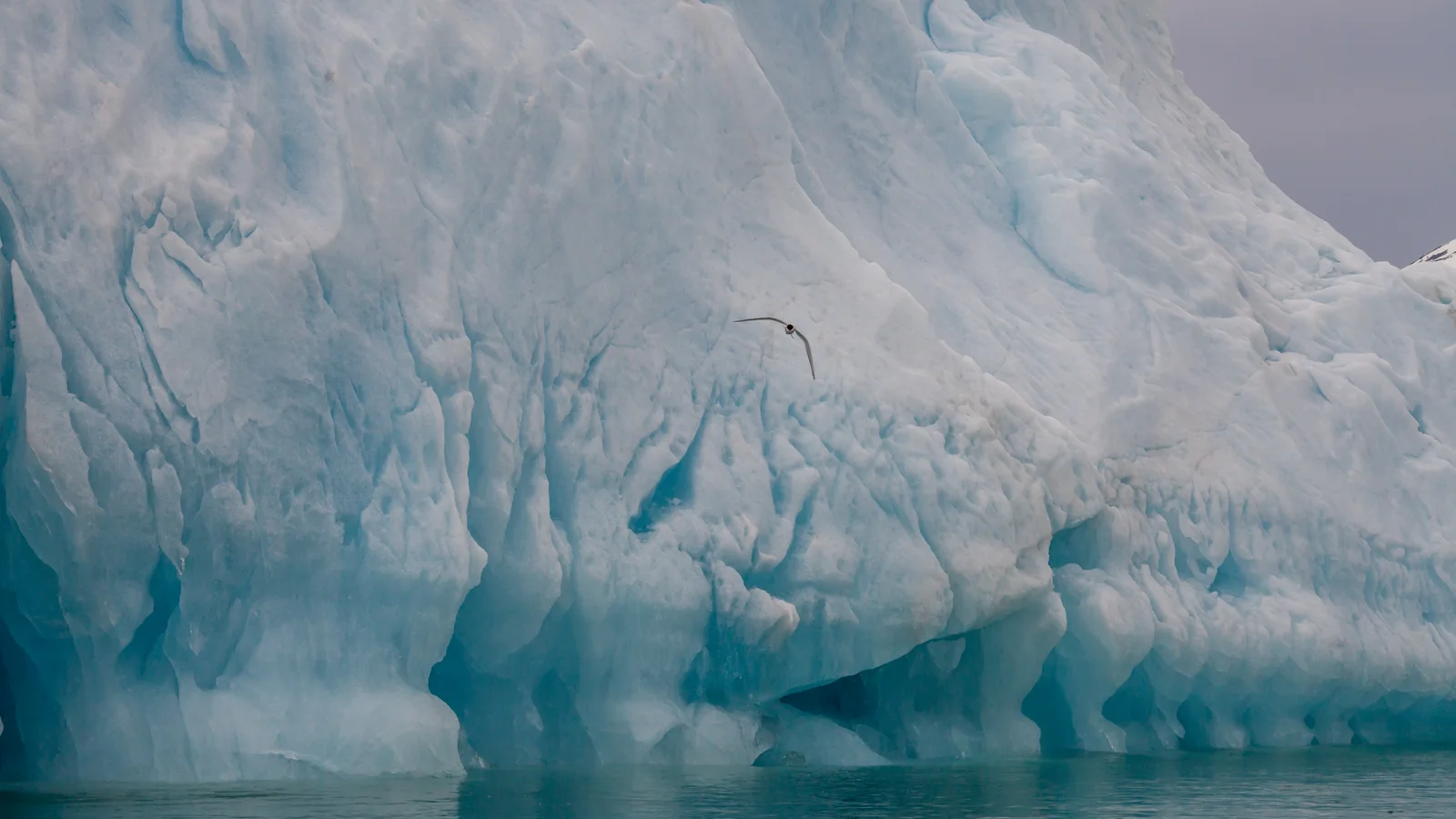
Iceberg, Liefdefjord, Svalbard: the sloping line across its face is its former waterline, and the ice beneath it is a lattice of molecules 1.5–2.8 Å across [10−10 m].
Color: native
"An iceberg slightly tilted, Liefdefjord, Svalbard" by Andreas Weith — https://commons.wikimedia.org/wiki/File:An_iceberg_slightly_tilted,_Liefdefjord,_Svalbard.jpg — CC BY-SA 4.0 (https://creativecommons.org/licenses/by-sa/4.0/)

Every molecular number on this page is marked measured or computed. Water is PubChem CID 962 and Wikidata item Q283; carbon dioxide, the straight molecule it is compared with below, is CID 280 and Q1997. The geometry comes from spectroscopy of isolated molecules in the gas phase, and the densities, viscosity and surface tension are computed for this page from the equations published by the International Association for the Properties of Water and Steam (IAPWS). The familiar one-line reason for the bend, that the lone pairs push the hydrogens together, is a model, and it gets its own section below.
How bent is a water molecule?
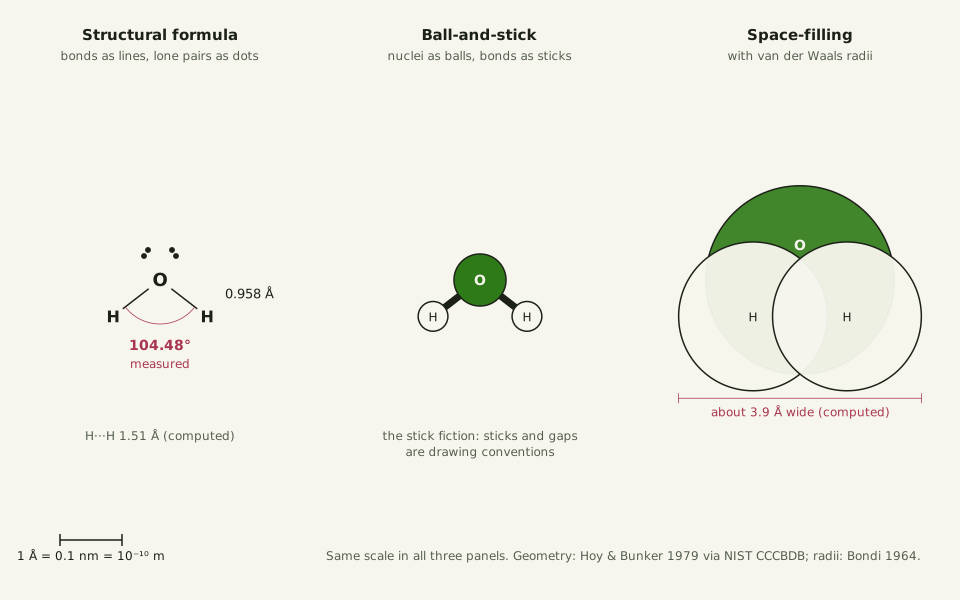
Hold the oxygen nucleus still. The two hydrogen nuclei sit 0.958 Å from it, with 104.4776° between the two bonds. Those are the equilibrium values that NIST's Computational Chemistry Comparison and Benchmark Database (CCCBDB) lists from Hoy and Bunker 1979 (measured; this site read the CCCBDB page, not the paper). The textbook figure of 104.5° is that value rounded.
From the two measured numbers, the hydrogen nuclei end up 1.51 Å apart (computed). These are gas-phase values for a molecule on its own; locked into ice, by Wikipedia's account of the structure, each hydrogen sits about 1.0 Å from its oxygen, a little farther than in the free molecule.
That 1.51 Å is a nucleus-to-nucleus distance. Nuclei are not edges. In Bondi's 1964 compilation (by Wikipedia's account of it), the radius an atom keeps from its neighbours in crystals is 1.20 Å for hydrogen and 1.52 Å for oxygen. Give each atom that radius and the molecule becomes a kinked blob about 3.9 Å wide and 3.3 Å tall (computed); where an atom's edge should be drawn is its own question, taken up in How Small Is an Atom?.
Slide the diagram sideways to read its labels, or open it full size.
One water molecule three ways, O–H 0.958 Å and 104.48° measured; the space-filling outline is about 3.9 Å wide [10−10 m] (computed). Data: water-geometry.csv (sources, version and license, JSON).
"One water molecule, three drawings" by Ants, Cells & Atoms, https://antscellsandatoms.com/molecules/water/ — CC BY 4.0 (https://creativecommons.org/licenses/by/4.0/)
Data sources for this figure
Data: Equilibrium geometry of water (O–H 0.958 Å, H–O–H 104.4776°) from Hoy & Bunker 1979, J. Mol. Spectrosc. 74:1, as listed by NIST CCCBDB Release 22 (SRD 101), retrieved 2026-10-24; Van der Waals radii H 1.20 Å, C 1.70 Å, O 1.52 Å from Bondi 1964, J. Phys. Chem. 68:441, as listed in Wikipedia, Van der Waals radius (CC BY-SA 4.0, paraphrased values), retrieved 2026-10-24
Data: Equilibrium geometry of water (O–H 0.958 Å, H–O–H 104.4776°) from Hoy & Bunker 1979, J. Mol. Spectrosc. 74:1, as listed by NIST CCCBDB Release 22 (SRD 101), retrieved 2026-10-24; Geometry of carbon dioxide (C=O 1.162 Å, 180°) from Herzberg 1966 as listed by NIST CCCBDB Release 22 (SRD 101), retrieved 2026-10-24
Of the three, the middle drawing is the most familiar and the most misleading. Its sticks and the gaps between the balls are drawing conventions, the habit this site calls the stick fiction; nothing in the molecule is stick-shaped, and the electron cloud fills the gaps. The space-filling drawing on the right is the one closer to the electron cloud, so every molecule on this site is shown both ways.
Why isn't water straight like carbon dioxide?
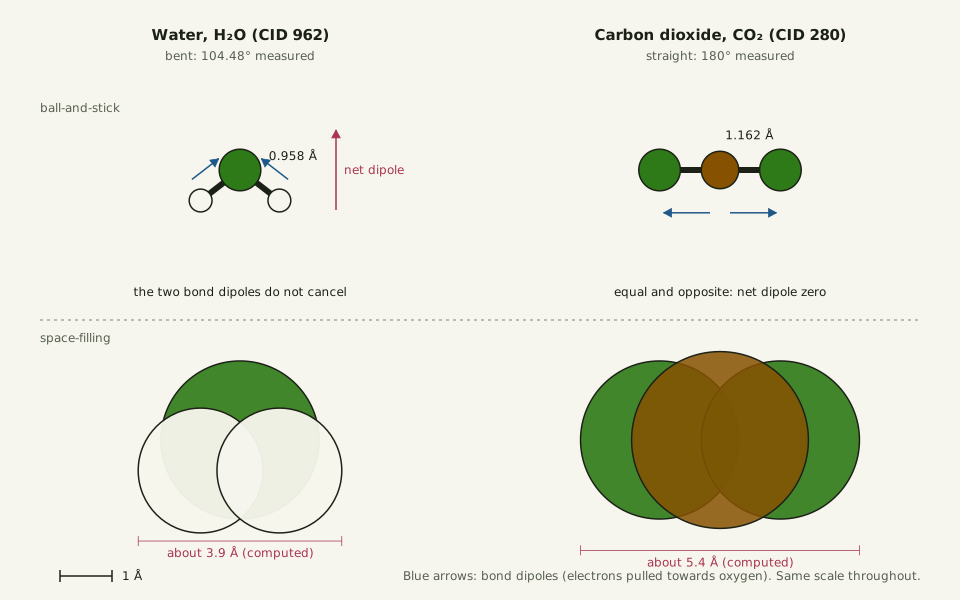
Count what surrounds the oxygen atom: two bonding pairs of electrons and two non-bonding pairs, four pairs in all. In the valence-shell electron-pair repulsion model (VSEPR, by Wikipedia's account of Gillespie and Nyholm's 1957 version), four pairs point toward the corners of a tetrahedron, and lone pairs, held closer to the nucleus, push harder than bonding pairs, so the two O–H bonds are squeezed together. A perfect tetrahedron puts 109.47° between any two corners (computed, arccos of −1/3). The measured angle, 104.48°, is 5.0° smaller: the model predicts the direction of the bend, not its size.
Carbon dioxide makes the contrast. Its carbon has two double bonds and no lone pairs, so the two oxygens sit on opposite sides at 180°, each 1.162 Å from the carbon (measured, Herzberg 1966 as listed by CCCBDB), 2.32 Å apart (computed). With Bondi radii the whole molecule is a rod about 5.4 Å long (computed), against water's 3.9 Å.
Slide the diagram sideways to read its labels, or open it full size.
Bent H2O (about 3.9 Å) against straight CO2 (about 5.4 Å) [10−10 m], ball-and-stick above and space-filling below; the blue arrows are bond dipoles. Data: water-geometry.csv (sources, version and license, JSON), molecule-identity.csv (sources, version and license, JSON).
"Bent water against straight carbon dioxide" by Ants, Cells & Atoms, https://antscellsandatoms.com/molecules/water/ — CC BY 4.0 (https://creativecommons.org/licenses/by/4.0/)
Data sources for this figure
Data: Equilibrium geometry of water (O–H 0.958 Å, H–O–H 104.4776°) from Hoy & Bunker 1979, J. Mol. Spectrosc. 74:1, as listed by NIST CCCBDB Release 22 (SRD 101), retrieved 2026-10-24; Geometry of carbon dioxide (C=O 1.162 Å, 180°) from Herzberg 1966 as listed by NIST CCCBDB Release 22 (SRD 101), retrieved 2026-10-24; Van der Waals radii H 1.20 Å, C 1.70 Å, O 1.52 Å from Bondi 1964, J. Phys. Chem. 68:441, as listed in Wikipedia, Van der Waals radius (CC BY-SA 4.0, paraphrased values), retrieved 2026-10-24; PubChem PUG-View, CID 962 (water) and CID 280 (carbon dioxide), identity and molecular weight, NCBI data, retrieved 2026-10-24
Data: Equilibrium geometry of water (O–H 0.958 Å, H–O–H 104.4776°) from Hoy & Bunker 1979, J. Mol. Spectrosc. 74:1, as listed by NIST CCCBDB Release 22 (SRD 101), retrieved 2026-10-24; Geometry of carbon dioxide (C=O 1.162 Å, 180°) from Herzberg 1966 as listed by NIST CCCBDB Release 22 (SRD 101), retrieved 2026-10-24
Data sources for this figure
Data: PubChem PUG-View, CID 962 (water) and CID 280 (carbon dioxide), identity and molecular weight, NCBI data, retrieved 2026-10-24; Wikidata items Q283 and Q1997, canonical SMILES (P233) and PubChem CID (P662), CC0, retrieved 2026-10-24; Equilibrium geometry of water (O–H 0.958 Å, H–O–H 104.4776°) from Hoy & Bunker 1979, J. Mol. Spectrosc. 74:1, as listed by NIST CCCBDB Release 22 (SRD 101), retrieved 2026-10-24; Geometry of carbon dioxide (C=O 1.162 Å, 180°) from Herzberg 1966 as listed by NIST CCCBDB Release 22 (SRD 101), retrieved 2026-10-24; NaCl: PubChem PUG-View, CID 5234 (sodium chloride), identity and Crystal Structures (COD 2108652, 4300180, 4320809, Fm-3m, Z = 4), NCBI data, retrieved 2026-10-24; Wikidata item Q2314, canonical SMILES (P233) and PubChem CID (P662), CC0, retrieved 2026-10-24; Aspirin: PubChem PUG-View, CID 2244 (aspirin), identity, NCBI data, retrieved 2026-10-24; Wikidata item Q18216, canonical SMILES (P233) and PubChem CID (P662), CC0, retrieved 2026-10-24; geometry computed for this site from bond lengths and angles measured in benzene (Herzberg 1966), phenol, acetic acid and methyl formate (Hellwege & Hellwege 1976) as listed by NIST CCCBDB Release 22 (SRD 101), retrieved 2026-10-24; DNA dodecamer d(CGCGAATTCGCG)2: RCSB PDB 1BNA, CC0, X-ray 1.9 Å, https://doi.org/10.2210/pdb1bna/pdb, coordinates from Drew HR, Wing RM, Takano T, Broka C, Tanaka S, Itakura K, Dickerson RE 1981, Proceedings of the National Academy of Sciences 78(4):2179-2183 (abstract); Wikidata item Q7430 (deoxyribonucleic acid, the class, not this fragment), CC0, revision 2557663824 (modified 2026-10-16)
The shape sets the electrical character. In each O–H bond the electrons sit nearer the oxygen, so each bond is a small arrow of charge pointing at the oxygen. In carbon dioxide the two arrows are equal and opposite and cancel; in water they lean toward each other and add, leaving one end of the molecule slightly negative and the hydrogen end slightly positive. That net dipole has been measured by watching the molecule's spectrum shift in an electric field (Clough and colleagues 1973, bibliographic record).
Without the bend there would be no dipole. Without the dipole, most of what follows would not happen. Carbon dioxide, with no net dipole, is a gas at ordinary temperature and pressure, as PubChem's record notes. The ionic grid of sodium chloride, by comparison, has no molecules in it.
From one bent molecule to a network
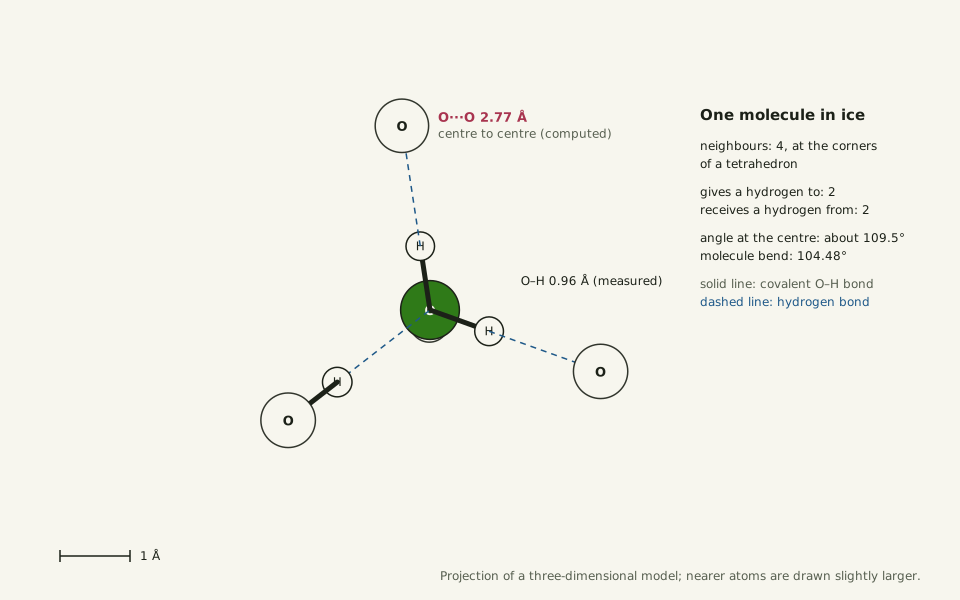
Bring two water molecules together and the positive hydrogen of one is drawn to the negative oxygen of the other. That attraction, a hydrogen bond, is weaker than the O–H bond inside a molecule but strong enough to organise the liquid, and in ice it organises everything. By Wikipedia's account of the ice Ih structure, each oxygen has four neighbours at the corners of a tetrahedron: a molecule gives one hydrogen to each of two neighbours and receives one from each of the other two. Its hydrogens stay close to it, about 1.0 Å along a 2.75 Å oxygen-to-oxygen link in that account; on this page the spacing comes out at 2.77 Å (computed, see below).
Slide the diagram sideways to read its labels, or open it full size.
One molecule in ice: four neighbours 2.77 Å away [10−10 m] (computed), two hydrogens given and two received; solid O–H 0.96 Å measured, hydrogen bonds dashed. Data: ice-lattice.csv (sources, version and license, JSON).
"Four hydrogen bonds around one water molecule" by Ants, Cells & Atoms, https://antscellsandatoms.com/molecules/water/ — CC BY 4.0 (https://creativecommons.org/licenses/by/4.0/)
Data sources for this figure
Data: Equilibrium geometry of water (O–H 0.958 Å, H–O–H 104.4776°) from Hoy & Bunker 1979, J. Mol. Spectrosc. 74:1, as listed by NIST CCCBDB Release 22 (SRD 101), retrieved 2026-10-24; IAPWS R10-06(2009), Revised Release on the Equation of State 2006 for H2O Ice Ih, equations computed for this page 2026-10-24 (ice density input to the oxygen spacing); Structure type of ice Ih (hexagonal, four-coordinated oxygens on the wurtzite arrangement) as summarized in Wikipedia, Ice Ih (CC BY-SA 4.0, paraphrased), citing Pauling 1935, retrieved 2026-10-24; four molecules per cell follows from that arrangement (computed for this page); primary crystallography Peterson & Levy 1957 and Röttger et al. 1994, bibliographic records only
Data sources for this figure
Data: IAPWS R10-06(2009), Revised Release on the Equation of State 2006 for H2O Ice Ih, equations computed for this page 2026-10-24; PubChem PUG-View, CID 962 (water) and CID 280 (carbon dioxide), identity and molecular weight, NCBI data, retrieved 2026-10-24; CODATA 2022 recommended values, NIST SRD 121 (physics.nist.gov/constants), Avogadro constant, retrieved 2026-10-24; Four hydrogen bonds per molecule, and lattice constants a = 0.452 nm and c = 0.736 nm measured near 0 °C (used only to check the four molecules per cell, computed for this page): Libbrecht KG 2019, Snow Crystals, monograph, arXiv 1910.06389 v2 (2021), https://arxiv.org/abs/1910.06389, section 2.2, retrieved 2026-10-24
In the liquid the same bonds form and break continually. By the same account, water just above 0 °C still holds many of them. They are what you feel as water's stickiness and skin. In water at 20 °C the viscosity is 1.0016 mPa·s (computed from the IAPWS 2008 formulation), the stickiness that sets where the syrup line falls for a swimmer of a given size and speed, and the drag that every drifting cell among the plankton lives with.
The surface tension at 20 °C is 72.74 mN/m (computed from the IAPWS 1976 formulation as revised in 2014): a skin of molecules pulled inward by their neighbours, firm enough to carry a water strider. The same molecules, never still, are the pelting that keeps a micrometre-sized bead jittering in Brownian motion. Values for 20 °C and 25 °C are in water-properties.csv (sources, version and license, JSON) Data: IAPWS R6-95(2018), Revised Release on the IAPWS Formulation 1995 for the Thermodynamic Properties of Ordinary Water Substance, equations computed for this page 2026-10-24; IAPWS R10-06(2009), Revised Release on the Equation of State 2006 for H2O Ice Ih, equations computed for this page 2026-10-24; IAPWS R12-08, Release on the IAPWS Formulation 2008 for the Viscosity of Ordinary Water Substance, equations computed for this page 2026-10-24; IAPWS R1-76(2014), Revised Release on Surface Tension of Ordinary Water Substance, equation computed for this page 2026-10-24.
Why does ice float?
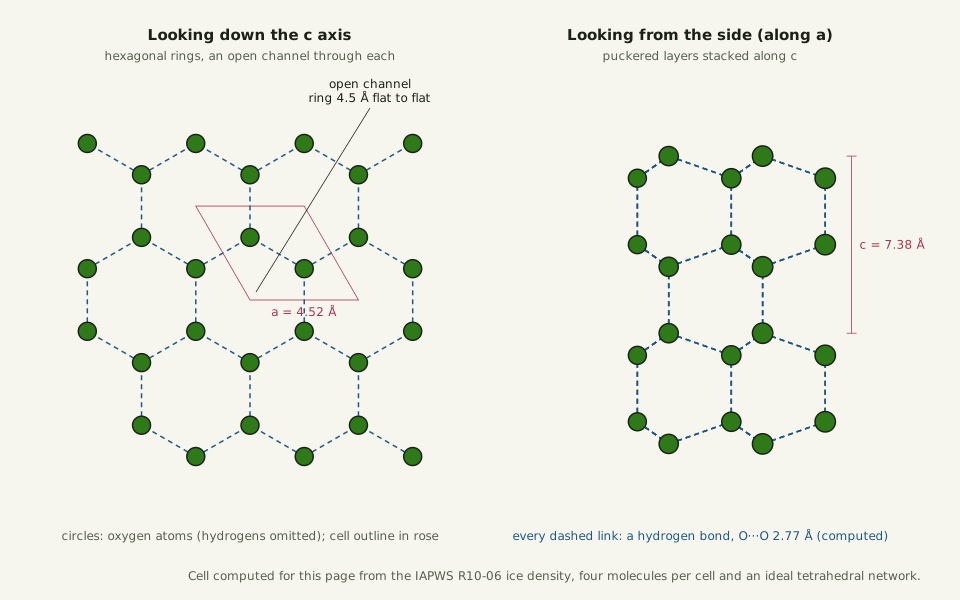
Because the network is open. The oxygens of ice Ih form puckered hexagonal rings stacked along one axis, the space group is P63/mmc, and the oxygens take the wurtzite arrangement (by Wikipedia's account, which cites Pauling 1935; the crystallography of Peterson and Levy 1957 and the lattice measurements of Röttger and colleagues 1994 were available only as bibliographic records). Four neighbours at tetrahedral angles leave a channel through every ring that no molecule fills; in that account the rings leave almost enough room for one more molecule inside each. Take the density of ice from the IAPWS 2006 equation, the four molecules per cell that arrangement implies, the molar mass 18.015 g/mol and the Avogadro constant, and the cell comes out 4.52 Å across and 7.38 Å tall, with 2.77 Å between neighbouring oxygens (all computed, assuming the ideal tetrahedral network).
Slide the diagram sideways to read its labels, or open it full size.
The open network of ice Ih: rings 4.5 Å flat to flat, cell 4.52 by 7.38 Å, neighbours 2.77 Å apart [10−10 m] (all computed from the IAPWS ice density). Data: ice-lattice.csv (sources, version and license, JSON).
"The open network of ice Ih" by Ants, Cells & Atoms, https://antscellsandatoms.com/molecules/water/ — CC BY 4.0 (https://creativecommons.org/licenses/by/4.0/)
Data sources for this figure
Data: IAPWS R10-06(2009), Revised Release on the Equation of State 2006 for H2O Ice Ih, equations computed for this page 2026-10-24; PubChem PUG-View, CID 962 (water) and CID 280 (carbon dioxide), identity and molecular weight, NCBI data, retrieved 2026-10-24; CODATA 2022 recommended values, NIST SRD 121 (physics.nist.gov/constants), Avogadro constant, retrieved 2026-10-24; Structure type of ice Ih (hexagonal, four-coordinated oxygens on the wurtzite arrangement) as summarized in Wikipedia, Ice Ih (CC BY-SA 4.0, paraphrased), citing Pauling 1935, retrieved 2026-10-24; four molecules per cell follows from that arrangement (computed for this page); primary crystallography Peterson & Levy 1957 and Röttger et al. 1994, bibliographic records only
Data sources for this figure
Data: IAPWS R10-06(2009), Revised Release on the Equation of State 2006 for H2O Ice Ih, equations computed for this page 2026-10-24; PubChem PUG-View, CID 962 (water) and CID 280 (carbon dioxide), identity and molecular weight, NCBI data, retrieved 2026-10-24; CODATA 2022 recommended values, NIST SRD 121 (physics.nist.gov/constants), Avogadro constant, retrieved 2026-10-24; Four hydrogen bonds per molecule, and lattice constants a = 0.452 nm and c = 0.736 nm measured near 0 °C (used only to check the four molecules per cell, computed for this page): Libbrecht KG 2019, Snow Crystals, monograph, arXiv 1910.06389 v2 (2021), https://arxiv.org/abs/1910.06389, section 2.2, retrieved 2026-10-24
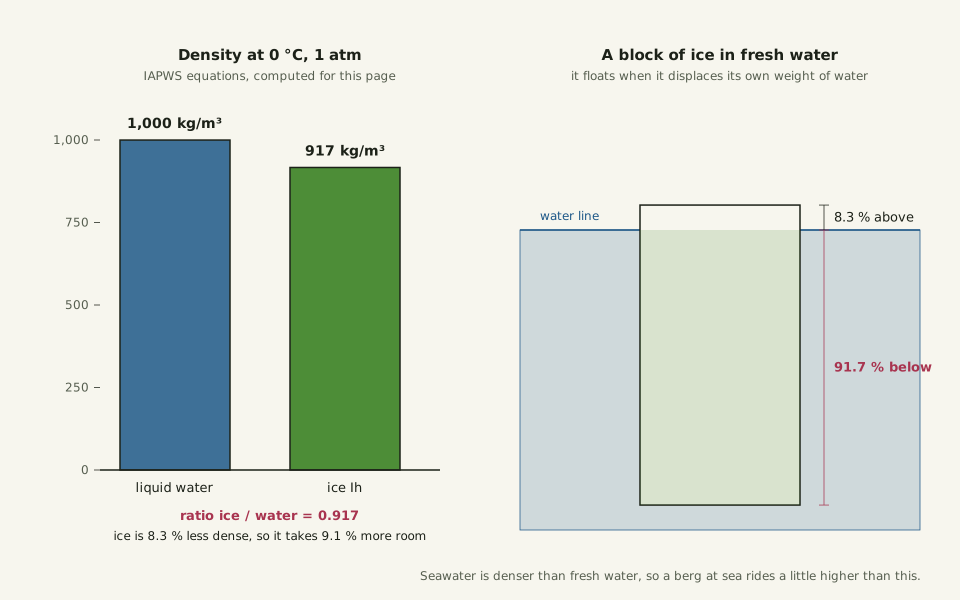
Now weigh the two phases at the melting point under one atmosphere. Liquid water at 0 °C is 999.84 kg/m3 and ice Ih is 916.72 kg/m3 (both computed for this page from the IAPWS 1995 and 2006 equations, which reproduce the check values printed in those releases). The ratio is 0.917. Ice is 8.3% less dense, so the same mass of water takes 9.1% more room as ice.
A floating body displaces its own weight of liquid, so a block of ice in fresh water sits 91.7% below the surface and 8.3% above (computed). The 0.917 g/cm3 for ice at 0 °C quoted in PubChem's record from the Hazardous Substances Data Bank, and the 0.9167 g/cm3 in Wikipedia's article, say the same.
Slide the diagram sideways to read its labels, or open it full size.
Ice Ih against liquid water at 0 °C and 1 atm, 917 against 1,000 kg/m3, a ratio of 0.917, set by molecules 2.8 Å apart [10−10 m]; in fresh water 91.7% of a floating block sits below the line (computed). Data: water-properties.csv (sources, version and license, JSON).
"Ice is lighter than the water it floats in" by Ants, Cells & Atoms, https://antscellsandatoms.com/molecules/water/ — CC BY 4.0 (https://creativecommons.org/licenses/by/4.0/)
Data: IAPWS R6-95(2018), Revised Release on the IAPWS Formulation 1995 for the Thermodynamic Properties of Ordinary Water Substance, equations computed for this page 2026-10-24; IAPWS R10-06(2009), Revised Release on the Equation of State 2006 for H2O Ice Ih, equations computed for this page 2026-10-24
Data sources for this figure
Data: IAPWS R6-95(2018), Revised Release on the IAPWS Formulation 1995 for the Thermodynamic Properties of Ordinary Water Substance, equations computed for this page 2026-10-24; IAPWS R10-06(2009), Revised Release on the Equation of State 2006 for H2O Ice Ih, equations computed for this page 2026-10-24; IAPWS R12-08, Release on the IAPWS Formulation 2008 for the Viscosity of Ordinary Water Substance, equations computed for this page 2026-10-24; IAPWS R1-76(2014), Revised Release on Surface Tension of Ordinary Water Substance, equation computed for this page 2026-10-24
Cold does not close the gap. Ice at −20 °C reaches 919.57 kg/m3 (computed), still far short of the liquid, while liquid water is densest near 4 °C, 999.97 kg/m3 (computed), and gets lighter above and below that temperature. Six-sided snowflakes inherit the hexagonal rings in the drawing above. Floating sea ice inherits the open channels through those rings.
 Illustration
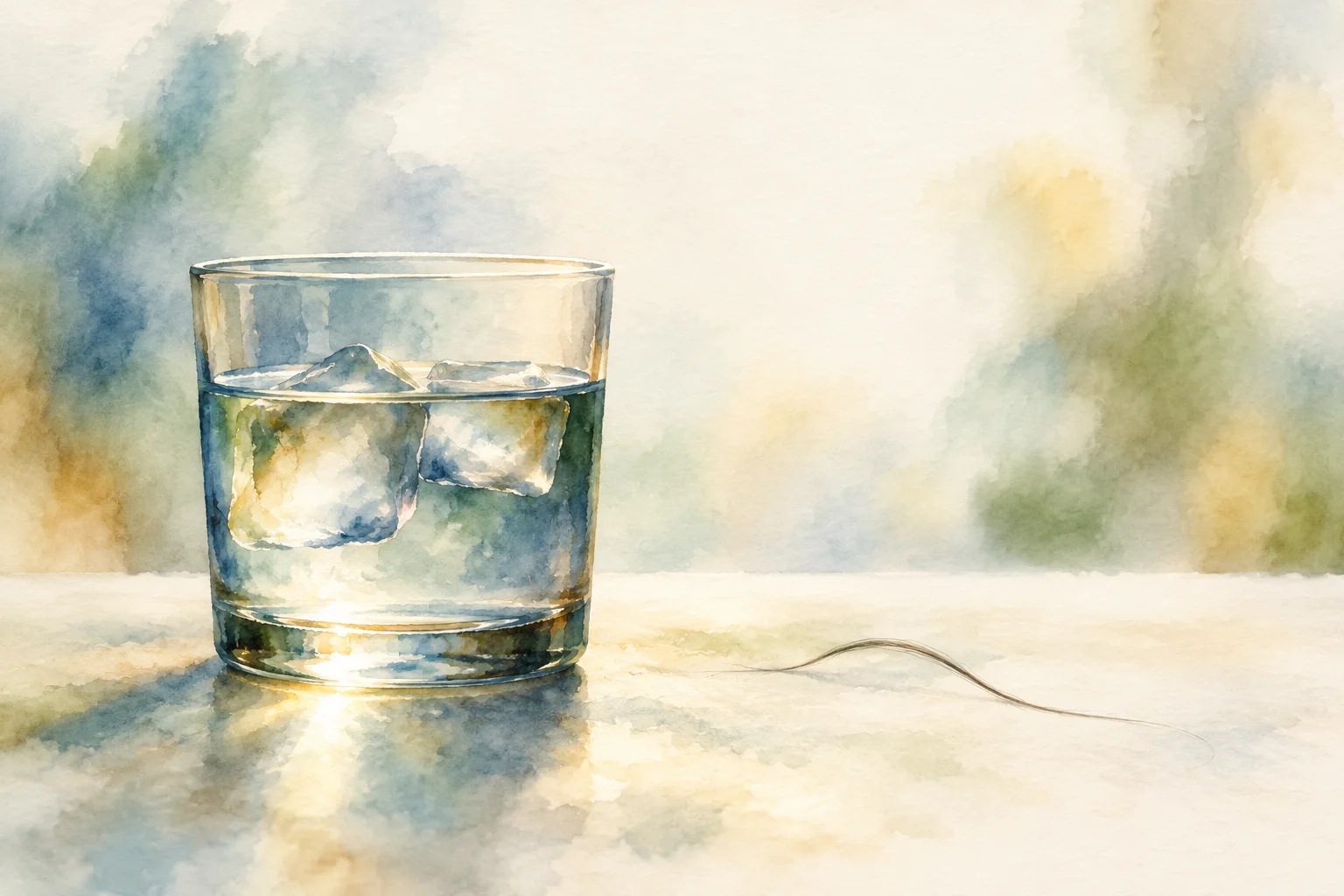
Ice cubes float in a glass of water with most of each cube below the surface; a strand of hair lies beside the glass.
Illustration — not to scale
Illustration: Ants, Cells & Atoms. Generated schematic illustration — not a photograph, micrograph or specimen record. © Ants, Cells & Atoms, all rights reserved.
How many molecules in a cube of water?
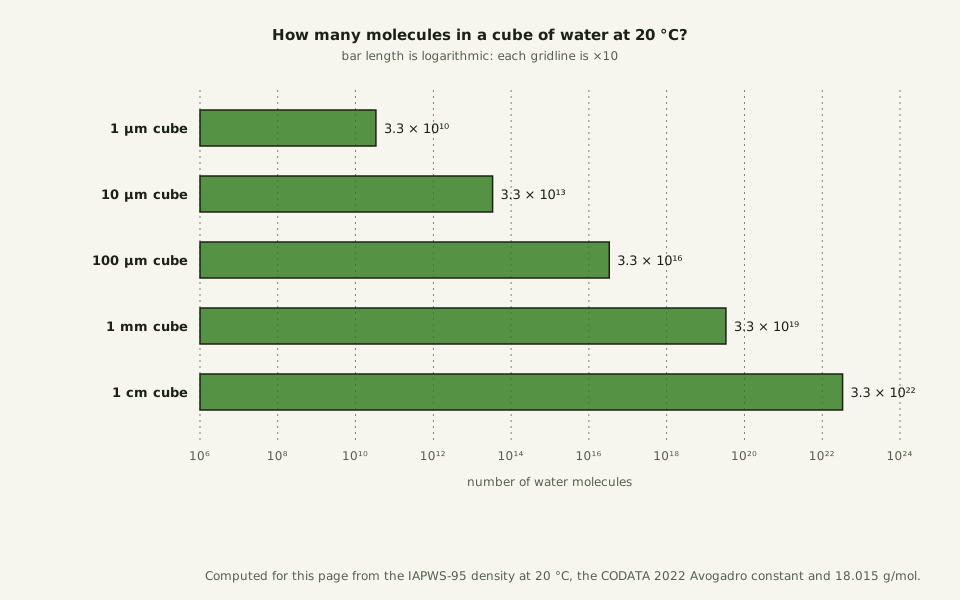
Return to the glass. At 20 °C a cube of water 1 µm on a side holds about 3.3 × 10¹⁰ molecules (computed from the IAPWS-95 density, 18.015 g/mol and the CODATA 2022 Avogadro constant). The cube's volume is roughly that of a small cell on the ladder in How Big Is a Cell?. Every tenfold step in the edge multiplies the count by a thousand: a 1 mm cube holds 3.3 × 10¹⁹ and a 1 cm cube, about the size of the ice cube you dropped in, 3.3 × 10²².
Slide the diagram sideways to read its labels, or open it full size.
Water molecules in a cube of water at 20 °C, from a 1 µm cube (3.3 × 10¹⁰) to a 1 cm cube (3.3 × 10²²); each molecule is 1.5–2.8 Å across [10−10 m]. Data: water-molecule-counts.csv (sources, version and license, JSON).
"Water molecules in a cube of water" by Ants, Cells & Atoms, https://antscellsandatoms.com/molecules/water/ — CC BY 4.0 (https://creativecommons.org/licenses/by/4.0/)
Data: IAPWS R6-95(2018), Revised Release on the IAPWS Formulation 1995 for the Thermodynamic Properties of Ordinary Water Substance, equations computed for this page 2026-10-24; PubChem PUG-View, CID 962 (water) and CID 280 (carbon dioxide), identity and molecular weight, NCBI data, retrieved 2026-10-24; CODATA 2022 recommended values, NIST SRD 121 (physics.nist.gov/constants), Avogadro constant, retrieved 2026-10-24
Each of those 3.3 × 10²² molecules in a frozen cube has two hydrogens. The crystal never settles exactly where they go. Every oxygen-to-oxygen link carries one hydrogen near one end or the other, and by Wikipedia's account of Pauling's 1935 argument there are many ways to satisfy that rule across the whole lattice, a disorder that stays frozen in as the ice cools. The oxygens hold a strict hexagonal pattern, and the hydrogens hold only a rule.
Sources
- NIST Computational Chemistry Comparison and Benchmark Database (CCCBDB), Standard Reference Database 101, Release 22 (May 2022). Experimental geometry of water, CAS 7732-18-5, listing Hoy & Bunker 1979. https://cccbdb.nist.gov/expgeom2x.asp?casno=7732185 Read: full text of the experimental geometry page (values and reference codes); used as the entry point to the 1979 paper.
- Hoy AR, Bunker PR. "A precise solution of the rotation bending Schrödinger equation for a triatomic molecule with application to the water molecule." Journal of Molecular Spectroscopy 74(1):1–8 (1979). https://doi.org/10.1016/0022-2852(79)90019-5 Read: bibliographic record only.
- International Association for the Properties of Water and Steam. IAPWS R6-95(2018), Revised Release on the IAPWS Formulation 1995 for the Thermodynamic Properties of Ordinary Water Substance for General and Scientific Use (2018). https://iapws.org/technical-guidance/release/IAPWS-95 Read: full text (PDF); equations re-computed for this page and checked against the release's Tables 7 and 8. Text license: IAPWS: publication in whole or in part allowed with attribution (https://iapws.org/technical-guidance/release/IAPWS-95).
- International Association for the Properties of Water and Steam. IAPWS R10-06(2009), Revised Release on the Equation of State 2006 for H2O Ice Ih (2009). https://iapws.org/technical-guidance/release/Ice-2009 Read: full text (PDF); equation re-computed for this page and checked against the release's Table 6. Text license: IAPWS: publication in whole or in part allowed with attribution (https://iapws.org/technical-guidance/release/Ice-2009).
- PubChem, compound CID 962 (Water), National Library of Medicine; database described in Kim S, et al. "PubChem 2025 update." Nucleic Acids Research 53(D1):D1516–D1525 (2025). https://doi.org/10.1093/nar/gkae1059 Read: full text of the compound record (identity, molecular weight 18.015 g/mol, experimental density entries contributed by the Hazardous Substances Data Bank).
- PubChem, compound CID 280 (Carbon Dioxide), National Library of Medicine; database described in Kim S, et al. "PubChem 2025 update." Nucleic Acids Research 53(D1):D1516–D1525 (2025). https://doi.org/10.1093/nar/gkae1059 Read: full text of the compound record (identity, molecular weight 44.009 g/mol).
- Wikidata. Item Q283, water: canonical SMILES (P233) and PubChem CID (P662). CC0. https://www.wikidata.org/wiki/Q283 (read 2026-10-24) Read: full text of the item record. Text license: CC0 1.0 (https://creativecommons.org/publicdomain/zero/1.0/).
- Wikidata. Item Q1997, carbon dioxide: canonical SMILES (P233) and PubChem CID (P662). CC0. https://www.wikidata.org/wiki/Q1997 (read 2026-10-24) Read: full text of the item record. Text license: CC0 1.0 (https://creativecommons.org/publicdomain/zero/1.0/).
- Wikipedia contributors. "Van der Waals radius." Wikipedia (read 2026-10-24). https://en.wikipedia.org/wiki/Van_der_Waals_radius Read: full text; paraphrased only (CC BY-SA). Text license: CC BY-SA 4.0 (https://creativecommons.org/licenses/by-sa/4.0/).
- Bondi A. "van der Waals Volumes and Radii." The Journal of Physical Chemistry 68(3):441–451 (1964). https://doi.org/10.1021/j100785a001 Read: bibliographic record only.
- Wikipedia contributors. "VSEPR theory." Wikipedia (read 2026-10-24). https://en.wikipedia.org/wiki/VSEPR_theory Read: full text; paraphrased only (CC BY-SA). Text license: CC BY-SA 4.0 (https://creativecommons.org/licenses/by-sa/4.0/).
- NIST Computational Chemistry Comparison and Benchmark Database (CCCBDB), Standard Reference Database 101, Release 22 (May 2022). Experimental geometry of carbon dioxide, CAS 124-38-9, listing Herzberg G, Electronic Spectra and Electronic Structure of Polyatomic Molecules (Van Nostrand, 1966). https://cccbdb.nist.gov/expgeom2x.asp?casno=124389 Read: full text of the experimental geometry page; the Herzberg 1966 book it cites was not read (bibliographic record only).
- Clough SA, Beers Y, Klein GP, Rothman LS. "Dipole moment of water from Stark measurements of H2O, HDO, and D2O." The Journal of Chemical Physics 59(5):2254–2259 (1973). https://doi.org/10.1063/1.1680328 Read: bibliographic record only.
- Wikipedia contributors. "Ice Ih." Wikipedia (read 2026-10-24). https://en.wikipedia.org/wiki/Ice_Ih Read: full text; paraphrased only (CC BY-SA). Text license: CC BY-SA 4.0 (https://creativecommons.org/licenses/by-sa/4.0/).
- Pauling L. "The Structure and Entropy of Ice and of Other Crystals with Some Randomness of Atomic Arrangement." Journal of the American Chemical Society 57(12):2680–2684 (1935). https://doi.org/10.1021/ja01315a102 Read: bibliographic record only.
- Peterson SW, Levy HA. "A single-crystal neutron diffraction study of heavy ice." Acta Crystallographica 10(1):70–76 (1957). https://doi.org/10.1107/S0365110X5700016X Read: bibliographic record only.
- Röttger K, Endriss A, Ihringer J, Doyle S, Kuhs WF. "Lattice constants and thermal expansion of H2O and D2O ice Ih between 10 and 265 K." Acta Crystallographica Section B 50(6):644–648 (1994). https://doi.org/10.1107/S0108768194004933 Read: bibliographic record only.
- CODATA 2022 recommended values of the fundamental physical constants, NIST Standard Reference Database 121. Avogadro constant, 6.02214076 × 10²³ mol⁻¹ (exact). https://physics.nist.gov/cgi-bin/cuu/Value?na Read: full text of the constant's value page.
- International Association for the Properties of Water and Steam. IAPWS R12-08, Release on the IAPWS Formulation 2008 for the Viscosity of Ordinary Water Substance (2008). https://iapws.org/technical-guidance/release/viscosity Read: full text (PDF); equations re-computed for this page and checked against the release's Table 4. Text license: IAPWS: publication in whole or in part allowed with attribution (https://iapws.org/technical-guidance/release/viscosity).
- International Association for the Properties of Water and Steam. IAPWS R1-76(2014), Revised Release on Surface Tension of Ordinary Water Substance (2014). https://iapws.org/technical-guidance/release/Surf-H2O Read: full text (PDF); equation re-computed for this page and checked against the release's Table 1. Text license: IAPWS: publication in whole or in part allowed with attribution (https://iapws.org/technical-guidance/release/Surf-H2O).
Cite this page
Ants, Cells & Atoms. “Water Molecule: The Bent Shape Behind Floating Ice.” Published 2026-10-25. https://antscellsandatoms.com/molecules/water/. Accessed (add the date you read it).
No DOI is issued for entries. Figures made here are CC BY 4.0; see each caption for the license of photographs.
Related entries
Sodium Chloride: Why a Salt Crystal Has No Molecules
Image: “Crystals of NaCl” by Alessandro e Damiano (2017) · CC BY 4.0
"Crystals of NaCl" by Alessandro e Damiano — https://commons.wikimedia.org/wiki/File:Crystals_of_NaCl.jpg — CC BY 4.0 (https://creativecommons.org/licenses/by/4.0/)

Acetylsalicylic Acid: A Form Made in 1853, 'Aspirin' in 1899
Image: “Filipendula ulmaria detail” by Marterum (2020) · CC0 1.0
"Filipendula ulmaria detail" by Marterum — https://commons.wikimedia.org/wiki/File:Filipendula_ulmaria_detail.jpg — CC0 1.0 (https://creativecommons.org/publicdomain/zero/1.0/)

Snowflakes: The Six-Fold Pattern Starts in the Molecule
Image: “SnowflakesWilsonBentley” by Wilson Bentley (1902) · Public domain
"SnowflakesWilsonBentley" by Wilson Bentley (1902) — https://commons.wikimedia.org/wiki/File:SnowflakesWilsonBentley.jpg — Public domain (photographs by Wilson Bentley, who died in 1931, published as Plate XIX of his snow-crystal studies in the annual summary of the Monthly Weather Review for 1902: public domain in the US (published before 1930) and in the EU (life of the author plus 70 years, ended 2001); the scan is from the NOAA Historic NWS Collection (image wea02087))
