The Stick Fiction: Ball-and-Stick Models Invent the Gaps

Slide the ladder sideways to read its labels, or open it full size.
Bonded atoms in a small molecule: water and carbon dioxide span 1.5–5.4 Å, from water's hydrogen-to-hydrogen nucleus distance to carbon dioxide's space-filling outline [10−10 m] (computed).
Log scale from 10 cm to 0.1 nm; each rung is ten times smaller than the one to its left. Dashed lines: naked eye about 0.1 mm and light microscope about 0.2 µm, explained on the page on how to read the Zoom ladder. Data: the-stick-fiction-shapes.csv (sources, version and license, JSON).
"Zoom ladder: bonded atoms in a small molecule" by Ants, Cells & Atoms, https://antscellsandatoms.com/molecules/the-stick-fiction/ — CC BY 4.0 (https://creativecommons.org/licenses/by/4.0/)
Data sources for this figure
Data: Equilibrium geometry of water (O–H 0.958 Å, H–O–H 104.4776°) from Hoy & Bunker 1979, J. Mol. Spectrosc. 74:1, as listed by NIST CCCBDB Release 22 (SRD 101), retrieved 2026-10-24; Geometry of carbon dioxide (C=O 1.162 Å, 180°) from Herzberg 1966 as listed by NIST CCCBDB Release 22 (SRD 101), retrieved 2026-10-24; Van der Waals radii H 120 pm, C 170 pm, O 152 pm from Bondi 1964, J. Phys. Chem. 68:441, as listed by PubChem element records 1, 6 and 8, retrieved 2026-10-24; outline lengths computed 2026-10-24
Data sources for this figure
Data: Equilibrium geometry of water (O–H 0.958 Å, H–O–H 104.4776°) from Hoy & Bunker 1979, J. Mol. Spectrosc. 74:1, as listed by NIST CCCBDB Release 22 (SRD 101), retrieved 2026-10-24; Geometry of carbon dioxide (C=O 1.162 Å, 180°) from Herzberg 1966 as listed by NIST CCCBDB Release 22 (SRD 101), retrieved 2026-10-24; SMILES O (water, Q283) and C(=O)=O (carbon dioxide, Q1997), Wikidata, CC0, retrieved 2026-10-24; Covalent radii H 31 pm and O 66 pm, PubChem element records 1 and 8 (PubChem Elements, from Cordero et al. 2008, Dalton Trans. 2832), retrieved 2026-10-24; Van der Waals radii H 120 pm, C 170 pm, O 152 pm from Bondi 1964, J. Phys. Chem. 68:441, as listed by PubChem element records 1, 6 and 8, retrieved 2026-10-24; Scale of 1 in to 1 Å from Corey & Pauling 1953, Rev. Sci. Instrum. 24:621 (abstract), retrieved 2026-10-24; Angles, lengths, outlines and model-scale widths computed 2026-10-24
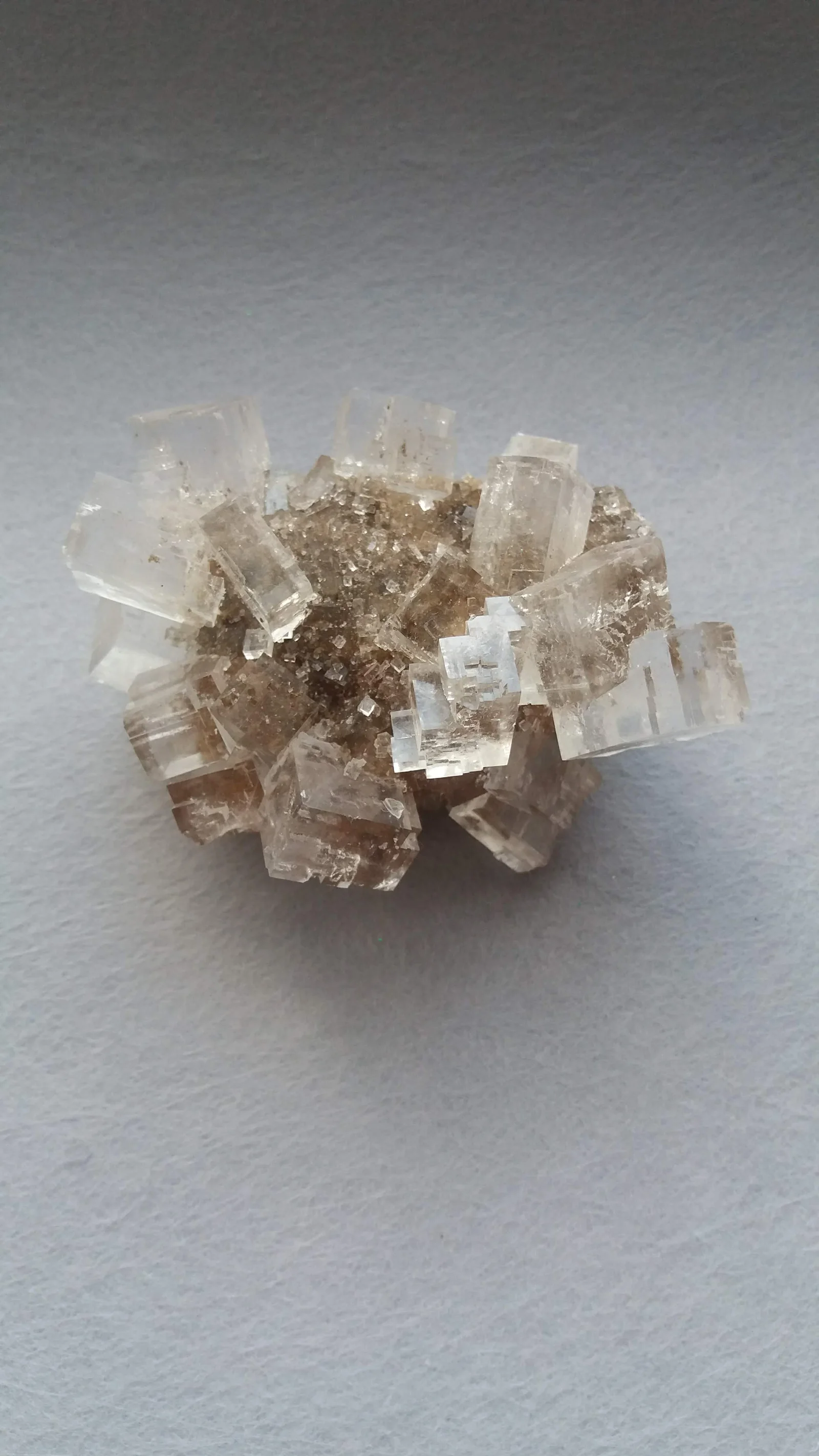
Halite, the mineral form of sodium chloride, from a salt mine at Bakhmut; the photographer gives no size, and the bonded atoms on this page sit about 1 Å apart [10−10 m].
Color: native
"Clear Halite Crystals on matrix" by IvanSakhno — https://commons.wikimedia.org/wiki/File:Clear_Halite_Crystals_on_matrix.jpg — CC BY 4.0 (https://creativecommons.org/licenses/by/4.0/)

These crystals formed in saturated brine in the salt mine, the photographer notes; halite is sodium chloride as a mineral. Nothing inside them is stick-shaped, though a ball-and-stick drawing of the sodium chloride grid would join its ions with rods. That is why every molecule on this site is drawn twice: with sticks, to show its angles, and space-filling, to show the room it takes up. Any entry that shows only the stick version names the stick fiction and links here.
Where did the sticks come from?
The sticks began as a way of counting. In a lecture at the Royal Institution on 7 April 1865, August Wilhelm von Hofmann built molecules out of croquet balls, by Wikipedia's account: white for hydrogen, red for oxygen, black for carbon. Metal arms screwed into each ball stood for its combining power. That way, in his words as Wikipedia quotes them, he could "join the balls and to rear in this manner a kind of mechanical structures in imitation of the atomic edifices to be illustrated."
Hofmann meant the model as an illustration, not a picture of reality, the article adds: the sticks did not stand for physical bonds, and his methane lay flat, though the real molecule is a tetrahedron. Later kits kept the sticks and fixed the angles. In a modern plastic kit, each ball is drilled with as many holes as its usual valence, aimed at the corners of a tetrahedron: four for carbon, two for oxygen, one for hydrogen.
Small balls were chosen for visibility. In a ball-and-stick model the spheres are usually much smaller than the rods are long, Wikipedia's article on it explains, so that atoms and bonds show throughout; the price is no clear idea of the space the molecule occupies. Ball size is the maker's choice. The drawings below show what it does to water.
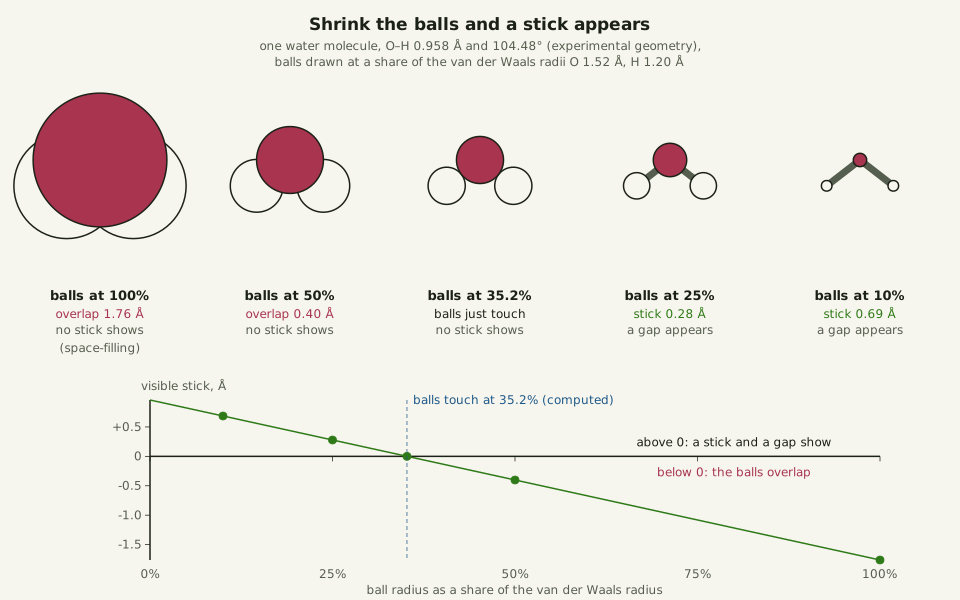
Slide the diagram sideways to read its labels, or open it full size.
One water molecule, O–H 0.958 Å [10−11 m] (measured), with its balls shrunk from 100% to 10% of the van der Waals radii; the balls part only below 35.2% (computed).
Each stick length in the chart is the nucleus distance minus the two ball radii. Data: the-stick-fiction-ball-sizes.csv (sources, version and license, JSON).
"Shrink the balls and a stick appears" by Ants, Cells & Atoms, https://antscellsandatoms.com/molecules/the-stick-fiction/ — CC BY 4.0 (https://creativecommons.org/licenses/by/4.0/)
Data sources for this figure
Data: Equilibrium geometry of water (O–H 0.958 Å, H–O–H 104.4776°) from Hoy & Bunker 1979, J. Mol. Spectrosc. 74:1, as listed by NIST CCCBDB Release 22 (SRD 101), retrieved 2026-10-24; Van der Waals radii H 120 pm and O 152 pm from Bondi 1964, J. Phys. Chem. 68:441, as listed by PubChem element records 1 and 8, retrieved 2026-10-24; ball sizes and stick lengths computed 2026-10-24
Data sources for this figure
Data: Equilibrium geometry of water (O–H 0.958 Å) from Hoy & Bunker 1979, J. Mol. Spectrosc. 74:1, as listed by NIST CCCBDB Release 22 (SRD 101), retrieved 2026-10-24; Geometry of carbon dioxide (C=O 1.162 Å) from Herzberg 1966 as listed by NIST CCCBDB Release 22 (SRD 101), retrieved 2026-10-24; Van der Waals radii H 120 pm, C 170 pm, O 152 pm from Bondi 1964, J. Phys. Chem. 68:441, as listed by PubChem element records 1, 6 and 8, retrieved 2026-10-24; Ball radii and visible stick lengths computed 2026-10-24
Accurate space-filling models came later. Robert Corey and Linus Pauling built accurate scale models of atoms from hard wood at 1 inch to 1 Å, their 1953 paper reports (abstract), and used them in place of calculation to study the likely shape of protein chains. By Wikipedia's account they sized each sphere to the atom's van der Waals radius and sliced flat faces where two atoms joined, so that the centres sat one bond length apart. At their scale a water molecule is 3.9 inches, about 9.9 cm, across (computed): roughly the hand atop the Zoom ladder.
Walter Koltun's lightweight version, the CPK models (for Corey, Pauling and Koltun), was about to reach researchers when he described it in 1965 (abstract).
Are there really gaps between bonded atoms?
No. A van der Waals radius is the radius of an imaginary hard sphere marking how close another atom can approach, in Wikipedia's definition. PubChem's element records list 1.52 Å for oxygen, 1.20 Å for hydrogen and 1.70 Å for carbon, the same values Wikipedia gives from Bondi's 1964 compilation. Oxygen and hydrogen spheres would just touch with their centres 2.72 Å apart. In water, PubChem CID 962, the two nuclei sit 0.958 Å apart (measured), 35% of that touching distance (computed).
So bonded spheres do not meet at a point: they overlap by 1.76 Å (computed). Each nucleus lies inside its partner's sphere. The hydrogen nucleus sits 0.56 Å inside the oxygen's surface and the oxygen nucleus 0.24 Å inside the hydrogen's (computed). Carbon dioxide, CID 280, does the same: its carbon and oxygen nuclei are 1.162 Å apart (measured), 36% of the 3.22 Å at which their spheres would touch.
Unbonded atoms in the same molecule overlap less. Water's two hydrogen nuclei are 1.515 Å apart, 63% of their touching distance, and the two oxygens of carbon dioxide 2.324 Å apart, 76% of theirs (both computed).
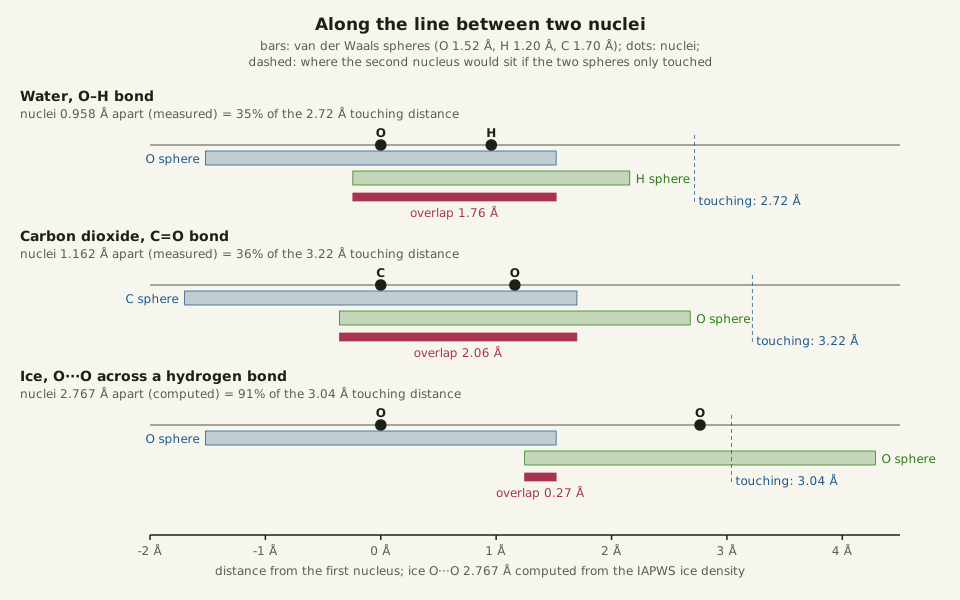
Slide the diagram sideways to read its labels, or open it full size.
Along the line between two nuclei: bonded pairs at 0.958 and 1.162 Å (measured), hydrogen-bonded oxygens in ice at 2.77 Å (computed), each set against its touching distance of 2.72–3.22 Å [10−11–10−10 m].
Bars are van der Waals spheres; the red bar is their overlap. Data: the-stick-fiction-contact-distances.csv (sources, version and license, JSON).
"Along the line between two nuclei" by Ants, Cells & Atoms, https://antscellsandatoms.com/molecules/the-stick-fiction/ — CC BY 4.0 (https://creativecommons.org/licenses/by/4.0/)
Data sources for this figure
Data: Equilibrium geometry of water (O–H 0.958 Å) from Hoy & Bunker 1979, J. Mol. Spectrosc. 74:1, as listed by NIST CCCBDB Release 22 (SRD 101), retrieved 2026-10-24; Geometry of carbon dioxide (C=O 1.162 Å) from Herzberg 1966 as listed by NIST CCCBDB Release 22 (SRD 101), retrieved 2026-10-24; Oxygen–oxygen distance in ice Ih, 2.767 Å, computed for this site from IAPWS R10-06(2009), Revised Release on the Equation of State 2006 for H2O Ice Ih, assuming an ideal tetrahedral network (ice-lattice.csv), computed 2026-10-24; Van der Waals radii H 120 pm, C 170 pm, O 152 pm from Bondi 1964, J. Phys. Chem. 68:441, as listed by PubChem element records 1, 6 and 8, retrieved 2026-10-24; touching distances and overlaps computed 2026-10-24
Data sources for this figure
Data: Equilibrium geometry of water (O–H 0.958 Å) from Hoy & Bunker 1979, J. Mol. Spectrosc. 74:1, as listed by NIST CCCBDB Release 22 (SRD 101), retrieved 2026-10-24; Geometry of carbon dioxide (C=O 1.162 Å) from Herzberg 1966 as listed by NIST CCCBDB Release 22 (SRD 101), retrieved 2026-10-24; Oxygen–oxygen distance in ice Ih computed for this site from IAPWS R10-06(2009), assuming an ideal tetrahedral network, computed 2026-10-24; Van der Waals radii H 120 pm, C 170 pm, O 152 pm from Bondi 1964, J. Phys. Chem. 68:441, as listed by PubChem element records 1, 6 and 8, retrieved 2026-10-24; Touching distances, shares, overlaps and depths computed 2026-10-24
Wikipedia's article on the van der Waals surface states the general rule: bonded atoms sit closer together than the sum of their van der Waals radii, so a molecule always takes up less room than its atoms would separately. The electrons themselves are smeared out in space, and in a molecule the places where they are dense are usually around each atom and along its bonds, by Wikipedia's account of electron density. The space between two bonded nuclei is one of the crowded places, not a gap.
Hydrogen-bonded molecules also sit slightly inside each other's reach. In ice each oxygen has four hydrogen bonds, by Wikipedia's account of ice Ih. Neighbouring oxygens in ice are 2.77 Å apart, computed on the water molecule page from the IAPWS ice density for an ideal network: 91% of the 3.04 Å at which two oxygen spheres would touch.
| Atom pair | Nuclei apart | Spheres would touch at | Share | Overlap |
|---|---|---|---|---|
| Water, O–H, bonded | 0.958 Å (measured) | 2.72 Å | 35% | 1.76 Å |
| Carbon dioxide, C=O, bonded | 1.162 Å (measured) | 3.22 Å | 36% | 2.06 Å |
| Water, H···H, same molecule | 1.515 Å (computed) | 2.40 Å | 63% | 0.89 Å |
| Carbon dioxide, O···O, same molecule | 2.324 Å (computed) | 3.04 Å | 76% | 0.72 Å |
| Ice Ih, O···O, hydrogen-bonded neighbours | 2.767 Å (computed) | 3.04 Å | 91% | 0.27 Å |
When do sticks still help?
When the question is an angle. In a ball-and-stick drawing of water, the two sticks meet at the oxygen nucleus, and the 104.48° between them (measured) can be read off with a protractor. In the space-filling drawing the same angle is out of sight: its vertex lies 1.52 Å inside the outline, and both hydrogen nuclei lie inside the oxygen's own sphere. Carbon dioxide's straight 180° line is just as buried, inside an outline 5.4 Å long (computed).
A stick, though, shows only the angle it was set at. Count the electron groups on the oxygen in water's SMILES string from Wikidata, O: two bonds to hydrogen and two lone pairs, as the water molecule page explains. The simplest computed shape then puts the bonds 109.47° apart, the same tetrahedral angle at which the modern kit drills its oxygen balls, and 4.99° wider than measured. For carbon dioxide, C(=O)=O, the count gives two groups and 180°, which matches the measured angle.
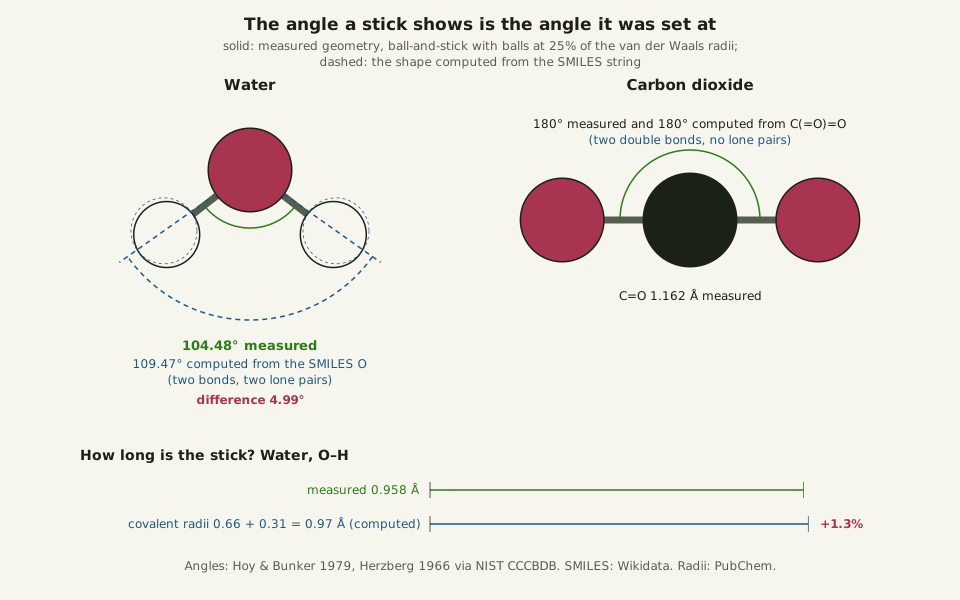
Slide the diagram sideways to read its labels, or open it full size.
Ball-and-stick water and carbon dioxide, bonds 0.958 and 1.162 Å (measured) [10−11–10−10 m]: water's computed 109.47° is 4.99° wider than its measured 104.48°.
Dashed lines and circles: the shape computed from the SMILES strings. Data: the-stick-fiction-shapes.csv (sources, version and license, JSON).
"The angle a stick shows is the angle it was set at" by Ants, Cells & Atoms, https://antscellsandatoms.com/molecules/the-stick-fiction/ — CC BY 4.0 (https://creativecommons.org/licenses/by/4.0/)
Data sources for this figure
Data: Equilibrium geometry of water (O–H 0.958 Å, H–O–H 104.4776°) from Hoy & Bunker 1979, J. Mol. Spectrosc. 74:1, as listed by NIST CCCBDB Release 22 (SRD 101), retrieved 2026-10-24; Geometry of carbon dioxide (C=O 1.162 Å, 180°) from Herzberg 1966 as listed by NIST CCCBDB Release 22 (SRD 101), retrieved 2026-10-24; SMILES O (water, Q283) and C(=O)=O (carbon dioxide, Q1997), Wikidata, CC0, retrieved 2026-10-24; shapes computed 2026-10-24 by counting electron groups on the central atom; Covalent radii H 31 pm and O 66 pm, PubChem element records 1 and 8 (PubChem Elements, from Cordero et al. 2008, Dalton Trans. 2832), retrieved 2026-10-24; Van der Waals radii H 120 pm, C 170 pm, O 152 pm from Bondi 1964, J. Phys. Chem. 68:441, as listed by PubChem element records 1, 6 and 8, retrieved 2026-10-24
Data sources for this figure
Data: Equilibrium geometry of water (O–H 0.958 Å, H–O–H 104.4776°) from Hoy & Bunker 1979, J. Mol. Spectrosc. 74:1, as listed by NIST CCCBDB Release 22 (SRD 101), retrieved 2026-10-24; Geometry of carbon dioxide (C=O 1.162 Å, 180°) from Herzberg 1966 as listed by NIST CCCBDB Release 22 (SRD 101), retrieved 2026-10-24; SMILES O (water, Q283) and C(=O)=O (carbon dioxide, Q1997), Wikidata, CC0, retrieved 2026-10-24; Covalent radii H 31 pm and O 66 pm, PubChem element records 1 and 8 (PubChem Elements, from Cordero et al. 2008, Dalton Trans. 2832), retrieved 2026-10-24; Van der Waals radii H 120 pm, C 170 pm, O 152 pm from Bondi 1964, J. Phys. Chem. 68:441, as listed by PubChem element records 1, 6 and 8, retrieved 2026-10-24; Scale of 1 in to 1 Å from Corey & Pauling 1953, Rev. Sci. Instrum. 24:621 (abstract), retrieved 2026-10-24; Angles, lengths, outlines and model-scale widths computed 2026-10-24
Stick lengths can be off as well. Covalent radii are sized so that two of them add up to a bond length, by Wikipedia's account. PubChem's element records list 0.66 Å for oxygen and 0.31 Å for hydrogen, from Cordero and colleagues' 2008 compilation based on crystal structures (abstract). End to end they make a 0.97 Å O–H stick, 1.3% longer than measured (computed).
Sticks also help with counting neighbours. Wikipedia's drawing of ice Ih marks the hydrogen bonds with dashed lines, four to each oxygen, and in the cubic grid of sodium chloride each ion is surrounded by six ions of the opposite charge, by Wikipedia's account of that crystal; a stick to each of the six marks a neighbour, six times over. Some models keep only the sticks: in the skeletal kits behind Crick and Watson's model of DNA, by Wikipedia's account, atoms were points where rods met. Larger molecules here, such as acetylsalicylic acid, follow the same rule: wherever only sticks appear, the page names the stick fiction.
| Molecule | Across the nuclei | Across the van der Waals outline |
|---|---|---|
| Water, measured geometry | 1.515 Å, hydrogen to hydrogen (computed) | 3.9 Å wide (computed) |
| Carbon dioxide, measured geometry | 2.324 Å, oxygen to oxygen (computed) | 5.4 Å long (computed) |
| Acetylsalicylic acid, computed shapes | 7.9–8.0 Å at its longest (computed) | 10.3–10.4 Å at its longest (computed) |
| DNA, a twelve-base-pair crystal (PDB 1BNA) | atom centres fit within a cylinder 2.2 nm across (computed) | fits within a cylinder about 2.5 nm across (computed) |
| Sodium chloride crystal, three crystal records | neighbouring nuclei 2.80–2.83 Å apart (computed); cubic cell 5.60–5.66 Å on each edge (measured) | no single molecule to outline: the crystal is one grid of ions |
Data: the-stick-fiction-molecule-sizes.csv (sources, version and license, JSON) Data: Equilibrium geometry of water from Hoy & Bunker 1979, J. Mol. Spectrosc. 74:1, and of carbon dioxide from Herzberg 1966, as listed by NIST CCCBDB Release 22 (SRD 101), retrieved 2026-10-24; Van der Waals radii H 120 pm, C 170 pm, N 155 pm, O 152 pm, P 180 pm as listed by PubChem element records 1, 6, 7, 8 and 15, retrieved 2026-10-24 and 2026-10-25; Acetylsalicylic acid: Wikidata Q18216 canonical SMILES (P233), CC0, with bond lengths and angles of benzene, phenol, acetic acid and methyl formate from NIST CCCBDB Release 22 (SRD 101), retrieved 2026-10-24; DNA: RCSB PDB 1BNA, CC0, coordinates from Drew HR, Wing RM, Takano T, Broka C, Tanaka S, Itakura K, Dickerson RE 1981, Proceedings of the National Academy of Sciences 78(4):2179–2183, https://doi.org/10.2210/pdb1bna/pdb, retrieved 2026-10-25; Sodium chloride: Crystallography Open Database records 2108652, 4300180 and 4320809, CC0, as listed in PubChem CID 5234, retrieved 2026-10-24; Sizes computed 2026-10-24 and 2026-10-25 on the pages named in each row; copied into this table 2026-10-25, which names the page each size comes from.
Which drawing is closer to the electron cloud?
For the outside of a molecule, the space-filling one. Its spheres stand for the room each atom keeps from its neighbours, and space-filling models grew, in Wikipedia's account of their history, from a wish to show the electronic surfaces a molecule presents to other molecules. They hide the inside: bonds, angles and nuclei vanish behind the nearest atoms.
For the inside, the ball-and-stick drawing is the honest one. In a good model, as Wikipedia puts it, the angles between the rods are the angles between the bonds, and the ball centres are spaced in proportion to the distances between nuclei. Its one invention is the empty space: the gap is whatever the chosen ball size leaves, and in water it closes once the balls reach 35% of their van der Waals size.
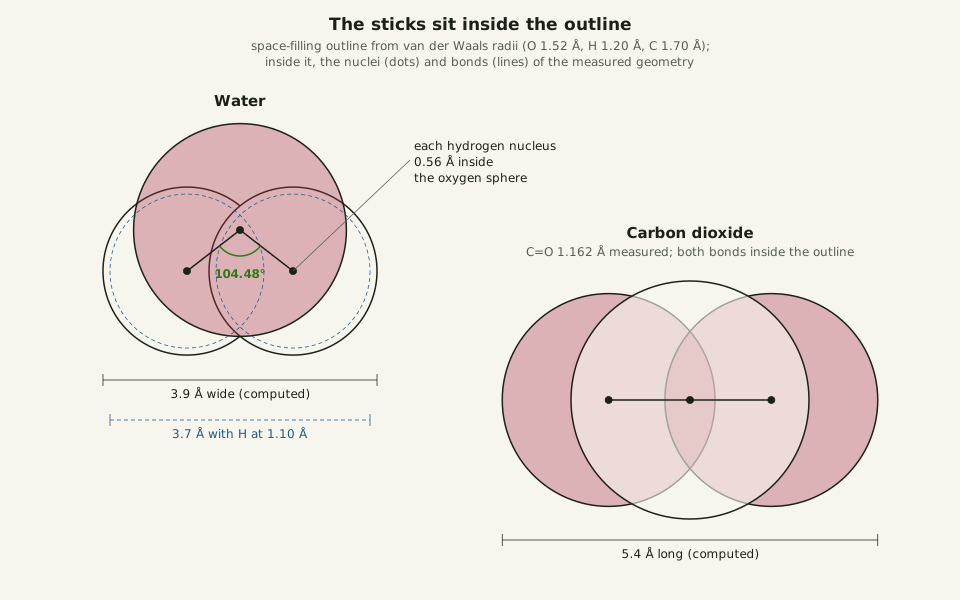
Slide the diagram sideways to read its labels, or open it full size.
The sticks inside the outline: water 3.9 Å wide and carbon dioxide 5.4 Å long [10−10 m] (computed), with every nucleus and bond of the measured geometry inside them.
Dashed: water's outline with a hydrogen radius of 1.10 Å instead of 1.20 Å. Data: the-stick-fiction-shapes.csv (sources, version and license, JSON).
"The sticks sit inside the outline" by Ants, Cells & Atoms, https://antscellsandatoms.com/molecules/the-stick-fiction/ — CC BY 4.0 (https://creativecommons.org/licenses/by/4.0/)
Data sources for this figure
Data: Equilibrium geometry of water (O–H 0.958 Å, H–O–H 104.4776°) from Hoy & Bunker 1979, J. Mol. Spectrosc. 74:1, as listed by NIST CCCBDB Release 22 (SRD 101), retrieved 2026-10-24; Geometry of carbon dioxide (C=O 1.162 Å, 180°) from Herzberg 1966 as listed by NIST CCCBDB Release 22 (SRD 101), retrieved 2026-10-24; Van der Waals radii H 120 pm, C 170 pm, O 152 pm from Bondi 1964, J. Phys. Chem. 68:441, as listed by PubChem element records 1, 6 and 8, retrieved 2026-10-24; outlines computed 2026-10-24; Alternative hydrogen radius 1.10 Å (dashed outline) as listed in Wikipedia, Van der Waals radius (CC BY-SA 4.0, paraphrased value), retrieved 2026-10-24
Data sources for this figure
Data: Equilibrium geometry of water (O–H 0.958 Å, H–O–H 104.4776°) from Hoy & Bunker 1979, J. Mol. Spectrosc. 74:1, as listed by NIST CCCBDB Release 22 (SRD 101), retrieved 2026-10-24; Geometry of carbon dioxide (C=O 1.162 Å, 180°) from Herzberg 1966 as listed by NIST CCCBDB Release 22 (SRD 101), retrieved 2026-10-24; SMILES O (water, Q283) and C(=O)=O (carbon dioxide, Q1997), Wikidata, CC0, retrieved 2026-10-24; Covalent radii H 31 pm and O 66 pm, PubChem element records 1 and 8 (PubChem Elements, from Cordero et al. 2008, Dalton Trans. 2832), retrieved 2026-10-24; Van der Waals radii H 120 pm, C 170 pm, O 152 pm from Bondi 1964, J. Phys. Chem. 68:441, as listed by PubChem element records 1, 6 and 8, retrieved 2026-10-24; Scale of 1 in to 1 Å from Corey & Pauling 1953, Rev. Sci. Instrum. 24:621 (abstract), retrieved 2026-10-24; Angles, lengths, outlines and model-scale widths computed 2026-10-24
| Drawing | An atom is | A bond is | Shows | Hides |
|---|---|---|---|---|
| Ball-and-stick | a small ball centred on its nucleus | a rod | where the nuclei sit and the angles between bonds | the room the atoms fill; it adds gaps |
| Space-filling | a sphere of its van der Waals radius | not drawn; bonded spheres overlap | the outer shape and size | bonds, angles and nuclei |
| Electron-density surface | part of one surface of a chosen density | not drawn | atoms, bonds or overall shape, depending on the density chosen | any single natural edge |
Neither drawing is the cloud itself. A computed electron-density surface, a third kind of picture, is drawn at a density its maker chooses: a high value picks out the atoms, a middle one the bonds, and a low one the molecule's overall shape and size, by Wikipedia's account.
Tables of van der Waals radii differ, too, because each averages different measurements and an atom's surroundings change its radius. Wikipedia's table gives hydrogen as 1.10 or 1.20 Å. With the smaller value, water's outline narrows from 3.9 to 3.7 Å (computed). An atom has no sharp boundary, as PubChem's element records note, so where a molecule ends is a choice of cutoff: the question How Small Is an Atom? asks of a single atom.
Sources
- Wikipedia contributors. "Van der Waals radius." Wikipedia (read 2026-10-24). https://en.wikipedia.org/wiki/Van_der_Waals_radius Read: full text; paraphrased only. Text license: CC BY-SA 4.0 (https://creativecommons.org/licenses/by-sa/4.0/).
- PubChem, element records 1 (Hydrogen), 6 (Carbon) and 8 (Oxygen), Atomic Radius, National Library of Medicine; van der Waals radii contributed by the Los Alamos National Laboratory periodic table, covalent radii by PubChem Elements. Database described in Kim S, et al. "PubChem 2025 update." Nucleic Acids Research 53(D1):D1516–D1525 (2025). https://doi.org/10.1093/nar/gkae1059 Read: full text of the Atomic Radius section of each element record.
- NIST Computational Chemistry Comparison and Benchmark Database (CCCBDB), Standard Reference Database 101, Release 22 (May 2022). Experimental geometry of water, CAS 7732-18-5, listing Hoy & Bunker 1979. https://cccbdb.nist.gov/expgeom2x.asp?casno=7732185 Read: full text of the experimental geometry page (values and reference codes).
- Hoy AR, Bunker PR. "A precise solution of the rotation bending Schrödinger equation for a triatomic molecule with application to the water molecule." Journal of Molecular Spectroscopy 74(1):1–8 (1979). https://doi.org/10.1016/0022-2852(79)90019-5 Read: bibliographic record only.
- Wikipedia contributors. "Sodium chloride." Wikipedia (read 2026-10-24). https://en.wikipedia.org/wiki/Sodium_chloride Read: full text; paraphrased only. Text license: CC BY-SA 4.0 (https://creativecommons.org/licenses/by-sa/4.0/).
- Wikipedia contributors. "Molecular model." Wikipedia (read 2026-10-24). https://en.wikipedia.org/wiki/Molecular_model Read: full text; paraphrased, with one quotation of Hofmann's 1865 lecture as the article gives it. Text license: CC BY-SA 4.0 (https://creativecommons.org/licenses/by-sa/4.0/).
- Wikipedia contributors. "Ball-and-stick model." Wikipedia (read 2026-10-24). https://en.wikipedia.org/wiki/Ball-and-stick_model Read: full text; paraphrased only. Text license: CC BY-SA 4.0 (https://creativecommons.org/licenses/by-sa/4.0/).
- Corey RB, Pauling L. "Molecular Models of Amino Acids, Peptides, and Proteins." Review of Scientific Instruments 24(8):621–627 (1953). https://doi.org/10.1063/1.1770803 Read: abstract.
- Wikipedia contributors. "Space-filling model." Wikipedia (read 2026-10-24). https://en.wikipedia.org/wiki/Space-filling_model Read: full text; paraphrased only. Text license: CC BY-SA 4.0 (https://creativecommons.org/licenses/by-sa/4.0/).
- Koltun WL. "Precision space-filling atomic models." Biopolymers 3(6):665–679 (1965). https://doi.org/10.1002/bip.360030606 Read: abstract.
- Bondi A. "van der Waals Volumes and Radii." The Journal of Physical Chemistry 68(3):441–451 (1964). https://doi.org/10.1021/j100785a001 Read: bibliographic record only.
- Wikidata. Item Q283, water: canonical SMILES (P233) and PubChem CID (P662). CC0. https://www.wikidata.org/wiki/Q283 (read 2026-10-24) Read: full text of the item record. Text license: CC0 1.0 (https://creativecommons.org/publicdomain/zero/1.0/).
- Wikidata. Item Q1997, carbon dioxide: canonical SMILES (P233) and PubChem CID (P662). CC0. https://www.wikidata.org/wiki/Q1997 (read 2026-10-24) Read: full text of the item record. Text license: CC0 1.0 (https://creativecommons.org/publicdomain/zero/1.0/).
- NIST Computational Chemistry Comparison and Benchmark Database (CCCBDB), Standard Reference Database 101, Release 22 (May 2022). Experimental geometry of carbon dioxide, CAS 124-38-9, listing Herzberg G, Electronic Spectra and Electronic Structure of Polyatomic Molecules (Van Nostrand, 1966). https://cccbdb.nist.gov/expgeom2x.asp?casno=124389 Read: full text of the experimental geometry page; the Herzberg 1966 book it cites was not read (bibliographic record only).
- Wikipedia contributors. "Van der Waals surface." Wikipedia (read 2026-10-24). https://en.wikipedia.org/wiki/Van_der_Waals_surface Read: full text; paraphrased only. Text license: CC BY-SA 4.0 (https://creativecommons.org/licenses/by-sa/4.0/).
- Wikipedia contributors. "Electron density." Wikipedia (read 2026-10-24). https://en.wikipedia.org/wiki/Electron_density Read: full text; paraphrased only. Text license: CC BY-SA 4.0 (https://creativecommons.org/licenses/by-sa/4.0/).
- Wikipedia contributors. "Ice Ih." Wikipedia (read 2026-10-24). https://en.wikipedia.org/wiki/Ice_Ih Read: full text; paraphrased only. Text license: CC BY-SA 4.0 (https://creativecommons.org/licenses/by-sa/4.0/).
- International Association for the Properties of Water and Steam. IAPWS R10-06(2009), Revised Release on the Equation of State 2006 for H2O Ice Ih (2009). https://iapws.org/technical-guidance/release/Ice-2009 Read: full text (PDF); the oxygen spacing in ice is computed from its ice density on the water molecule page. Text license: IAPWS: publication in whole or in part allowed with attribution (https://iapws.org/technical-guidance/release/Ice-2009).
- Wikipedia contributors. "Covalent radius." Wikipedia (read 2026-10-24). https://en.wikipedia.org/wiki/Covalent_radius Read: full text; paraphrased only. Text license: CC BY-SA 4.0 (https://creativecommons.org/licenses/by-sa/4.0/).
- Cordero B, Gómez V, Platero-Prats AE, Revés M, Echeverría J, Cremades E, Barragán F, Alvarez S. "Covalent radii revisited." Dalton Transactions (21):2832–2838 (2008). https://doi.org/10.1039/b801115j Read: abstract.
Cite this page
Ants, Cells & Atoms. “The Stick Fiction: Ball-and-Stick Models Invent the Gaps.” Published 2026-10-25. https://antscellsandatoms.com/molecules/the-stick-fiction/. Accessed (add the date you read it).
No DOI is issued for entries. Figures made here are CC BY 4.0; see each caption for the license of photographs.
Related entries
 Illustration
Water Molecule: The Bent Shape Behind Floating Ice
Image: Illustration: Ants, Cells & Atoms, all rights reserved
Illustration: Ants, Cells & Atoms. Generated schematic illustration — not a photograph, micrograph or specimen record. © Ants, Cells & Atoms, all rights reserved.
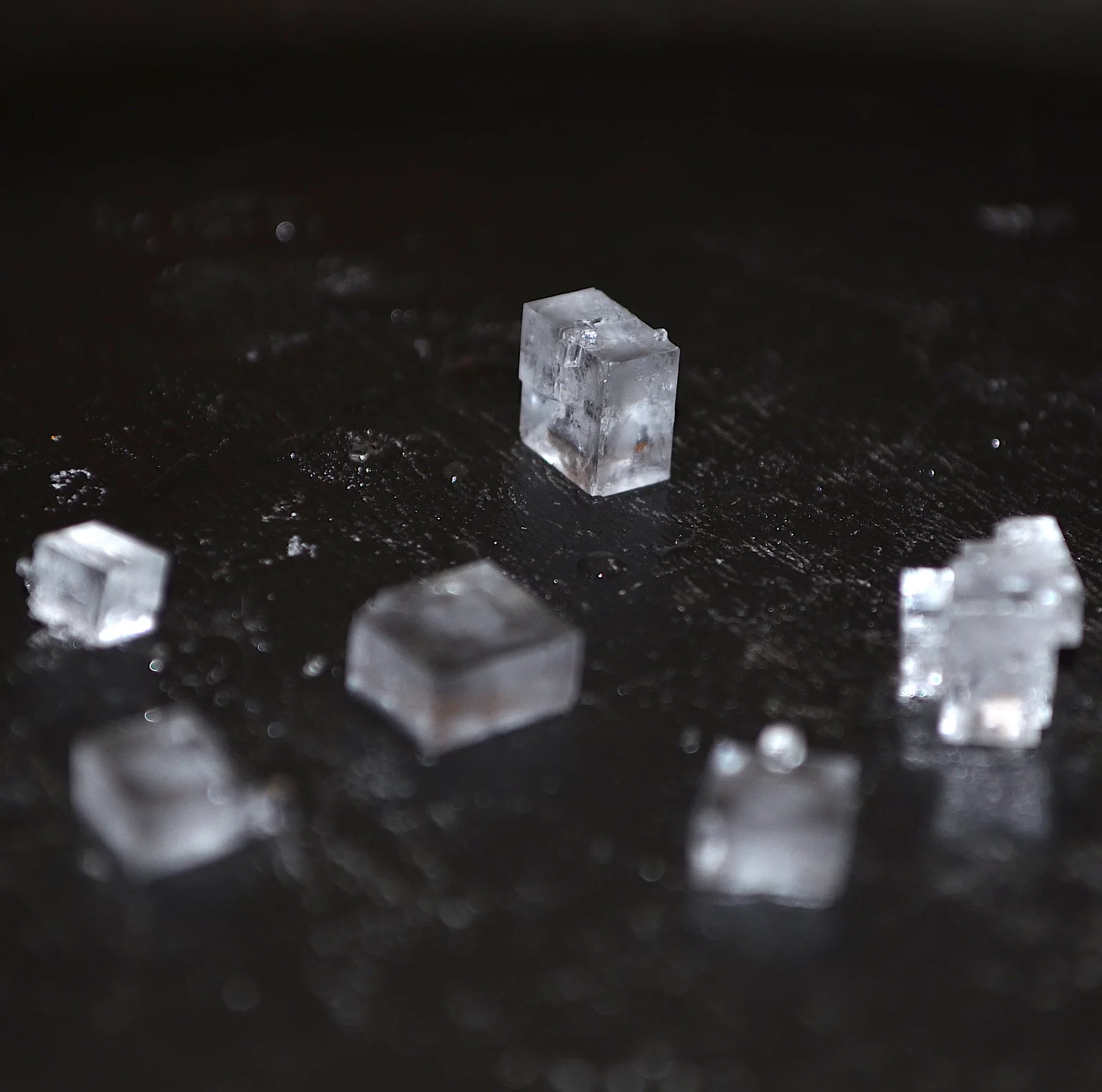
Sodium Chloride: Why a Salt Crystal Has No Molecules
Image: “Crystals of NaCl” by Alessandro e Damiano (2017) · CC BY 4.0
"Crystals of NaCl" by Alessandro e Damiano — https://commons.wikimedia.org/wiki/File:Crystals_of_NaCl.jpg — CC BY 4.0 (https://creativecommons.org/licenses/by/4.0/)

Acetylsalicylic Acid: A Form Made in 1853, 'Aspirin' in 1899
Image: “Filipendula ulmaria detail” by Marterum (2020) · CC0 1.0
"Filipendula ulmaria detail" by Marterum — https://commons.wikimedia.org/wiki/File:Filipendula_ulmaria_detail.jpg — CC0 1.0 (https://creativecommons.org/publicdomain/zero/1.0/)
