How Small Is an Atom? For Most Elements, About 0.1–0.5 nm

Slide the ladder sideways to read its labels, or open it full size.
An atom, most elements: about 0.1–0.5 nm across [10−10 m], the exact width set by which radius is used; a typical hair, 50–100 µm, sits five to six rungs up.
Log scale from 10 cm to 0.1 nm; each rung is ten times smaller than the one to its left. Dashed lines: naked eye about 0.1 mm and light microscope about 0.2 µm, explained on the Zoom ladder page.
"Zoom ladder: how small is an atom" by Ants, Cells & Atoms, https://antscellsandatoms.com/scale/atom-size/ — CC BY 4.0 (https://creativecommons.org/licenses/by/4.0/)
Data sources for this figure
Data: PubChem element records 1–96, Atomic Radius section, PubChem 2025 update, https://doi.org/10.1093/nar/gkae1059 (covalent radii from Cordero B et al. 2008, Dalton Transactions, https://doi.org/10.1039/b801115j; empirical radii from Slater JC 1964, The Journal of Chemical Physics, https://doi.org/10.1063/1.1725697; van der Waals radii from the Los Alamos National Laboratory periodic table; retrieved 2026-10-25); Li C et al. 2023, Journal of Biomedical Optics 28(11):116501, CC BY 4.0, https://doi.org/10.1117/1.JBO.28.11.116501 (human hair, typically 50–100 µm; shared reference-objects.csv; retrieved 2026-10-25); subject band 0.1–0.5 nm from the article front matter zoom, same value as the Bench card; ladder computed 2026-10-25 for this page
Bench card
- Question
- How wide is an atom?
- Answer range
- about 0.1–0.5 nm across for most elements [10−10 m], the exact width set by where the edge is drawn (93 of 96 elements by covalent radius, 85 of 87 by empirical radius, 89 of 96 by van der Waals radius); a typical hair, 50–100 µm, spans about 100,000 to 1,000,000 such atomsSource: atom-size-diameter-summary.csv and atom-size-hair-count.csv on this page
- Method
- atom diameters from three tabulated radii (covalent, empirical, van der Waals) for elements 1–96; cross-checked by the room one atom or ion takes in gold, salt and liquid water, from density, atomic or molecular weight and the Avogadro constant, and by the cell edges of three salt crystal recordsSource: atom-size-two-routes.csv on this page
- Inputs
- 284 tabulated radii for 96 elements; 6 density and weight values; the Avogadro constant; 3 crystal cell edges; 1 hair widthSource: atom-size-atomic-radii.csv and atom-size-two-routes.csv on this page
atom-size-bench.csv (CSV) · where each value comes from, and its license (JSON)
Data credits for this card
Data: PubChem element records 1–96, Atomic Radius section, PubChem 2025 update, https://doi.org/10.1093/nar/gkae1059 (covalent radii from Cordero B et al. 2008, Dalton Transactions, https://doi.org/10.1039/b801115j; empirical radii from Slater JC 1964, The Journal of Chemical Physics, https://doi.org/10.1063/1.1725697; van der Waals radii from the Los Alamos National Laboratory periodic table; retrieved 2026-10-25); Li C et al. 2023, Journal of Biomedical Optics 28(11):116501, CC BY 4.0, https://doi.org/10.1117/1.JBO.28.11.116501 (human hair, typically 50–100 µm; shared reference-objects.csv; retrieved 2026-10-25); PubChem 2025 update: Kim S et al. 2025, Nucleic Acids Research 53(D1):D1516–D1525, https://doi.org/10.1093/nar/gkae1059 (retrieved 2026-10-25); counts computed 2026-10-25 for this page
 Illustration
A hair beside a grain of sand, seen through a magnifying glass.
Illustration — not to scale
Illustration: Ants, Cells & Atoms. Generated schematic illustration — not a photograph, micrograph or specimen record. © Ants, Cells & Atoms, all rights reserved.
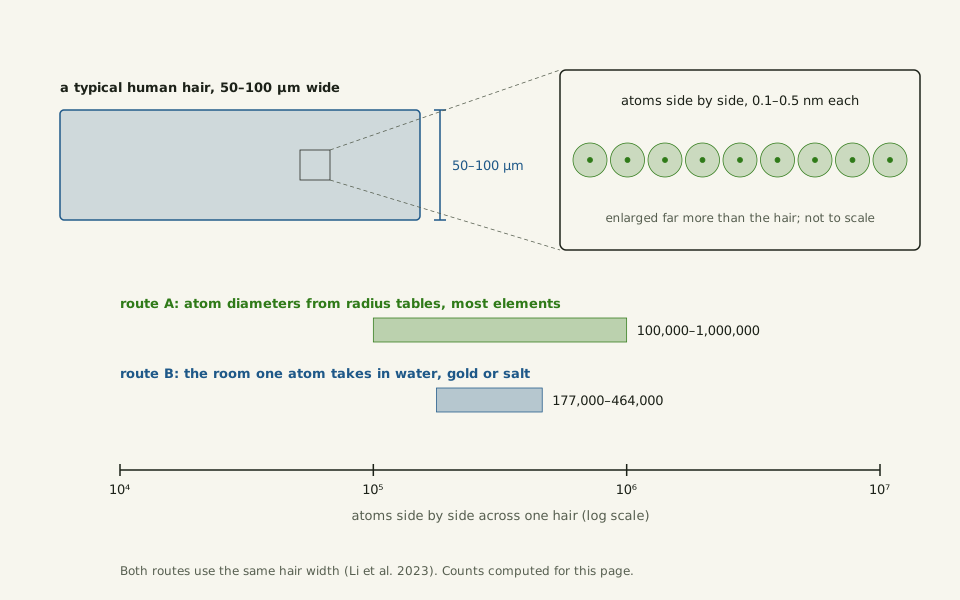
Slide the diagram sideways to read its labels, or open it full size.
A typical hair, 50–100 µm [10−5–10−4 m], counted in atoms: 100,000 to 1,000,000 by the radius tables, 177,000 to 464,000 at the room atoms take up in water, gold and salt.
Drawing not to scale. Data: atom-size-hair-count.csv (sources, version and license, JSON).
"How many atoms fit across a hair" by Ants, Cells & Atoms, https://antscellsandatoms.com/scale/atom-size/ — CC BY 4.0 (https://creativecommons.org/licenses/by/4.0/)
Data sources for this figure
Data: Li C et al. 2023, Journal of Biomedical Optics 28(11):116501, CC BY 4.0, https://doi.org/10.1117/1.JBO.28.11.116501 (human hair, typically 50–100 µm; shared reference-objects.csv; retrieved 2026-10-25); PubChem element records 1–96, Atomic Radius section, PubChem 2025 update, https://doi.org/10.1093/nar/gkae1059 (covalent radii from Cordero B et al. 2008, Dalton Transactions, https://doi.org/10.1039/b801115j; empirical radii from Slater JC 1964, The Journal of Chemical Physics, https://doi.org/10.1063/1.1725697; van der Waals radii from the Los Alamos National Laboratory periodic table; retrieved 2026-10-25); route B room per atom from atom-size-two-routes.csv (gold, salt and water densities with the Avogadro constant); counts computed 2026-10-25 for this page
Data sources for this figure
Data: Li C et al. 2023, Journal of Biomedical Optics 28(11):116501, CC BY 4.0, https://doi.org/10.1117/1.JBO.28.11.116501 (human hair, typically 50–100 µm; shared reference-objects.csv; retrieved 2026-10-25); VanDusen BM, Fegley SR, Peterson CH 2012, PLoS ONE 7(12):e52694, CC BY 4.0, https://doi.org/10.1371/journal.pone.0052694 (sand 63–2000 µm, Udden-Wentworth classes as used in the paper; shared reference-objects.csv; retrieved 2026-10-25); Volkmer B, Heinemann M 2011, PLoS ONE 6(7):e23126, Table 1, CC BY 4.0, https://doi.org/10.1371/journal.pone.0023126 (E. coli mean widths 1.0–1.5 µm across 22 growth conditions; shared cell-sizes.csv; retrieved 2026-10-25); Valli J et al. 2021, Journal of Biological Chemistry 297(1):100791, CC BY 4.0, https://doi.org/10.1016/j.jbc.2021.100791 (lateral limit 170–250 nm for a standard fluorescence system, citing Abbe 1873; shared reference-objects.csv; retrieved 2026-10-25); counts computed 2026-10-25 for this page
The count comes from two routes, both computed for this page. Route A takes atom widths from tables of atomic radii. Route B uses density to work out how much room one atom takes up in a real solid or liquid. Both routes use the same hair width, given as typically 50–100 µm by Li and colleagues in 2023; the atom sizes come from separate sources.
Where is an atom's edge?
Electrons have no sharp outer limit. As Wikipedia's article on atomic radius explains, their positions are spread out as probabilities that fade gradually with distance from the nucleus, so the boundary of an atom is not a well-defined physical thing. Every radius in a table is a choice of where to stop.
Hydrogen, with one electron, shows the problem most simply. In its lowest-energy state the electron's most probable distance from the nucleus is about one Bohr radius, 52.9 pm (CODATA 2022), as Wikipedia's article on the Bohr radius explains. Yet only 32% of the electron's cloud lies inside that radius, computed for this page from the ground-state wavefunction as given by Stamopoulos in 2025. Draw the edge at 120 pm and 83% lies inside; enclosing 99% takes 222 pm.
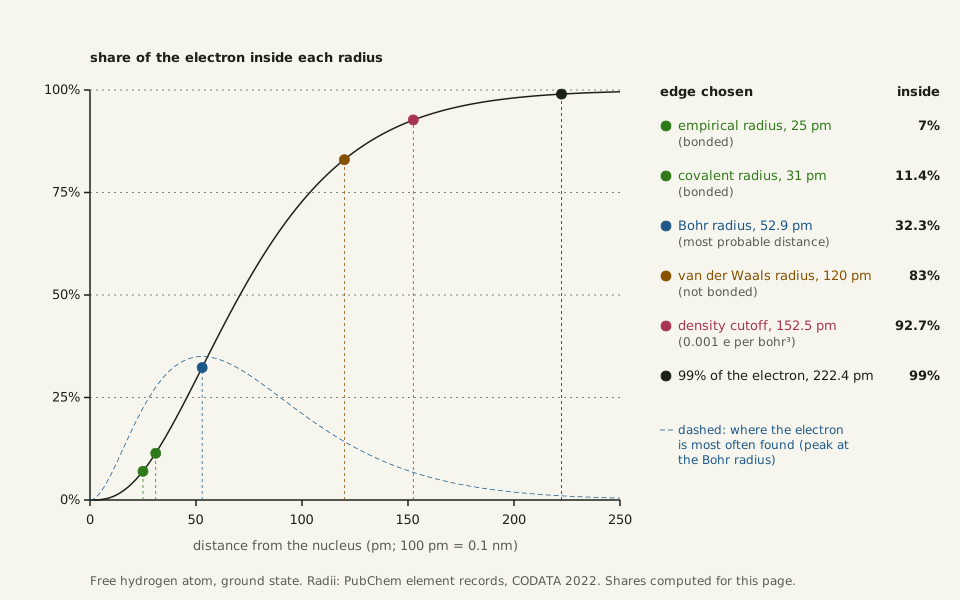
Slide the diagram sideways to read its labels, or open it full size.
A free hydrogen atom, Bohr radius 52.9 pm [10−11 m]: the share of its electron inside each chosen edge, from 7% at 25 pm to 99% at 222 pm.
Data: atom-size-hydrogen-edge.csv (sources, version and license, JSON), computed for this page.
"Where is the edge of a hydrogen atom?" by Ants, Cells & Atoms, https://antscellsandatoms.com/scale/atom-size/ — CC BY 4.0 (https://creativecommons.org/licenses/by/4.0/)
Data sources for this figure
Data: CODATA 2022, Bohr radius 5.29177210544e-11 m, https://physics.nist.gov/cgi-bin/cuu/Value?bohrrada0 (retrieved 2026-10-25); hydrogen radii (covalent 31 pm, empirical 25 pm, van der Waals 120 pm) from PubChem element record 1 (Hydrogen), PubChem 2025 update, https://doi.org/10.1093/nar/gkae1059 (retrieved 2026-10-25); the van der Waals value is Bondi's, Bondi A 1964, The Journal of Physical Chemistry 68(3):441–451, https://doi.org/10.1021/j100785a001 (bibliographic record; as tabulated in Wikipedia, Van der Waals radius, read 2026-10-25); density cutoff of 0.001 electrons per cubic bohr as used by Rahm M, Hoffmann R, Ashcroft NW 2016, Chemistry – A European Journal 22(41):14625–14632, https://doi.org/10.1002/chem.201602949 (abstract; retrieved 2026-10-25); shares of the electron computed 2026-10-25 for this page from the hydrogen ground-state wavefunction as given in Stamopoulos D 2025, Materials 18(10):2344, CC BY 4.0, https://doi.org/10.3390/ma18102344 (relation 46; retrieved 2026-10-25)
Data sources for this figure
Data: CODATA 2022, Bohr radius 5.29177210544e-11 m, https://physics.nist.gov/cgi-bin/cuu/Value?bohrrada0 (retrieved 2026-10-25); hydrogen radii from PubChem element record 1 (Hydrogen), PubChem 2025 update, https://doi.org/10.1093/nar/gkae1059 (retrieved 2026-10-25); the van der Waals value is Bondi's, Bondi A 1964, The Journal of Physical Chemistry 68(3):441–451, https://doi.org/10.1021/j100785a001 (bibliographic record; as tabulated in Wikipedia, Van der Waals radius, read 2026-10-25); density cutoff as used by Rahm M, Hoffmann R, Ashcroft NW 2016, Chemistry – A European Journal 22(41):14625–14632, https://doi.org/10.1002/chem.201602949 (abstract; retrieved 2026-10-25); shares computed 2026-10-25 for this page from the hydrogen ground-state wavefunction as given in Stamopoulos D 2025, Materials 18(10):2344, CC BY 4.0, https://doi.org/10.3390/ma18102344 (relation 46; retrieved 2026-10-25)
Tables pick their edges for different jobs. PubChem's element records give hydrogen a covalent radius of 31 pm and an empirical radius of 25 pm, both taken from bonded atoms, whose electron clouds overlap; around a free atom they hold only 11% and 7% of the cloud. A computed scale draws the edge far out. Rahm, Hoffmann and Ashcroft took each atom's radius as the average distance at which its electron density falls to 0.001 electrons per cubic bohr, a cube one Bohr radius on a side, for elements 1 to 96 (abstract).
Applied to free hydrogen, that cutoff gives 152.5 pm, with 92.7% of the electron inside, computed for this page. So one hydrogen atom can be given a radius anywhere from 25 to 153 pm, a sixfold spread.
Same atom, different radii
A covalent radius is a share of a bond. Two covalent radii add up to the length of the bond between two atoms. Cordero and colleagues deduced a set for most elements up to atomic number 96 from crystal structures, interpolating a few, among them the noble gases (abstract). Slater's empirical radii of 1964 work the same way; they matched over 1,200 measured bonds with an average deviation of about 0.12 Å (abstract).
A van der Waals radius is larger: it marks how close another atom can come when the two are not bonded, by Wikipedia's definition. Bondi's 1964 values, from molecular crystals and gases, covered only 28 of the 44 main-group elements, Mantina and colleagues write (abstract); in 2009 they computed the other 16 to fit his scale. PubChem's records list van der Waals radii for 96 elements: 26 match Bondi's values as Wikipedia tabulates them, 16 are Mantina's, and the origin of the other 54 is not stated.
Give each atom of a molecule a ball this size and bonded atoms overlap, Wikipedia notes. Ball-and-stick models shrink the balls and add rods, suggesting gaps that are not there: what this site calls the stick fiction.
Ionic radii split the distance between neighbouring ions in a crystal such as sodium chloride. X-ray crystallography gives that distance but not where one ion ends, Wikipedia's article on ionic radius notes, so the tables have to choose. In Shannon's 1976 tables, as Wikipedia lists them, one set splits the gap between sodium and chloride as 102 and 181 pm, another as 116 and 167 pm.
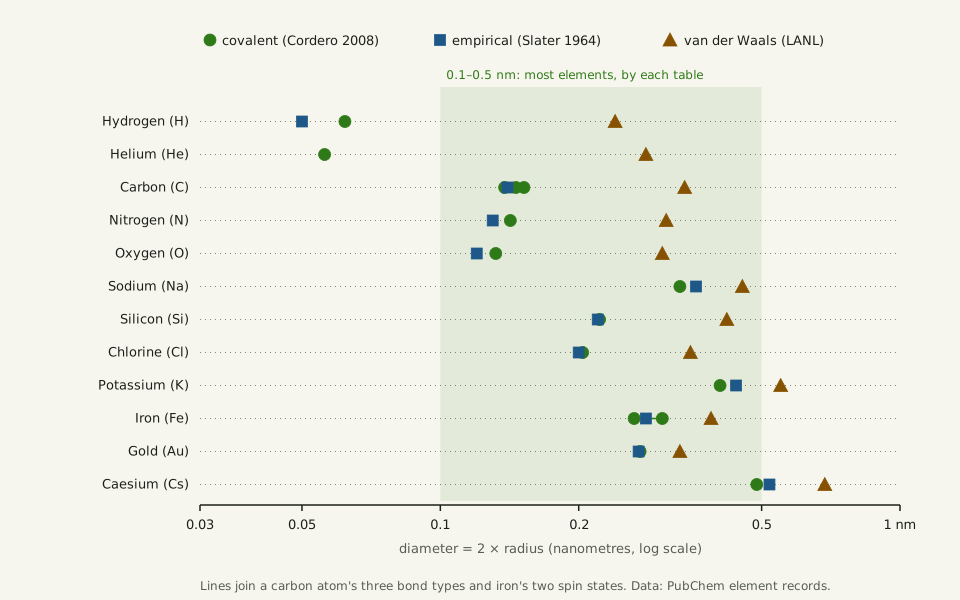
Slide the diagram sideways to read its labels, or open it full size.
Twelve atoms by three radius tables, 0.05–0.69 nm across [10−11–10−10 m]; the band marks 0.1–0.5 nm, where most elements fall by each table.
Data: atom-size-atomic-radii.csv (sources, version and license, JSON) (284 values for elements 1–96) and atom-size-diameter-summary.csv (sources, version and license, JSON).
"Same atom, different radii: twelve atoms by three radius tables" by Ants, Cells & Atoms, https://antscellsandatoms.com/scale/atom-size/ — CC BY 4.0 (https://creativecommons.org/licenses/by/4.0/)
Data sources for this figure
Data: PubChem element records 1–96, Atomic Radius section, PubChem 2025 update, https://doi.org/10.1093/nar/gkae1059 (covalent radii from Cordero B et al. 2008, Dalton Transactions, https://doi.org/10.1039/b801115j; empirical radii from Slater JC 1964, The Journal of Chemical Physics, https://doi.org/10.1063/1.1725697; van der Waals radii from the Los Alamos National Laboratory periodic table; retrieved 2026-10-25); van der Waals radii in the figure: hydrogen, carbon, nitrogen, oxygen, sodium, silicon, chlorine, potassium and gold equal Bondi's 1964 values, Bondi A 1964, The Journal of Physical Chemistry 68(3):441–451, https://doi.org/10.1021/j100785a001 (bibliographic record; as tabulated in Wikipedia, Van der Waals radius, read 2026-10-25); caesium equals the value Mantina M et al. 2009 computed, The Journal of Physical Chemistry A 113(19):5806–5812, https://doi.org/10.1021/jp8111556 (abstract); helium and iron have no stated origin; diameters and the 0.1–0.5 nm counts computed 2026-10-25 for this page
Data sources for this figure
Data: PubChem element records 1–96, Atomic Radius section, PubChem 2025 update, https://doi.org/10.1093/nar/gkae1059 (covalent radii from Cordero B et al. 2008, Dalton Transactions, https://doi.org/10.1039/b801115j; empirical radii from Slater JC 1964, The Journal of Chemical Physics, https://doi.org/10.1063/1.1725697; van der Waals radii from the Los Alamos National Laboratory periodic table; retrieved 2026-10-25); van der Waals radii of 16 elements equal the values Mantina M et al. 2009 computed, The Journal of Physical Chemistry A 113(19):5806–5812, https://doi.org/10.1021/jp8111556 (abstract; retrieved 2026-10-25); van der Waals radii of 26 elements equal the values of Bondi A 1964, The Journal of Physical Chemistry 68(3):441–451, https://doi.org/10.1021/j100785a001 (bibliographic record; values as tabulated for Bondi in Wikipedia, Van der Waals radius, read 2026-10-25); the origin of the other 54 is not stated in the records; diameters computed 2026-10-25 for this page
Data: PubChem element records 1–96, Atomic Radius section, PubChem 2025 update, https://doi.org/10.1093/nar/gkae1059 (covalent radii from Cordero B et al. 2008, Dalton Transactions, https://doi.org/10.1039/b801115j; empirical radii from Slater JC 1964, The Journal of Chemical Physics, https://doi.org/10.1063/1.1725697; van der Waals radii from the Los Alamos National Laboratory periodic table; retrieved 2026-10-25); counts computed 2026-10-25 for this page
| Atom | Covalent radius | Empirical radius | Van der Waals radius |
|---|---|---|---|
| hydrogen | 31 pm | 25 pm | 120 pm |
| helium | 28 pm | not listed | 140 pm |
| carbon | 69–76 pm, by bond type | 70 pm | 170 pm |
| oxygen | 66 pm | 60 pm | 152 pm |
| sodium | 166 pm | 180 pm | 227 pm |
| gold | 136 pm | 135 pm | 166 pm |
| caesium | 244 pm | 260 pm | 343 pm (computed) |
The smallest atom depends on the table. In the same PubChem records, helium's covalent radius, 28 pm, is smaller than hydrogen's 31 pm; by van der Waals radius, hydrogen, at 120 pm, is smaller than helium, at 140 pm. Doubled into diameters, 0.1–0.5 nm holds 93 of the 96 elements by covalent radius, 85 of 87 by empirical radius and 89 of 96 by van der Waals radius, computed for this page.
How many atoms fit across a hair?
Dividing a width by one atom's width gives the number of atoms that would fit across it side by side. With atoms of 0.1–0.5 nm, a typical 50–100 µm hair holds 100,000 to 1,000,000, computed for this page. The low end pairs the thinnest hair with the widest atoms; the high end pairs the thickest hair with the narrowest.
A sand grain is 63 µm to 2 mm across on the grain-size scale VanDusen and colleagues used in 2012. That width spans 126,000 to 20 million atoms. Cultured Escherichia coli cells averaged 1.0–1.5 µm wide across 22 growth conditions (Volkmer and Heinemann 2011), or 2,000 to 15,000 atoms. Cells cover a much wider range of sizes, as the page on how big a cell can be shows.
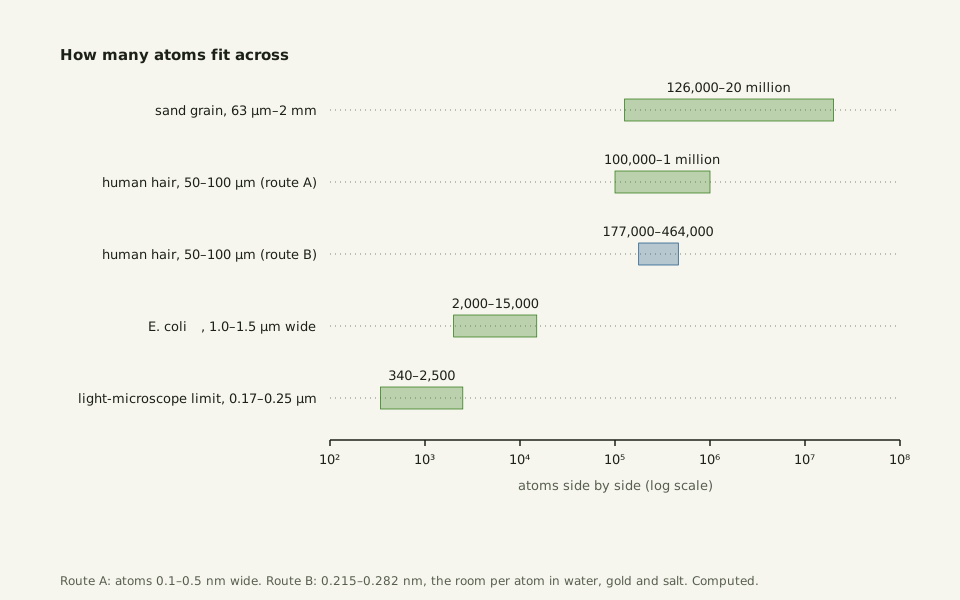
Slide the diagram sideways to read its labels, or open it full size.
Familiar widths from 0.17 µm to 2 mm [10−7–10−3 m], counted in atoms of 0.1–0.5 nm: 340 across a light microscope's finest detail, 20 million across a coarse sand grain.
Data: atom-size-hair-count.csv (sources, version and license, JSON), computed for this page.
"Atoms across familiar widths" by Ants, Cells & Atoms, https://antscellsandatoms.com/scale/atom-size/ — CC BY 4.0 (https://creativecommons.org/licenses/by/4.0/)
Data sources for this figure
Data: Li C et al. 2023, Journal of Biomedical Optics 28(11):116501, CC BY 4.0, https://doi.org/10.1117/1.JBO.28.11.116501 (human hair, typically 50–100 µm; shared reference-objects.csv; retrieved 2026-10-25); VanDusen BM, Fegley SR, Peterson CH 2012, PLoS ONE 7(12):e52694, CC BY 4.0, https://doi.org/10.1371/journal.pone.0052694 (sand 63–2000 µm, Udden-Wentworth classes as used in the paper; shared reference-objects.csv; retrieved 2026-10-25); Volkmer B, Heinemann M 2011, PLoS ONE 6(7):e23126, Table 1, CC BY 4.0, https://doi.org/10.1371/journal.pone.0023126 (E. coli mean widths 1.0–1.5 µm across 22 growth conditions; shared cell-sizes.csv; retrieved 2026-10-25); Valli J et al. 2021, Journal of Biological Chemistry 297(1):100791, CC BY 4.0, https://doi.org/10.1016/j.jbc.2021.100791 (lateral limit 170–250 nm for a standard fluorescence system, citing Abbe 1873; shared reference-objects.csv; retrieved 2026-10-25); counts computed 2026-10-25 for this page
At the scale of molecules the counts get short. One turn of the DNA double helix runs about 3.3–3.4 nm along its axis, computed from the coordinates of the PDB 1BNA crystal and the 9.8 base pairs per turn that Drew and colleagues report for its centre (1981, abstract): about 7 to 34 atoms of 0.1–0.5 nm laid end to end, computed for this page.
A second route: weigh the atoms
Route B skips the radius tables. Divide the mass of one mole of a substance by its density and by the Avogadro constant, the number of particles in a mole, exactly 6.02214076 × 10²³ per mole (CODATA 2022). The result is the volume each particle takes up; for a compound, divide again by the atoms or ions in one particle. The side of a cube with that volume is one atom's share of a row.
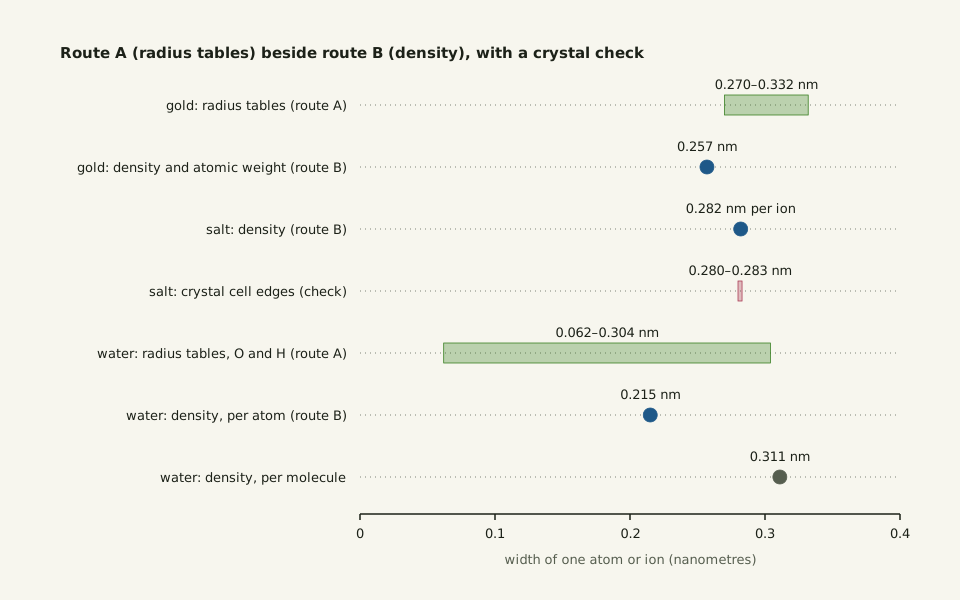
Gold has a standard atomic weight of 196.96657 and a density of 19.282 g/cm3, as its PubChem record lists them. That gives 16.96 Å3 per atom, a cube 0.257 nm on a side, computed for this page: 5–23% below gold's three tabulated diameters of 0.270–0.332 nm.
Liquid water at 25 °C has a density of 997.05 kg/m3 (IAPWS-95), so each molecule of water gets 30.00 Å3, a cube 0.311 nm wide, or 0.215 nm per atom, computed for this page. That figure falls inside the 0.062–0.304 nm span the covalent and van der Waals tables give hydrogen and oxygen.
Slide the diagram sideways to read its labels, or open it full size.
Route A beside route B: one atom's width in gold, salt and water, 0.06–0.33 nm [10−11–10−10 m], from radius tables, from density, and for salt from crystal cells.
Data: atom-size-two-routes.csv (sources, version and license, JSON), computed for this page.
"Two routes to the width of an atom: radius tables and density" by Ants, Cells & Atoms, https://antscellsandatoms.com/scale/atom-size/ — CC BY 4.0 (https://creativecommons.org/licenses/by/4.0/)
Data sources for this figure
Data: PubChem element records 1–96, Atomic Radius section, PubChem 2025 update, https://doi.org/10.1093/nar/gkae1059 (covalent radii from Cordero B et al. 2008, Dalton Transactions, https://doi.org/10.1039/b801115j; empirical radii from Slater JC 1964, The Journal of Chemical Physics, https://doi.org/10.1063/1.1725697; van der Waals radii from the Los Alamos National Laboratory periodic table; retrieved 2026-10-25); PubChem element record 79 (Gold), PubChem 2025 update, https://doi.org/10.1093/nar/gkae1059: density 19.282 g/cm3 (credited to Jefferson Lab; no temperature given) and standard atomic weight 196.966570(4) (IUPAC Commission on Isotopic Abundances and Atomic Weights), retrieved 2026-10-25; gold's van der Waals radius, 166 pm, equals Bondi's 1964 value, Bondi A 1964, The Journal of Physical Chemistry 68(3):441–451, https://doi.org/10.1021/j100785a001 (bibliographic record; as tabulated in Wikipedia, Van der Waals radius, read 2026-10-25); PubChem CID 5234 (sodium chloride): density 2.17 at 25 °C/4 °C, relative to water at 4 °C (CRC Handbook of Chemistry and Physics, 94th edition, via the Hazardous Substances Data Bank), formula weight 58.44 g/mol (computed by PubChem), rock-salt cell edges 5.6035, 5.6393 and 5.6635 Å from Crystallography Open Database records 2108652, 4300180 and 4320809 (CC0); retrieved 2026-10-25; water density 997.05 kg/m3 at 25 °C and 999.97 kg/m3 at 4 °C, IAPWS R6-95(2018), https://iapws.org/technical-guidance/release/IAPWS-95 (shared water-properties.csv); molecular weight 18.015 g/mol, PubChem CID 962 (computed by PubChem); retrieved 2026-10-25; CODATA 2022, Avogadro constant 6.02214076e23 per mole (exact), https://physics.nist.gov/cgi-bin/cuu/Value?na (retrieved 2026-10-25); volumes and widths computed 2026-10-25 for this page
Salt allows a check. A density of 2.17 g/cm3, from the CRC Handbook as PubChem lists it, gives each ion of sodium chloride 22.36 Å3, a cube 0.282 nm wide. Three crystal records give cubic cells 5.6035–5.6635 Å on a side, each holding eight ions, so each ion's cube is 0.280–0.283 nm: within 1% of the density route, computed for this page.
Route B leans on the Avogadro constant, once a measured quantity. By Wikipedia's account, Jean Perrin, who named Avogadro's number in 1909, measured it by several methods and won the 1926 Nobel Prize in Physics largely for that work. His 1909 paper, Mouvement brownien et réalité moléculaire, names in its title the Brownian motion explained on another page.
Can you see an atom?
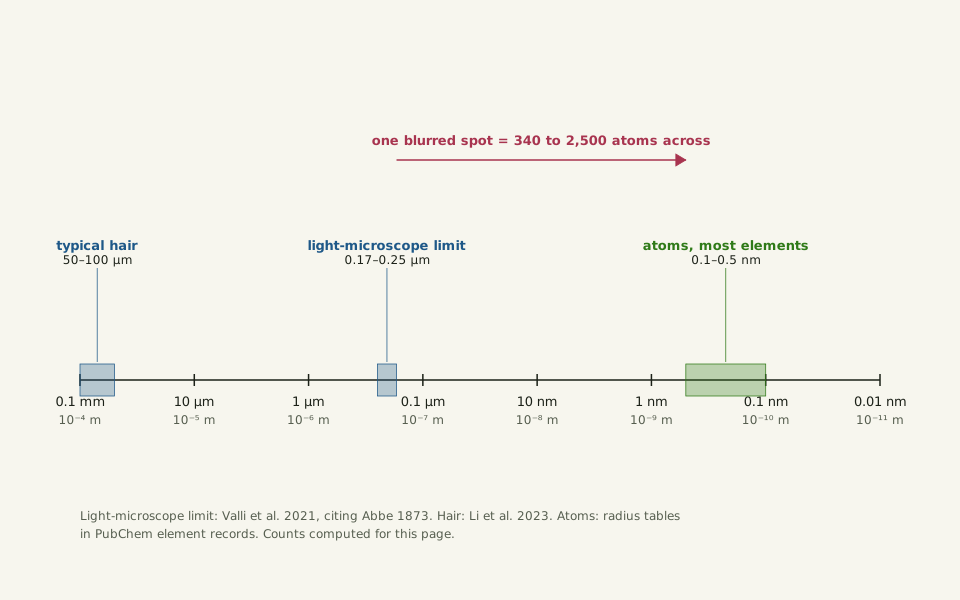
Not with an ordinary light microscope. A standard fluorescence microscope can separate details no finer than about 170–250 nm, according to a 2021 methods review by Valli and colleagues, citing Abbe's 1873 limit. One blurred spot that size spans 340 to 2,500 atoms of 0.1–0.5 nm, computed for this page.
Slide the diagram sideways to read its labels, or open it full size.
A light microscope's finest detail, 0.17–0.25 µm [10−7 m], beside atoms of 0.1–0.5 nm: one blurred spot spans 340 to 2,500 atoms.
Data: atom-size-hair-count.csv (sources, version and license, JSON); light-microscope limit from the shared reference-objects.csv.
"Why a light microscope cannot show an atom" by Ants, Cells & Atoms, https://antscellsandatoms.com/scale/atom-size/ — CC BY 4.0 (https://creativecommons.org/licenses/by/4.0/)
Data sources for this figure
Data: Valli J et al. 2021, Journal of Biological Chemistry 297(1):100791, CC BY 4.0, https://doi.org/10.1016/j.jbc.2021.100791 (lateral limit 170–250 nm for a standard fluorescence system, citing Abbe 1873; shared reference-objects.csv; retrieved 2026-10-25); Li C et al. 2023, Journal of Biomedical Optics 28(11):116501, CC BY 4.0, https://doi.org/10.1117/1.JBO.28.11.116501 (human hair, typically 50–100 µm; shared reference-objects.csv; retrieved 2026-10-25); atoms 0.1–0.5 nm from atom-size-diameter-summary.csv; counts computed 2026-10-25 for this page
Data sources for this figure
Data: Li C et al. 2023, Journal of Biomedical Optics 28(11):116501, CC BY 4.0, https://doi.org/10.1117/1.JBO.28.11.116501 (human hair, typically 50–100 µm; shared reference-objects.csv; retrieved 2026-10-25); VanDusen BM, Fegley SR, Peterson CH 2012, PLoS ONE 7(12):e52694, CC BY 4.0, https://doi.org/10.1371/journal.pone.0052694 (sand 63–2000 µm, Udden-Wentworth classes as used in the paper; shared reference-objects.csv; retrieved 2026-10-25); Volkmer B, Heinemann M 2011, PLoS ONE 6(7):e23126, Table 1, CC BY 4.0, https://doi.org/10.1371/journal.pone.0023126 (E. coli mean widths 1.0–1.5 µm across 22 growth conditions; shared cell-sizes.csv; retrieved 2026-10-25); Valli J et al. 2021, Journal of Biological Chemistry 297(1):100791, CC BY 4.0, https://doi.org/10.1016/j.jbc.2021.100791 (lateral limit 170–250 nm for a standard fluorescence system, citing Abbe 1873; shared reference-objects.csv; retrieved 2026-10-25); counts computed 2026-10-25 for this page
A scanning tunnelling microscope uses no light. A sharp conducting tip is held 0.4–0.7 nm above a surface while electrons tunnel across the gap, and the current falls about tenfold for every 0.1 nm of extra distance. The microscope can tell apart features smaller than 0.1 nm, by Wikipedia's account, so single atoms can be imaged. Its development in 1981, at IBM Zürich, earned Gerd Binnig and Heinrich Rohrer the 1986 Nobel Prize in Physics.
Each point of the scan records one value, so the pictures start out grey, and any color is added in processing, Wikipedia notes. That makes the color in every such picture of atoms borrowed color: it belongs to the image, not to the atoms.
How big is the nucleus?
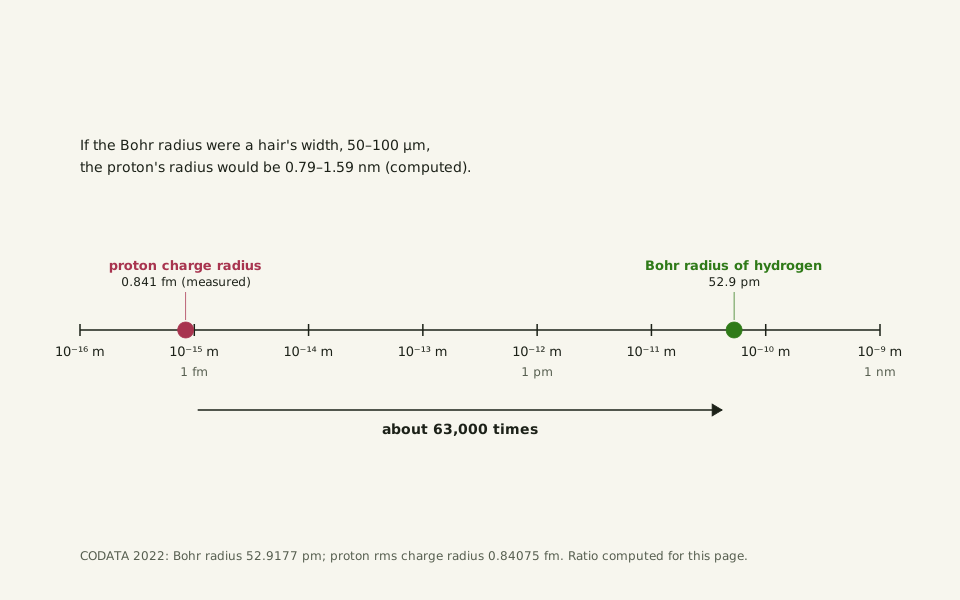
Ordinary hydrogen's nucleus is a single proton, with a charge radius of 0.841 fm, measured (CODATA 2022). Hydrogen's Bohr radius, 52.9 pm, is about 63,000 times larger, computed for this page. For atoms in general, Wikipedia's article on atomic radius gives radii more than 10,000 times those of their nuclei.
Slide the diagram sideways to read its labels, or open it full size.
A hydrogen atom and its nucleus: Bohr radius 52.9 pm [10−11 m], proton charge radius 0.841 fm [10−16 m], about 63,000 times smaller.
Values: CODATA 2022; ratio computed for this page.
"The hydrogen atom and its nucleus" by Ants, Cells & Atoms, https://antscellsandatoms.com/scale/atom-size/ — CC BY 4.0 (https://creativecommons.org/licenses/by/4.0/)
Data: CODATA 2022, Bohr radius 5.29177210544e-11 m, https://physics.nist.gov/cgi-bin/cuu/Value?bohrrada0 (retrieved 2026-10-25); CODATA 2022, proton rms charge radius 8.4075(64)e-16 m, https://physics.nist.gov/cgi-bin/cuu/Value?rp (retrieved 2026-10-25); ratio and scaled sizes computed 2026-10-25 for this page
Stretch hydrogen until its Bohr radius matches a hair's 50–100 µm, and the proton's radius would grow to only 0.79–1.59 nm, computed for this page. The proton would then be 1.6–3.2 nm across, about five to ten times the 0.311 nm cube a water molecule takes up in the liquid.
The proton's radius is known to within 0.00064 fm, under 0.1%, by CODATA's 2022 figure. The atom around it still has no agreed edge: the edges drawn for hydrogen on this page run from 25 to 222 pm.
Sources
- Li C, Du Y, Chen H, Han X, Wu W, Kong X, Zhang C, Yuan X. "Transmission infrared micro-spectroscopic study of individual human hair." Journal of Biomedical Optics 28(11):116501 (2023). https://doi.org/10.1117/1.JBO.28.11.116501 Read: full text. Text license: CC BY 4.0 (https://creativecommons.org/licenses/by/4.0/).
- Wikipedia contributors. "Atomic radius." Wikipedia (read 2026-10-25). https://en.wikipedia.org/wiki/Atomic_radius Read: full text; paraphrased only. Text license: CC BY-SA 4.0 (https://creativecommons.org/licenses/by-sa/4.0/).
- CODATA 2022 recommended values, NIST Standard Reference Database 121. "Bohr radius." https://physics.nist.gov/cgi-bin/cuu/Value?bohrrada0 Read: dataset record.
- Wikipedia contributors. "Bohr radius." Wikipedia (read 2026-10-25). https://en.wikipedia.org/wiki/Bohr_radius Read: full text; paraphrased only. Text license: CC BY-SA 4.0 (https://creativecommons.org/licenses/by-sa/4.0/).
- Wikipedia contributors. "Hydrogen atom." Wikipedia (read 2026-10-25). https://en.wikipedia.org/wiki/Hydrogen_atom Read: full text; paraphrased only. Text license: CC BY-SA 4.0 (https://creativecommons.org/licenses/by-sa/4.0/).
- Stamopoulos D. "Multipole Expansion of the Scalar Potential on the Basis of Spherical Harmonics: Bridging the Gap Between the Inside and Outside Spaces via Solution of the Poisson Equation." Materials 18(10):2344 (2025). https://doi.org/10.3390/ma18102344 Read: full text. Text license: CC BY 4.0 (https://creativecommons.org/licenses/by/4.0/).
- PubChem, element records 1–96, Atomic Radius, National Library of Medicine; covalent and empirical radii contributed by PubChem Elements, van der Waals radii by the Los Alamos National Laboratory periodic table. Database described in Kim S, et al. "PubChem 2025 update." Nucleic Acids Research 53(D1):D1516–D1525 (2025). https://doi.org/10.1093/nar/gkae1059 Read: full text of the Atomic Radius section of each element record.
- Rahm M, Hoffmann R, Ashcroft NW. "Atomic and Ionic Radii of Elements 1–96." Chemistry – A European Journal 22(41):14625–14632 (2016). https://doi.org/10.1002/chem.201602949 Read: abstract.
- Cordero B, Gómez V, Platero-Prats AE, Revés M, Echeverría J, Cremades E, Barragán F, Alvarez S. "Covalent radii revisited." Dalton Transactions (21):2832–2838 (2008). https://doi.org/10.1039/b801115j Read: abstract.
- Slater JC. "Atomic Radii in Crystals." The Journal of Chemical Physics 41(10):3199–3204 (1964). https://doi.org/10.1063/1.1725697 Read: abstract.
- Wikipedia contributors. "Van der Waals radius." Wikipedia (read 2026-10-25). https://en.wikipedia.org/wiki/Van_der_Waals_radius Read: full text; paraphrased only. Text license: CC BY-SA 4.0 (https://creativecommons.org/licenses/by-sa/4.0/).
- Bondi A. "van der Waals Volumes and Radii." The Journal of Physical Chemistry 68(3):441–451 (1964). https://doi.org/10.1021/j100785a001 Read: bibliographic record only.
- Mantina M, Chamberlin AC, Valero R, Cramer CJ, Truhlar DG. "Consistent van der Waals radii for the whole main group." The Journal of Physical Chemistry A 113(19):5806–5812 (2009). https://doi.org/10.1021/jp8111556 Read: abstract.
- Wikipedia contributors. "Ionic radius." Wikipedia (read 2026-10-25). https://en.wikipedia.org/wiki/Ionic_radius Read: full text; paraphrased only. Text license: CC BY-SA 4.0 (https://creativecommons.org/licenses/by-sa/4.0/).
- Shannon RD. "Revised effective ionic radii and systematic studies of interatomic distances in halides and chalcogenides." Acta Crystallographica Section A 32(5):751–767 (1976). https://doi.org/10.1107/S0567739476001551 Read: bibliographic record only.
- VanDusen BM, Fegley SR, Peterson CH. "Prey Distribution, Physical Habitat Features, and Guild Traits Interact to Produce Contrasting Shorebird Assemblages among Foraging Patches." PLoS ONE 7(12):e52694 (2012). https://doi.org/10.1371/journal.pone.0052694 Read: full text. Text license: CC BY 4.0 (https://creativecommons.org/licenses/by/4.0/).
- Volkmer B, Heinemann M. "Condition-Dependent Cell Volume and Concentration of Escherichia coli to Facilitate Data Conversion for Systems Biology Modeling." PLoS ONE 6(7):e23126 (2011). https://doi.org/10.1371/journal.pone.0023126 Read: full text. Text license: CC BY 4.0 (https://creativecommons.org/licenses/by/4.0/).
- Drew HR, Wing RM, Takano T, Broka C, Tanaka S, Itakura K, Dickerson RE. "Structure of a B-DNA dodecamer: conformation and dynamics." RCSB Protein Data Bank entry 1BNA (deposited 1981). https://doi.org/10.2210/pdb1bna/pdb Read: dataset record (atomic coordinates). Text license: CC0 1.0 (https://creativecommons.org/publicdomain/zero/1.0/).
- Drew HR, Wing RM, Takano T, Broka C, Tanaka S, Itakura K, Dickerson RE. "Structure of a B-DNA dodecamer: conformation and dynamics." Proceedings of the National Academy of Sciences of the USA 78(4):2179–2183 (1981). https://doi.org/10.1073/pnas.78.4.2179 Read: abstract.
- CODATA 2022 recommended values, NIST Standard Reference Database 121. "Avogadro constant." https://physics.nist.gov/cgi-bin/cuu/Value?na Read: dataset record.
- PubChem, element record 79 (Gold), Density and Atomic Weight, National Library of Medicine; density contributed by Jefferson Lab, standard atomic weight by the IUPAC Commission on Isotopic Abundances and Atomic Weights. Database described in Kim S, et al. "PubChem 2025 update." Nucleic Acids Research 53(D1):D1516–D1525 (2025). https://doi.org/10.1093/nar/gkae1059 Read: full text of the Density and Atomic Weight sections.
- International Association for the Properties of Water and Steam. IAPWS R6-95(2018), Revised Release on the IAPWS Formulation 1995 for the Thermodynamic Properties of Ordinary Water Substance for General and Scientific Use (2018). https://iapws.org/technical-guidance/release/IAPWS-95 Read: values as computed from the release equations in this site's water-properties table. Text license: IAPWS: publication in whole or in part allowed with attribution (https://iapws.org/technical-guidance/release/IAPWS-95).
- PubChem, compound summary for CID 962 (water), Molecular Weight (computed by PubChem 2.2), National Library of Medicine. Database described in Kim S, et al. "PubChem 2025 update." Nucleic Acids Research 53(D1):D1516–D1525 (2025). https://doi.org/10.1093/nar/gkae1059 Read: full text of the Molecular Weight section.
- PubChem, compound summary for CID 5234 (sodium chloride): Density (Hazardous Substances Data Bank, citing the CRC Handbook of Chemistry and Physics, 94th edition), Molecular Weight (computed by PubChem 2.2) and Crystal Structures (Crystallography Open Database records 2108652, 4300180 and 4320809, CC0), National Library of Medicine. Database described in Kim S, et al. "PubChem 2025 update." Nucleic Acids Research 53(D1):D1516–D1525 (2025). https://doi.org/10.1093/nar/gkae1059 Read: full text of the Density, Molecular Weight and Crystal Structures sections.
- Wikipedia contributors. "Avogadro constant." Wikipedia (read 2026-10-25). https://en.wikipedia.org/wiki/Avogadro_constant Read: full text; paraphrased only. Text license: CC BY-SA 4.0 (https://creativecommons.org/licenses/by-sa/4.0/).
- Valli J, Garcia-Burgos A, Rooney LM, Vale de Melo e Oliveira B, Duncan RR, Rickman C. "Seeing beyond the limit: A guide to choosing the right super-resolution microscopy technique." Journal of Biological Chemistry 297(1):100791 (2021). https://doi.org/10.1016/j.jbc.2021.100791 Read: full text. Text license: CC BY 4.0 (https://creativecommons.org/licenses/by/4.0/).
- Wikipedia contributors. "Scanning tunneling microscope." Wikipedia (read 2026-10-25). https://en.wikipedia.org/wiki/Scanning_tunneling_microscope Read: full text; paraphrased only. Text license: CC BY-SA 4.0 (https://creativecommons.org/licenses/by-sa/4.0/).
- CODATA 2022 recommended values, NIST Standard Reference Database 121. "Proton rms charge radius." https://physics.nist.gov/cgi-bin/cuu/Value?rp Read: dataset record.
Cite this page
Ants, Cells & Atoms. “How Small Is an Atom? For Most Elements, About 0.1–0.5 nm.” Published 2026-10-25. https://antscellsandatoms.com/scale/atom-size/. Accessed (add the date you read it).
No DOI is issued for entries. Figures made here are CC BY 4.0; see each caption for the license of photographs.
Related entries
How Many Cells in the Human Body? About Half Are Bacteria
Image: “E. coli Bacteria (7316101966)” by NIAID (2002) · Public domain
"E. coli Bacteria (7316101966)" by NIAID (2002) — https://commons.wikimedia.org/wiki/File:E._coli_Bacteria_(7316101966).jpg — Public domain (work of a United States federal agency (NIAID, part of NIH), public domain in the United States under 17 U.S.C. §105; Commons tag PD-USGov-NIH-NIAID; Flickr source page credits NIAID with no contractor note; dated 2002-11-14 in the file metadata; no copyright term applies in the EU for a US government work released as public domain by its author agency (used as the source's explicit PD mark))

Reynolds Number: Why a Bacterium Can't Coast and a Fish Can
Image: “Oczlik (Cyclops) - samica” by Mikron86 (2025) · CC BY 4.0
"Oczlik (Cyclops) - samica" by Mikron86 — https://commons.wikimedia.org/wiki/File:Oczlik_(Cyclops)_-_samica.jpg — CC BY 4.0 (https://creativecommons.org/licenses/by/4.0/)

How Big Is a Cell? Most Are a Hair's Width or Far Narrower
Image: “SEM blood cells” by Bruce Wetzel and Harry Schaefer, National Cancer Institute (1982) · Public domain
"SEM blood cells" by Bruce Wetzel and Harry Schaefer, National Cancer Institute (1982) — https://commons.wikimedia.org/wiki/File:SEM_blood_cells.jpg — Public domain (work of United States federal employees at the National Cancer Institute (NIH), public domain in the United States under 17 U.S.C. §105; Commons tag PD-USGov; the NCI Visuals Online source states that all images are in the public domain and may be reproduced without permission, with credit to the listed source or author; dated February 1982; used in the EU on the source's explicit public-domain statement)
