Brownian Motion: Why a 1 µm Bead in Water Never Sits Still

Slide the ladder sideways to read its labels, or open it full size.
Brownian particles, from a 1 µm bead to Brown's specks, up to about 6 µm long as measured in 2010 [10−6 m], between the naked-eye and light-microscope lines.
Log scale from 10 cm to 0.1 nm, each rung ten times smaller (How to read the Zoom ladder). Blue mark: a Clarkia pollen grain, about 100 µm. Amber band: the syrup line for swimmers in water at 20 °C moving 1–10 body lengths per second, 0.32–1.0 mm.
"Zoom ladder: Brownian particles" by Ants, Cells & Atoms, https://antscellsandatoms.com/scale/brownian-motion/ — CC BY 4.0 (https://creativecommons.org/licenses/by/4.0/)
Data sources for this figure
Data: Particle sizes: Pearle P, Collett B, Bart K, Bilderback D, Newman D, Samuels S 2010, American Journal of Physics 78:1278 (preprint arXiv:1008.0039), https://doi.org/10.1119/1.3475685: Clarkia pollen about 100 µm across, amyloplast and spherosome sizes, the rough 0.2 µm visibility estimate at 370 times; read 2026-10-25; Syrup line band, water at 20 °C, 1–10 body lengths per second: shared file the-syrup-line-bands.csv (IAPWS R6-95(2018) density and IAPWS R12-08 viscosity, attribution to the International Association for the Properties of Water and Steam), computed 2026-10-24

Clarkia pulchella in flower; Brown's specks came from its pollen grains, each about 100 µm across [10−4 m] (Pearle et al. 2010).
Color: native (outdoor photograph; no dye)
"Clarkia pulchella Boise County USA" by Matt Berger — https://commons.wikimedia.org/wiki/File:Clarkia_pulchella_Boise_County_USA.jpg — CC BY 4.0 (https://creativecommons.org/licenses/by/4.0/)

What did Brown see inside Clarkia pollen?
Brown was studying how pollen works, not hunting for motion. In June 1827 he examined pollen of Clarkia pulchella (he spelled it Clarckia) through a single lens with a focal length of about 1/32 inch. The grains, he wrote, were filled with oblong particles.
In the 1866 reprint of his paper he gives their length as nearly 1/4000 to about 1/5000 of an inch, 5.1–6.4 µm (computed for this page). Pearle and colleagues, quoting the 1828 text, give 1/4000 to about 1/3000 of an inch, 6.4–8.5 µm (computed for this page).
"While examining the form of these particles immersed in water, I observed many of them very evidently in motion." (Robert Brown, 1828; 1866 reprint)
He ruled out currents in the fluid and evaporation, and at first took the motion to belong to the particles themselves. Then he found the same jiggle in pollen from herbarium sheets a century old, in bruised plant tissue, in crushed window glass and rock, and in "a fragment of the Sphinx". In an addendum the next year, Pearle and colleagues note, he rejected the notion that the moving particles were alive.
Pearle and colleagues repeated the work in 2010 with a modern microscope and a homemade single-lens one. The oblong particles were amyloplasts, they write, starch-storing bodies that measured about 4 µm long on average and up to about 6 µm under the modern microscope. The smaller round ones were spherosomes, fat droplets they estimate at about 1 µm across or less. Brown never said how the specks left the grains; pollen grains placed in water often burst and stream out their contents, they add.
Statements that Brown saw the pollen itself move are common, Pearle and colleagues observe, and they stress that he did not. Nor did he first see the specks moving inside the Clarkia grains, though he later saw motion inside the clearer grains of grasses and other plants.
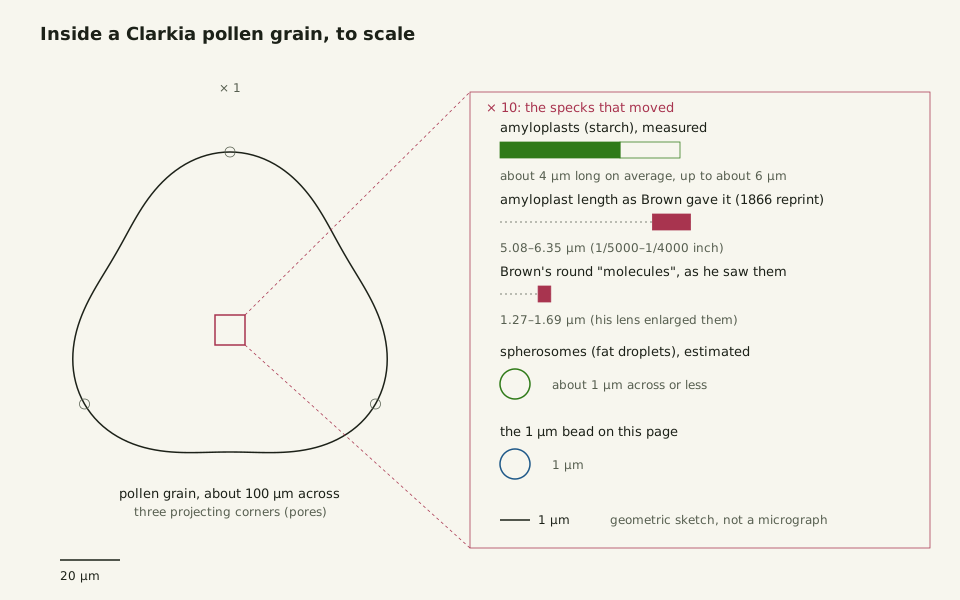
Slide the diagram sideways to read its labels, or open it full size.
A Clarkia pollen grain, about 100 µm across [10−4 m], and the 1–6 µm specks it held, drawn ten times larger on the right; a geometric sketch from Brown's text and Pearle et al. 2010.
"Inside a Clarkia pollen grain, to scale" by Ants, Cells & Atoms, https://antscellsandatoms.com/scale/brownian-motion/ — CC BY 4.0 (https://creativecommons.org/licenses/by/4.0/)
Data sources for this figure
Data: Brown R 1828, Philosophical Magazine 4:161–173, https://doi.org/10.1080/14786442808674769, as reprinted in Bennett JJ (ed.) 1866, The Miscellaneous Botanical Works of Robert Brown, vol. 1 (public domain): particle lengths 1/4000–1/5000 inch and molecule diameters 1/15,000–1/20,000 inch; read 2026-10-25; Pearle P, Collett B, Bart K, Bilderback D, Newman D, Samuels S 2010, American Journal of Physics 78:1278 (preprint arXiv:1008.0039), https://doi.org/10.1119/1.3475685: Clarkia pollen about 100 µm across, amyloplast and spherosome sizes, the rough 0.2 µm visibility estimate at 370 times; read 2026-10-25
Why didn't the 100 µm pollen grains jiggle?
Size decides how much the jiggle shows. A Clarkia pollen grain is about 100 µm across, about as wide as a human hair, which is typically 50–100 µm (Li and colleagues, 2023). Treated as a sphere of that size in water at 20 °C, it spreads only about 0.09 µm along one axis in a second, computed for this page. An amyloplast, treated as a sphere 4 µm across, manages about 0.46 µm, and the 1 µm bead about 0.93 µm.
Pearle and colleagues give a rough test of what Brown could see. The eye cannot separate points less than about 1 arcminute apart, which is 73 µm at 25 cm. Through a lens magnifying 370 times, the power Brown noted in his records, that shrinks to about 0.2 µm. By that estimate the specks visibly moved within a second, and the grain did not.
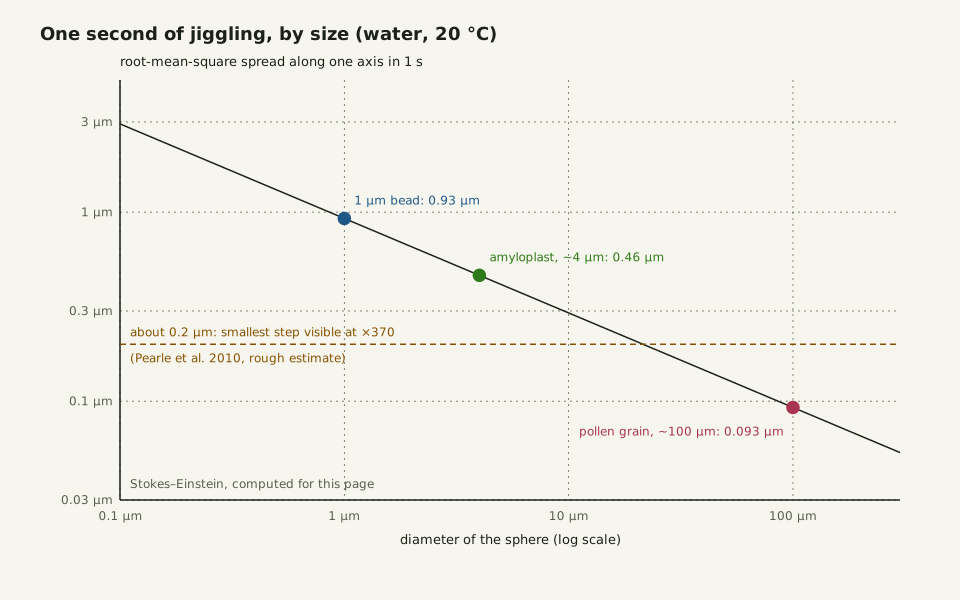
Slide the diagram sideways to read its labels, or open it full size.
One second of Brownian spread for spheres 0.1–300 µm across [10−7–10−4 m] in water at 20 °C, computed for this page; the amber line is Pearle and colleagues' rough 0.2 µm limit at 370 times. Data: brownian-motion-displacement.csv (sources, version and license, JSON).
"One second of Brownian spread, by size, in water at 20 °C" by Ants, Cells & Atoms, https://antscellsandatoms.com/scale/brownian-motion/ — CC BY 4.0 (https://creativecommons.org/licenses/by/4.0/)
Data sources for this figure
Data: CODATA 2022 recommended values, NIST Standard Reference Database 121: Boltzmann constant 1.380649e-23 J/K (exact), https://physics.nist.gov/cgi-bin/cuu/Value?k, retrieved 2026-10-25; Viscosity of liquid water at 20 °C, 1.0016 mPa·s: International Association for the Properties of Water and Steam, IAPWS R12-08 (2008), https://iapws.org/technical-guidance/release/viscosity; value computed 2026-10-24 (shared file water-properties.csv); Pearle P, Collett B, Bart K, Bilderback D, Newman D, Samuels S 2010, American Journal of Physics 78:1278 (preprint arXiv:1008.0039), https://doi.org/10.1119/1.3475685: Clarkia pollen about 100 µm across, amyloplast and spherosome sizes, the rough 0.2 µm visibility estimate at 370 times; read 2026-10-25
Data sources for this figure
Data: CODATA 2022 recommended values, NIST Standard Reference Database 121: Boltzmann constant 1.380649e-23 J/K (exact), https://physics.nist.gov/cgi-bin/cuu/Value?k, retrieved 2026-10-25; Viscosity of liquid water at 20 °C, 1.0016 mPa·s: International Association for the Properties of Water and Steam, IAPWS R12-08 (2008), https://iapws.org/technical-guidance/release/viscosity; value computed 2026-10-24 (shared file water-properties.csv); Lauga E, Powers TR 2009, Reports on Progress in Physics 72:096601 (preprint arXiv:0812.2887), https://doi.org/10.1088/0034-4885/72/9/096601: diffusion constant of a non-motile E. coli about 0.1 µm²/s; read 2026-10-25; Pearle P, Collett B, Bart K, Bilderback D, Newman D, Samuels S 2010, American Journal of Physics 78:1278 (preprint arXiv:1008.0039), https://doi.org/10.1119/1.3475685: Clarkia pollen about 100 µm across, amyloplast and spherosome sizes, the rough 0.2 µm visibility estimate at 370 times; read 2026-10-25; Perrin J 1913, Les Atomes (Paris: Félix Alcan), chapter IV, public domain (author died 1942), https://fr.wikisource.org/wiki/Les_Atomes/IV: mean square spread 2Dt; 500 displacements of grains 0.367 µm in radius, e = 7.84 µm in 30 s; viscosity 0.01 poise and N = 68.8e22 for series VII; read 2026-10-25; Picoplankton class limits 0.2–2 µm: Hirata T et al. 2011, Biogeosciences 8:311, CC BY 3.0, https://doi.org/10.5194/bg-8-311-2011, restating Sieburth, Smetacek & Lenz 1978 (shared file plankton-size-classes.csv), retrieved 2026-10-24
The spread falls as one over the square root of the diameter, so a sphere 100 times wider spreads 10 times less in the same second. What the sphere is made of does not matter. Perrin wrote in 1913 that, by the observations of Jevons, Ramsay and Gouy, two grains of the same size jiggle alike in the same fluid, whatever their substance or density.
Picoplankton, the smallest size class on the plankton page, are 0.2–2 µm across by the class limits Hirata and colleagues restate (2011). A sphere at the small end spreads about 2.1 µm in a second, ten times its own width; one at the large end, about 0.66 µm. How Big Is a Cell? maps where these sizes sit among cells.
What keeps a 1 µm bead moving?
Water looks still only because its motion is far too small to see. Perrin called that rest an illusion: underneath is a permanent state of violent, disordered agitation. A grain in the fluid is struck without pause by the molecules around it, and in general those pushes do not cancel exactly, so the grain is knocked about at random. The molecules doing the pelting are the ones described on Water Molecule.
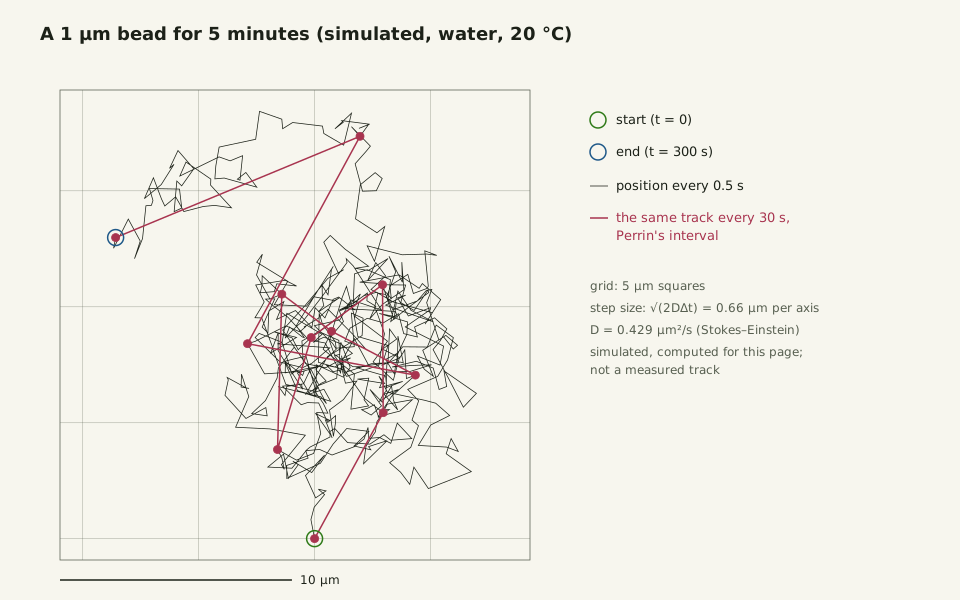
Slide the diagram sideways to read its labels, or open it full size.
A 1 µm bead [10−6 m] over 300 s in water at 20 °C, simulated for this page from the Stokes–Einstein coefficient; red: the same track sampled every 30 s, as Perrin marked his grains. Data: brownian-motion-random-walk-track.csv (sources, version and license, JSON).
"A simulated 1 µm bead for 5 minutes in water at 20 °C" by Ants, Cells & Atoms, https://antscellsandatoms.com/scale/brownian-motion/ — CC BY 4.0 (https://creativecommons.org/licenses/by/4.0/)
Data sources for this figure
Data: CODATA 2022 recommended values, NIST Standard Reference Database 121: Boltzmann constant 1.380649e-23 J/K (exact), https://physics.nist.gov/cgi-bin/cuu/Value?k, retrieved 2026-10-25; Viscosity of liquid water at 20 °C, 1.0016 mPa·s: International Association for the Properties of Water and Steam, IAPWS R12-08 (2008), https://iapws.org/technical-guidance/release/viscosity; value computed 2026-10-24 (shared file water-properties.csv); Perrin J 1909, Mouvement brownien et réalité moléculaire, Annales de chimie et de physique 8e série 18:5–114, public domain (author died 1942), https://fr.wikisource.org/wiki/Mouvement_brownien_et_r%C3%A9alit%C3%A9_mol%C3%A9culaire: gamboge grains 0.212 µm in radius, water at 17 °C, viscosity 0.011 poise, mean square 50.2 µm² in 30 s, N = 66e22; read 2026-10-25
Data: CODATA 2022 recommended values, NIST Standard Reference Database 121: Boltzmann constant 1.380649e-23 J/K (exact), https://physics.nist.gov/cgi-bin/cuu/Value?k, retrieved 2026-10-25; Viscosity of liquid water at 20 °C, 1.0016 mPa·s: International Association for the Properties of Water and Steam, IAPWS R12-08 (2008), https://iapws.org/technical-guidance/release/viscosity; value computed 2026-10-24 (shared file water-properties.csv)
 Illustration
The finest specks in a drop of water never settle.
Illustration: Ants, Cells & Atoms. Generated schematic illustration — not a photograph, micrograph or specimen record. © Ants, Cells & Atoms, all rights reserved.
The jiggle invites comparison with dust dancing in a sunbeam. Physicists who heard of the motion drew that comparison, Perrin supposed, and he explained why it fails. Air currents carry neighbouring dust motes roughly the same way, while two Brownian grains show no such shared drift, even when closer than their own diameter. By the tests of Wiener and Gouy that Perrin reports, deliberate shaking only adds a drift that is easy to tell apart, and evening out the temperature or dimming the light leaves the jiggle as it was.
Brown was not the first to see it. Pearle and colleagues credit Leeuwenhoek, and Perrin notes that Buffon and Spallanzani knew of such dancing particles but took them for primitive animalcules.
It also never stops. In a sealed cell, Perrin wrote, it can be watched for days, months or years, and it shows in drops of liquid trapped inside quartz for thousands of years. In this site's shorthand, every scale shares one law code, and at a micrometre Brownian motion is the local weather. Put plainly, nothing switches on at small sizes: the same uneven pushes act on a 100 µm grain, but they move it about ten times less in a second.
How far does a 1 µm bead wander in water?
The jiggle has no useful speed. Early observers clocked grains about a micrometre across at a few micrometres per second, Perrin wrote, but the path doubles back so often that such speeds are badly wrong. Einstein's 1905 theory, as Perrin set it out, tracks the straight-line displacement instead: its mean square along one axis grows in proportion to time.
For a smooth sphere of radius a in a liquid of viscosity η at absolute temperature T, that gives the Stokes–Einstein relation, D = kBT/(6πηa), with a mean square spread of 2Dt along one axis, the form Lauga and Powers also give in their 2009 review. With the Boltzmann constant from CODATA 2022 and a viscosity for water at 20 °C of 1.0016 mPa·s from the IAPWS formulation, a 1 µm bead has D = 4.29×10⁻¹³ m2/s, computed for this page.
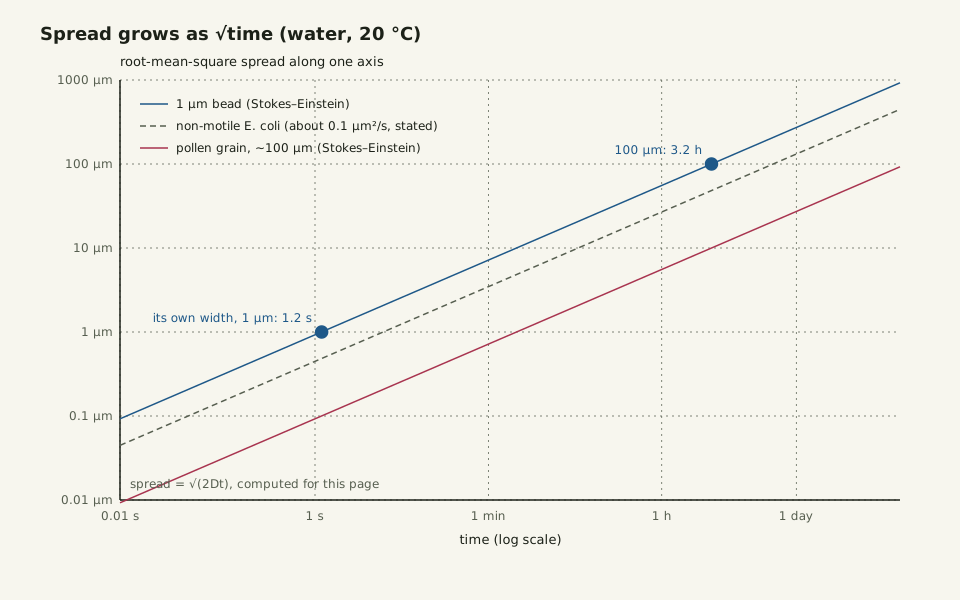
Spread grows as the square root of time, so a hundred times longer buys only ten times farther. The bead covers its own width along one axis in about 1.2 s, about 7 µm in a minute and 100 µm in about 3.2 hours, all computed for this page. How Do Insects Breathe? sets the same 1.2 s against oxygen.
| Particle in water | D (µm2/s) | Spread in 1 s | Time to spread its own width |
|---|---|---|---|
| sphere 0.2 µm across | 2.14 | 2.1 µm | 0.009 s |
| sphere 1 µm across (the bead) | 0.429 | 0.93 µm | 1.2 s |
| sphere 4 µm across (an amyloplast's size) | 0.107 | 0.46 µm | 75 s |
| sphere 100 µm across (a pollen grain's size) | 0.0043 | 0.093 µm | about 13.5 days |
| E. coli not swimming, room temperature | about 0.1 (stated) | about 0.45 µm | not given |
Living cells get the same treatment. Lauga and Powers put the diffusion constant of an Escherichia coli cell that is not swimming at about 0.1 µm2/s in water at room temperature, a rough scale that sits a few times below the bead's. Bacteria of this size are counted on How Many Cells in the Human Body?
Slide the diagram sideways to read its labels, or open it full size.
Spread along one axis for a 1 µm bead [10−6 m] and a 100 µm sphere in water at 20 °C, computed for this page, and a non-swimming E. coli at the stated 0.1 µm2/s. Data: brownian-motion-displacement.csv (sources, version and license, JSON).
"Spread against time: a 1 µm bead, a non-motile E. coli and a 100 µm sphere" by Ants, Cells & Atoms, https://antscellsandatoms.com/scale/brownian-motion/ — CC BY 4.0 (https://creativecommons.org/licenses/by/4.0/)
Data sources for this figure
Data: CODATA 2022 recommended values, NIST Standard Reference Database 121: Boltzmann constant 1.380649e-23 J/K (exact), https://physics.nist.gov/cgi-bin/cuu/Value?k, retrieved 2026-10-25; Viscosity of liquid water at 20 °C, 1.0016 mPa·s: International Association for the Properties of Water and Steam, IAPWS R12-08 (2008), https://iapws.org/technical-guidance/release/viscosity; value computed 2026-10-24 (shared file water-properties.csv); Lauga E, Powers TR 2009, Reports on Progress in Physics 72:096601 (preprint arXiv:0812.2887), https://doi.org/10.1088/0034-4885/72/9/096601: diffusion constant of a non-motile E. coli about 0.1 µm²/s; read 2026-10-25
Data sources for this figure
Data: CODATA 2022 recommended values, NIST Standard Reference Database 121: Boltzmann constant 1.380649e-23 J/K (exact), https://physics.nist.gov/cgi-bin/cuu/Value?k, retrieved 2026-10-25; Viscosity of liquid water at 20 °C, 1.0016 mPa·s: International Association for the Properties of Water and Steam, IAPWS R12-08 (2008), https://iapws.org/technical-guidance/release/viscosity; value computed 2026-10-24 (shared file water-properties.csv); Lauga E, Powers TR 2009, Reports on Progress in Physics 72:096601 (preprint arXiv:0812.2887), https://doi.org/10.1088/0034-4885/72/9/096601: diffusion constant of a non-motile E. coli about 0.1 µm²/s; read 2026-10-25; Pearle P, Collett B, Bart K, Bilderback D, Newman D, Samuels S 2010, American Journal of Physics 78:1278 (preprint arXiv:1008.0039), https://doi.org/10.1119/1.3475685: Clarkia pollen about 100 µm across, amyloplast and spherosome sizes, the rough 0.2 µm visibility estimate at 370 times; read 2026-10-25; Perrin J 1913, Les Atomes (Paris: Félix Alcan), chapter IV, public domain (author died 1942), https://fr.wikisource.org/wiki/Les_Atomes/IV: mean square spread 2Dt; 500 displacements of grains 0.367 µm in radius, e = 7.84 µm in 30 s; viscosity 0.01 poise and N = 68.8e22 for series VII; read 2026-10-25; Picoplankton class limits 0.2–2 µm: Hirata T et al. 2011, Biogeosciences 8:311, CC BY 3.0, https://doi.org/10.5194/bg-8-311-2011, restating Sieburth, Smetacek & Lenz 1978 (shared file plankton-size-classes.csv), retrieved 2026-10-24
How did Perrin track the jiggle?
Jean Perrin turned the jiggle into a measurement. With co-workers he made resin grains of gamboge and mastic of known radius, followed single grains under the microscope and marked their positions every 30 s. He reported the work in 1908 and in a 1909 paper, Mouvement brownien et réalité moléculaire (Brownian motion and molecular reality), and summed it up in the 1913 book Les Atomes.
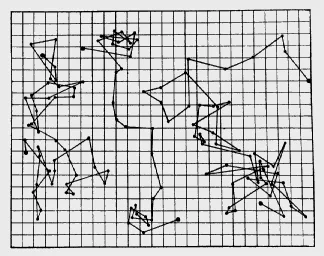
Three tracings of a mastic grain about 1 µm across [10−6 m], its positions marked every 30 s, from Perrin's 1909 paper.
Color: native (the page's single printed ink; a drawing of traced positions, not a micrograph)
“PerrinPlot2” by Jean Perrin (1909) · Public domain
Full credit
"PerrinPlot2" by Jean Perrin (1909) — https://commons.wikimedia.org/wiki/File:PerrinPlot2.gif — Public domain (drawing by Jean Perrin (died 1942) published in 1909 in the Annales de chimie et de physique (8e série, 18:5–114): public domain in the United States (published before 1931) and in France and the EU (author's life plus 70 years, expired 1 January 2013); the file is a reproduction of the printed two-dimensional figure, tagged PD-old-auto-expired (PD/1923) on Commons)

Each straight segment hides a tangle. Had the grain been marked every second, Perrin wrote, each segment would turn into a path of 30 sides as complicated as the whole drawing. The simulated track above shows the same effect. What he measured was half the mean square of such segments, the quantity Einstein's formula predicts for one axis.
Two of his data sets carry everything needed to rework them. In Les Atomes he reports 500 horizontal displacements in 30 s for grains 0.367 µm in radius, with a mean square of (7.84 µm)2 over both axes. In 1909, grains 0.212 µm in radius in water at 17 °C spread a mean square of 50.2 µm2 along one axis in 30 s.
Do two routes agree on the bead?
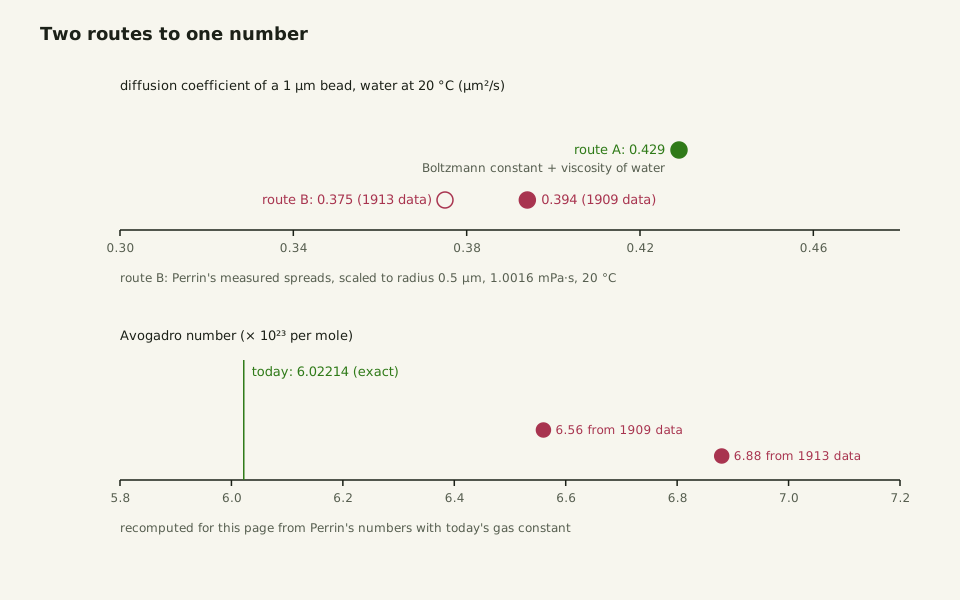
Perrin's numbers give a second route to the bead's D. Route A uses the Boltzmann constant and the viscosity of water: 4.29×10⁻¹³ m2/s. Route B uses only Perrin's measurements, scaled to a 0.5 µm radius in water at 20 °C: 3.75 and 3.94×10⁻¹³ m2/s, computed for this page.
The 1913 set needs one assumption: the book lists a viscosity of 0.01 poise for grains of that size but no temperature, so 20 °C was used. Route A comes out 1.09–1.14 times route B. The two routes share only the Stokes scaling with radius, viscosity and temperature.
Slide the diagram sideways to read its labels, or open it full size.
Two routes to the D of a 1 µm bead [10−6 m] in water at 20 °C, and the Avogadro number from Perrin's data, computed for this page. Data: brownian-motion-perrin-routes.csv (sources, version and license, JSON).
"Two routes to one number: the 1 µm bead and the Avogadro number" by Ants, Cells & Atoms, https://antscellsandatoms.com/scale/brownian-motion/ — CC BY 4.0 (https://creativecommons.org/licenses/by/4.0/)
Data sources for this figure
Data: CODATA 2022 recommended values, NIST Standard Reference Database 121: Boltzmann constant 1.380649e-23 J/K (exact), https://physics.nist.gov/cgi-bin/cuu/Value?k, retrieved 2026-10-25; CODATA 2022 recommended values, NIST Standard Reference Database 121: molar gas constant 8.314462618 J/(mol K) and Avogadro constant 6.02214076e23 per mole (both exact), https://physics.nist.gov/cgi-bin/cuu/Value?r and Value?na, retrieved 2026-10-25; Viscosity of liquid water at 20 °C, 1.0016 mPa·s: International Association for the Properties of Water and Steam, IAPWS R12-08 (2008), https://iapws.org/technical-guidance/release/viscosity; value computed 2026-10-24 (shared file water-properties.csv); Perrin J 1913, Les Atomes (Paris: Félix Alcan), chapter IV, public domain (author died 1942), https://fr.wikisource.org/wiki/Les_Atomes/IV: mean square spread 2Dt; 500 displacements of grains 0.367 µm in radius, e = 7.84 µm in 30 s; viscosity 0.01 poise and N = 68.8e22 for series VII; read 2026-10-25; Perrin J 1909, Mouvement brownien et réalité moléculaire, Annales de chimie et de physique 8e série 18:5–114, public domain (author died 1942), https://fr.wikisource.org/wiki/Mouvement_brownien_et_r%C3%A9alit%C3%A9_mol%C3%A9culaire: gamboge grains 0.212 µm in radius, water at 17 °C, viscosity 0.011 poise, mean square 50.2 µm² in 30 s, N = 66e22; read 2026-10-25
Data sources for this figure
Data: Perrin J 1909, Mouvement brownien et réalité moléculaire, Annales de chimie et de physique 8e série 18:5–114, public domain (author died 1942), https://fr.wikisource.org/wiki/Mouvement_brownien_et_r%C3%A9alit%C3%A9_mol%C3%A9culaire: gamboge grains 0.212 µm in radius, water at 17 °C, viscosity 0.011 poise, mean square 50.2 µm² in 30 s, N = 66e22; read 2026-10-25; Perrin J 1913, Les Atomes (Paris: Félix Alcan), chapter IV, public domain (author died 1942), https://fr.wikisource.org/wiki/Les_Atomes/IV: mean square spread 2Dt; 500 displacements of grains 0.367 µm in radius, e = 7.84 µm in 30 s; viscosity 0.01 poise and N = 68.8e22 for series VII; read 2026-10-25; CODATA 2022 recommended values, NIST Standard Reference Database 121: Boltzmann constant 1.380649e-23 J/K (exact), https://physics.nist.gov/cgi-bin/cuu/Value?k, retrieved 2026-10-25; CODATA 2022 recommended values, NIST Standard Reference Database 121: molar gas constant 8.314462618 J/(mol K) and Avogadro constant 6.02214076e23 per mole (both exact), https://physics.nist.gov/cgi-bin/cuu/Value?r and Value?na, retrieved 2026-10-25; Viscosity of liquid water at 20 °C, 1.0016 mPa·s: International Association for the Properties of Water and Steam, IAPWS R12-08 (2008), https://iapws.org/technical-guidance/release/viscosity; value computed 2026-10-24 (shared file water-properties.csv)
Read the other way, Perrin's numbers give the Avogadro number. Recomputed with today's gas constant, the two sets give 6.56 and 6.88×10²³ per mole, close to the 66 and 68.8×10²² he printed for grains of those two sizes. CODATA 2022 lists today's value as exactly 6.02214076×10²³, so the recomputed figures run 9–14% high, the same gap the bead's two routes show.
Einstein also applied his formula to sugar dissolving in water, Perrin recounts, and once a slip in the calculation was fixed the estimate came to 65×1022. Perrin took that as a sign that Stokes' rule still holds, in water, for molecules less than a thousandth of a micrometre across. Shrink the bead a thousandfold and, by his reasoning, the same jostling rule still applies.
Sources
- Brown R. "A brief account of microscopical observations made in the months of June, July and August 1827, on the particles contained in the pollen of plants; and on the general existence of active molecules in organic and inorganic bodies." The Philosophical Magazine 4(21):161–173 (1828). https://doi.org/10.1080/14786442808674769. Read as reprinted in Bennett JJ (ed.), The Miscellaneous Botanical Works of Robert Brown, vol. 1 (1866). Read: full text (1866 reprint).
- Pearle P, Collett B, Bart K, Bilderback D, Newman D, Samuels S. "What Brown saw and you can too." American Journal of Physics 78(12):1278–1289 (2010). https://doi.org/10.1119/1.3475685 Read: full text (preprint version).
- Perrin J. Les Atomes. Paris: Félix Alcan (1913), chapter III (Mouvement brownien. — Émulsions) and chapter IV (Les lois du mouvement brownien). https://fr.wikisource.org/wiki/Les_Atomes Read: full text (chapters III and IV).
- Li C, Du Y, Chen H, Han X, Wu W, Kong X, Zhang C, Yuan X. "Transmission infrared micro-spectroscopic study of individual human hair." Journal of Biomedical Optics 28(11):116501 (2023). https://doi.org/10.1117/1.JBO.28.11.116501 Read: full text. Text license: CC BY 4.0 (https://creativecommons.org/licenses/by/4.0/).
- Einstein A. "Über die von der molekularkinetischen Theorie der Wärme geforderte Bewegung von in ruhenden Flüssigkeiten suspendierten Teilchen." Annalen der Physik 322(8):549–560 (1905; volume 17 in the original numbering). https://doi.org/10.1002/andp.19053220806 Read: bibliographic record only.
- Lauga E, Powers TR. "The hydrodynamics of swimming microorganisms." Reports on Progress in Physics 72(9):096601 (2009). https://doi.org/10.1088/0034-4885/72/9/096601 Read: full text (preprint version).
- CODATA 2022 recommended values, NIST Standard Reference Database 121. "Boltzmann constant", "molar gas constant" and "Avogadro constant". https://physics.nist.gov/cgi-bin/cuu/Value?k Read: dataset record.
- International Association for the Properties of Water and Steam. IAPWS R12-08, Release on the IAPWS Formulation 2008 for the Viscosity of Ordinary Water Substance (2008). https://iapws.org/technical-guidance/release/viscosity Read: values as computed from the release equations in this site's water-properties table. Text license: IAPWS: publication in whole or in part allowed with attribution (https://iapws.org/technical-guidance/release/viscosity).
- Hirata T, Hardman-Mountford NJ, Brewin RJW, Aiken J, Barlow R, Suzuki K, Isada T, Howell E, Hashioka T, Noguchi-Aita M, Yamanaka Y. "Synoptic relationships between surface Chlorophyll-a and diagnostic pigments specific to phytoplankton functional types." Biogeosciences 8(2):311–327 (2011). https://doi.org/10.5194/bg-8-311-2011 Read: full text. Text license: CC BY 3.0 (https://creativecommons.org/licenses/by/3.0/).
- Perrin J. "Mouvement brownien et réalité moléculaire." Annales de chimie et de physique 8e série, 18:5–114 (1909). https://fr.wikisource.org/wiki/Mouvement_brownien_et_r%C3%A9alit%C3%A9_mol%C3%A9culaire Read: full text.
- GBIF Secretariat. GBIF Backbone Taxonomy. Checklist dataset https://doi.org/10.15468/39omei, accessed 2026-10-25; Clarkia pulchella Pursh, usage key 5420982. Read: dataset record (species match). Text license: CC BY 4.0 (https://creativecommons.org/licenses/by/4.0/).
Cite this page
Ants, Cells & Atoms. “Brownian Motion: Why a 1 µm Bead in Water Never Sits Still.” Published 2026-10-25. https://antscellsandatoms.com/scale/brownian-motion/. Accessed (add the date you read it).
No DOI is issued for entries. Figures made here are CC BY 4.0; see each caption for the license of photographs.
Related entries
How Many Cells in the Human Body? About Half Are Bacteria
Image: “E. coli Bacteria (7316101966)” by NIAID (2002) · Public domain
"E. coli Bacteria (7316101966)" by NIAID (2002) — https://commons.wikimedia.org/wiki/File:E._coli_Bacteria_(7316101966).jpg — Public domain (work of a United States federal agency (NIAID, part of NIH), public domain in the United States under 17 U.S.C. §105; Commons tag PD-USGov-NIH-NIAID; Flickr source page credits NIAID with no contractor note; dated 2002-11-14 in the file metadata; no copyright term applies in the EU for a US government work released as public domain by its author agency (used as the source's explicit PD mark))

Reynolds Number: Why a Bacterium Can't Coast and a Fish Can
Image: “Oczlik (Cyclops) - samica” by Mikron86 (2025) · CC BY 4.0
"Oczlik (Cyclops) - samica" by Mikron86 — https://commons.wikimedia.org/wiki/File:Oczlik_(Cyclops)_-_samica.jpg — CC BY 4.0 (https://creativecommons.org/licenses/by/4.0/)

How Big Is a Cell? Most Are a Hair's Width or Far Narrower
Image: “SEM blood cells” by Bruce Wetzel and Harry Schaefer, National Cancer Institute (1982) · Public domain
"SEM blood cells" by Bruce Wetzel and Harry Schaefer, National Cancer Institute (1982) — https://commons.wikimedia.org/wiki/File:SEM_blood_cells.jpg — Public domain (work of United States federal employees at the National Cancer Institute (NIH), public domain in the United States under 17 U.S.C. §105; Commons tag PD-USGov; the NCI Visuals Online source states that all images are in the public domain and may be reproduced without permission, with credit to the listed source or author; dated February 1982; used in the EU on the source's explicit public-domain statement)
