Sodium Chloride: Why a Salt Crystal Has No Molecules

Slide the ladder sideways to read its labels, or open it full size.
NaCl crystal: neighbouring ions 2.80–2.83 Å apart (computed), cubic cell 5.60–5.66 Å on each edge, in three crystal records [10−10 m].
Log scale from 10 cm to 0.1 nm, each rung ten times smaller; dashed lines: naked eye about 0.1 mm, light microscope about 0.2 µm (how to read the Zoom ladder). Blue band: the salt crystals measured in the slide photo further down, 0.08–0.19 mm. Data: sodium-chloride-lattice.csv (sources, version and license, JSON).
"Zoom ladder: sodium chloride" by Ants, Cells & Atoms, https://antscellsandatoms.com/molecules/sodium-chloride/ — CC BY 4.0 (https://creativecommons.org/licenses/by/4.0/)
Data sources for this figure
Data: Crystallography Open Database records 2108652 (Tsirelson V, Stash A 2020, Acta Cryst. B 76:769), 4300180 and 4320809 (Jürgens B, Irran E, Schneider J, Schnick W 2000, Inorg. Chem. 39:665), CC0, as listed in PubChem CID 5234, retrieved 2026-10-24; ion spacing computed 2026-10-24; Crystal sizes measured against the printed 0.1 mm bar of Ihor Panas, Light microscopy of sodium chloride crystals, CC BY-SA 4.0, https://commons.wikimedia.org/wiki/File:Light_microscopy_of_sodium_chloride_crystals.jpg; lengths computed 2026-10-24

Data sources for this figure
Data: Crystallography Open Database records 2108652 (Tsirelson V, Stash A 2020, Acta Cryst. B 76:769), 4300180 and 4320809 (Jürgens B, Irran E, Schneider J, Schnick W 2000, Inorg. Chem. 39:665) and 2104025 (Shiraki K, Tsuchiya T, Ono S 2003, Acta Cryst. B 59:701), CC0, as listed in PubChem CID 5234, retrieved 2026-10-24; Density, melting point: Hazardous Substances Data Bank in PubChem CID 5234, citing the CRC Handbook of Chemistry and Physics, 94th ed.; molar mass and covalently bonded unit count computed by PubChem, retrieved 2026-10-24; Gas-phase NaCl r_e 2.361 Å: NIST CCCBDB Release 22 (SRD 101), citing the NIST Diatomic Spectral Database, retrieved 2026-10-24; Avogadro constant: CODATA 2022 recommended values, NIST, retrieved 2026-10-24; Spacings, ratios and the implied density computed 2026-10-24
Bench card
- Name
- sodium chloride (table salt; the mineral halite)Source: Wikidata Q2314 and PubChem CID 5234 record, https://www.wikidata.org/wiki/Q2314
- Formula
- NaCl (one Na+ for each Cl−)Source: Wikidata Q2314 (P274), https://www.wikidata.org/wiki/Q2314
- PubChem CID
- 5234 (identity only)Source: Wikidata Q2314 (P662), checked against the PubChem record, https://www.wikidata.org/wiki/Q2314
- Shape
- rock-salt lattice: face-centred cubic, space group Fm-3m; each ion surrounded by six of the other kindSource: three Crystallography Open Database records (2108652, 4300180, 4320809) in PubChem CID 5234; six neighbours computed from the space group and Z = 4, https://doi.org/10.1093/nar/gkae1059
- Size
- cell edge 0.560–0.566 nm (measured); nearest Na–Cl 0.280–0.283 nm (computed, half the edge), nucleus to nucleus, from experimental crystal records [10−10 m]Source: cell edges measured (three COD records in PubChem CID 5234); Na–Cl computed as half the edge, https://doi.org/10.1093/nar/gkae1059
- Found in
- table salt; rock salt, the mineral halite; dissolved in seawaterSource: Hazardous Substances Data Bank in PubChem CID 5234 (citing the Merck Index and Hawley's Condensed Chemical Dictionary), https://doi.org/10.1093/nar/gkae1059
sodium-chloride-bench.csv (CSV) · where each value comes from, and its license (JSON)
Data credits for this card
Data: Wikidata Q2314 (formula P274, PubChem CID P662), CC0, retrieved 2026-10-24; Crystallography Open Database records 2108652 (Tsirelson V, Stash A 2020, Acta Cryst. B 76:769), 4300180 and 4320809 (Jürgens B, Irran E, Schneider J, Schnick W 2000, Inorg. Chem. 39:665), CC0, as listed in PubChem CID 5234, retrieved 2026-10-24; Occurrence: Hazardous Substances Data Bank in PubChem CID 5234, citing the Merck Index and Hawley's Condensed Chemical Dictionary, retrieved 2026-10-24
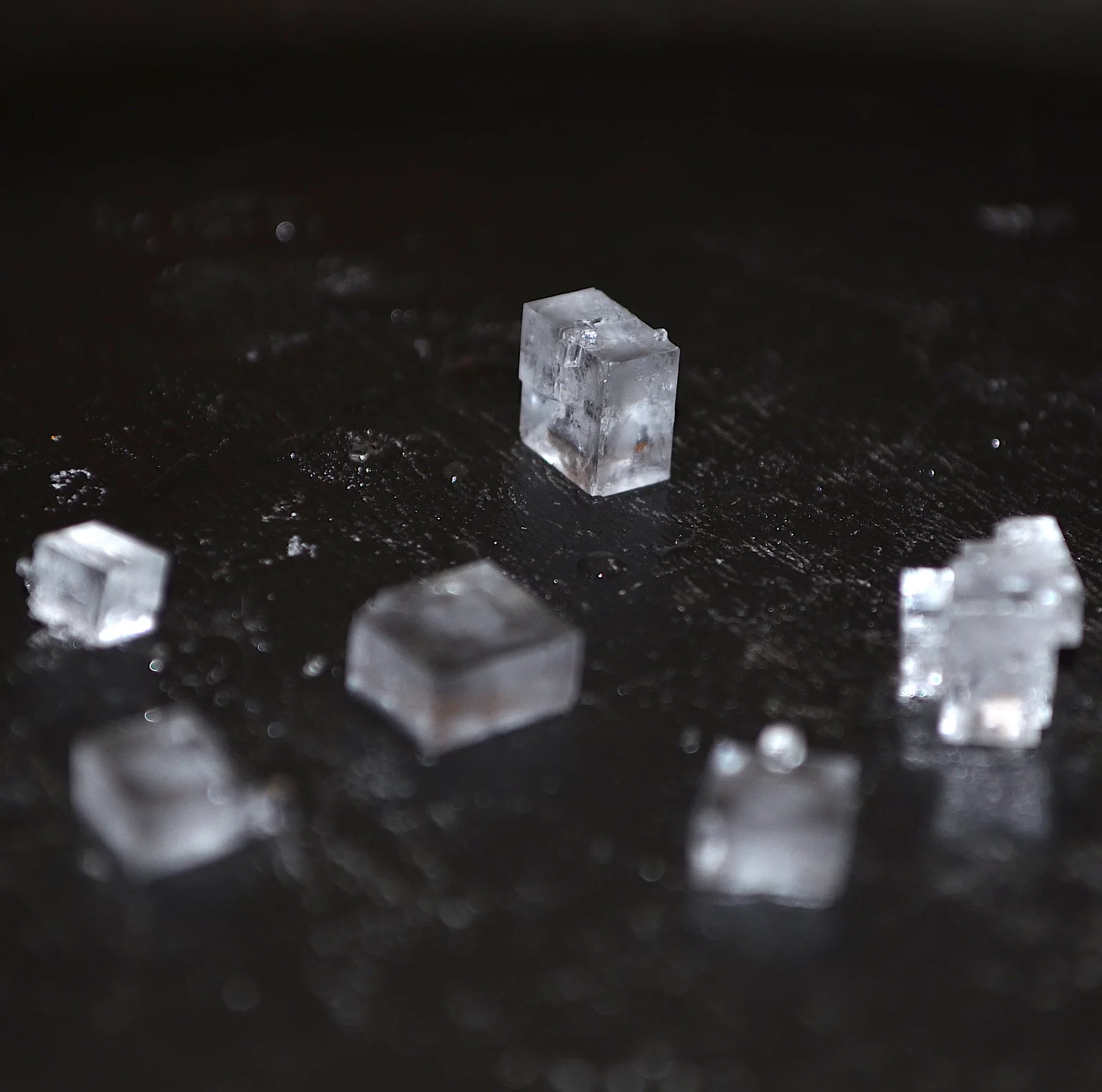
Sodium chloride crystals on a dark surface; the photographer gives no size, and neighbouring ions inside sit about 0.28 nm apart (computed) [10−10 m].
Color: native (colorless crystals; no dye named or visible)
"Crystals of NaCl" by Alessandro e Damiano — https://commons.wikimedia.org/wiki/File:Crystals_of_NaCl.jpg — CC BY 4.0 (https://creativecommons.org/licenses/by/4.0/)

Salt forms colorless cubic crystals, PubChem's record notes from the CRC Handbook, and in nature it is the mineral halite. In the photo above, the crystal in focus is a clear block whose flat faces meet at right angles. The slide photo further down adds a scale bar.
Is there a salt molecule?
The formula NaCl is a ratio. Sodium chloride is an ionic compound with one sodium ion for each chloride ion, Wikipedia's article on it explains. In SMILES, a one-line code for structures, PubChem writes salt's structure as two separate pieces, [Na+].[Cl-], and counts two covalently bonded units in the record; water and acetylsalicylic acid each count one. Wikidata gives salt the same SMILES string.
In the solid, each ion is surrounded by six ions of the opposite charge at the corners of a regular octahedron, by Wikipedia's account. In the crystal records below, all six sit at the same distance (computed). So no chloride is any one sodium's partner. The crystal is one continuous grid.
That picture is more than a century old. By Wikipedia's account of X-ray crystallography, table salt became the first crystal structure solved at the scale of atoms, and it showed that a crystal need not be built of covalently bonded molecules.
Lone NaCl molecules do exist, in the gas. Salt melts at 800.7 °C and begins to give off vapour a little above that, PubChem's record notes. The NIST CCCBDB lists one such molecule with its two nuclei 2.361 Å apart (measured), 16% closer than neighbours in the crystal (computed). The drawing below puts sticks between the ions, the habit this site calls the stick fiction; neither the molecule nor the crystal contains a rod.
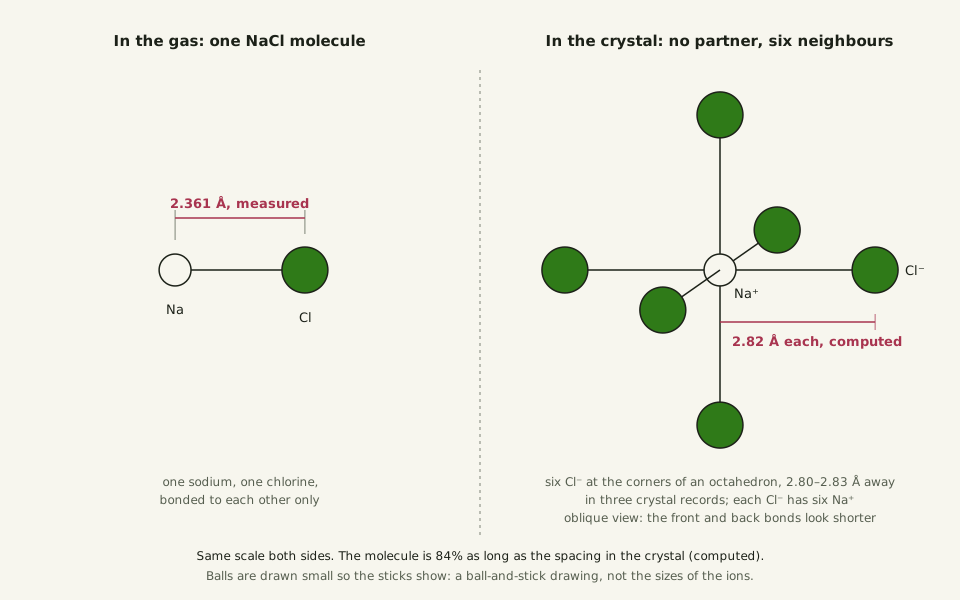
Slide the diagram sideways to read its labels, or open it full size.
A lone NaCl molecule in the gas, 2.361 Å nucleus to nucleus (measured), against one sodium ion in the crystal, 2.80–2.83 Å (computed) from each of six chloride ions [10−10 m].
Ball-and-stick, same scale; balls shrunk so the sticks show. Data: sodium-chloride-lattice.csv (sources, version and license, JSON).
"A salt molecule exists only in the gas" by Ants, Cells & Atoms, https://antscellsandatoms.com/molecules/sodium-chloride/ — CC BY 4.0 (https://creativecommons.org/licenses/by/4.0/)
Data sources for this figure
Data: Gas-phase NaCl, r_e 2.361 Å (23Na35Cl): NIST CCCBDB Release 22 (SRD 101), citing the NIST Diatomic Spectral Database, retrieved 2026-10-24; Crystallography Open Database records 2108652 (Tsirelson V, Stash A 2020, Acta Cryst. B 76:769), 4300180 and 4320809 (Jürgens B, Irran E, Schneider J, Schnick W 2000, Inorg. Chem. 39:665), CC0, as listed in PubChem CID 5234, retrieved 2026-10-24; spacing computed 2026-10-24; Ball sizes drawn at a quarter of the crystal ionic radii Na+ 1.16 Å and Cl- 1.67 Å as listed in Wikipedia, Ionic radius (CC BY-SA 4.0, paraphrased values, from Shannon 1976), retrieved 2026-10-24
Data sources for this figure
Data: Crystallography Open Database records 2108652 (Tsirelson V, Stash A 2020, Acta Cryst. B 76:769), 4300180 and 4320809 (Jürgens B, Irran E, Schneider J, Schnick W 2000, Inorg. Chem. 39:665) and 2104025 (Shiraki K, Tsuchiya T, Ono S 2003, Acta Cryst. B 59:701), CC0, as listed in PubChem CID 5234, retrieved 2026-10-24; Density, melting point: Hazardous Substances Data Bank in PubChem CID 5234, citing the CRC Handbook of Chemistry and Physics, 94th ed.; molar mass and covalently bonded unit count computed by PubChem, retrieved 2026-10-24; Gas-phase NaCl r_e 2.361 Å: NIST CCCBDB Release 22 (SRD 101), citing the NIST Diatomic Spectral Database, retrieved 2026-10-24; Avogadro constant: CODATA 2022 recommended values, NIST, retrieved 2026-10-24; Spacings, ratios and the implied density computed 2026-10-24
How far apart are the ions?
PubChem lists three records from the Crystallography Open Database (COD 2108652, 4300180 and 4320809) that place sodium chloride in space group Fm-3m, the symmetry label of a face-centred cubic grid, with four NaCl units in each cubic cell. Their cell edges are 5.6035, 5.6393 and 5.6635 Å, and PubChem's summary gives no temperature for them. Half an edge is the distance between neighbouring nuclei: 2.80–2.83 Å (computed). A fourth record in the list describes a different cell and is left aside here.
X-ray crystallography gives that spacing but not where one ion ends and the next begins, Wikipedia's ionic radius article explains. Tables of ionic radii split the spacing by convention. Wikipedia lists two sets from Shannon's 1976 tables: "crystal" radii of 1.16 Å for sodium and 1.67 Å for chloride, and "effective" radii of 1.02 and 1.81 Å. Either pair adds up to 2.83 Å, within about 1% of the spacing above (computed).
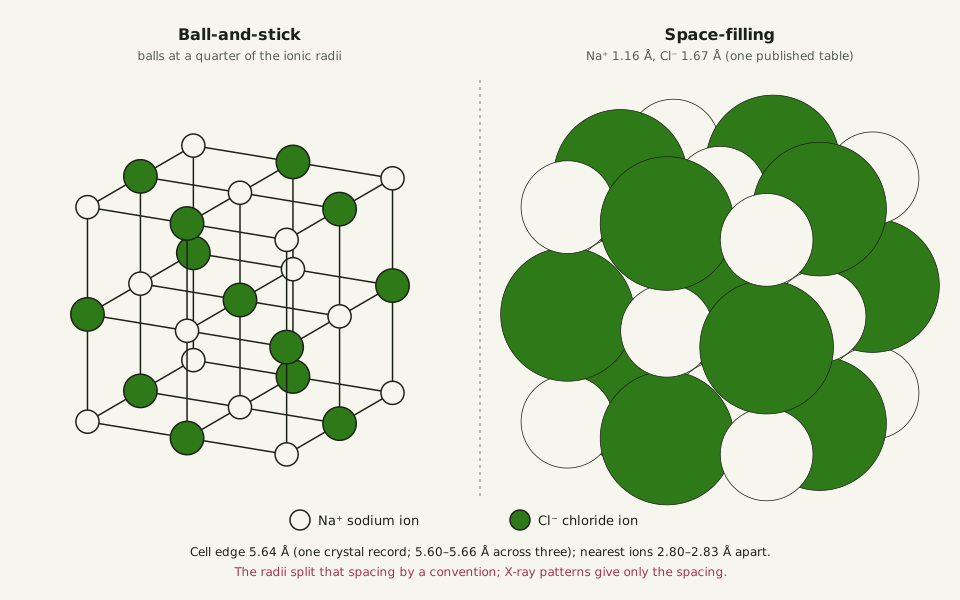
Slide the diagram sideways to read its labels, or open it full size.
One cubic cell of sodium chloride, 5.64 Å on each edge (5.60–5.66 Å in three records), with sticks and space-filling [10−10 m].
Of the two, the space-filling drawing is closer to the electron cloud. Space-filling radii: Na+ 1.16 Å and Cl− 1.67 Å, as Wikipedia lists them from Shannon 1976. Data: sodium-chloride-lattice.csv (sources, version and license, JSON).
"One cubic cell of salt, with sticks and without" by Ants, Cells & Atoms, https://antscellsandatoms.com/molecules/sodium-chloride/ — CC BY 4.0 (https://creativecommons.org/licenses/by/4.0/)
Data sources for this figure
Data: Crystallography Open Database record 4300180 (Jürgens B, Irran E, Schneider J, Schnick W 2000, Inorg. Chem. 39:665), with records 2108652 (Tsirelson V, Stash A 2020) and 4320809 for the range, CC0, as listed in PubChem CID 5234, retrieved 2026-10-24; ion positions computed from space group Fm-3m and Z = 4; Crystal ionic radii Na+ 1.16 Å and Cl- 1.67 Å as listed in Wikipedia, Ionic radius (CC BY-SA 4.0, paraphrased values, from Shannon 1976), retrieved 2026-10-24
Data sources for this figure
Data: Crystallography Open Database records 2108652 (Tsirelson V, Stash A 2020, Acta Cryst. B 76:769), 4300180 and 4320809 (Jürgens B, Irran E, Schneider J, Schnick W 2000, Inorg. Chem. 39:665) and 2104025 (Shiraki K, Tsuchiya T, Ono S 2003, Acta Cryst. B 59:701), CC0, as listed in PubChem CID 5234, retrieved 2026-10-24; Density, melting point: Hazardous Substances Data Bank in PubChem CID 5234, citing the CRC Handbook of Chemistry and Physics, 94th ed.; molar mass and covalently bonded unit count computed by PubChem, retrieved 2026-10-24; Gas-phase NaCl r_e 2.361 Å: NIST CCCBDB Release 22 (SRD 101), citing the NIST Diatomic Spectral Database, retrieved 2026-10-24; Avogadro constant: CODATA 2022 recommended values, NIST, retrieved 2026-10-24; Spacings, ratios and the implied density computed 2026-10-24
Drawn with these radii, neighbouring ions touch along every cube edge. Drawn ball-and-stick, the same cell becomes an open frame. As on the water molecule page, both drawings appear here: the sticks show where the nuclei sit, and the spheres show the room the ions fill. Shannon thought his crystal radii closer to the physical size of ions in a solid, as Wikipedia quotes him.
Along which planes does salt split?
Left to grow slowly, salt crystals form cubes. Sodium chloride crystals at equilibrium are cubic because the lattice under them is cubic, Desarnaud and colleagues wrote in 2018, and the six faces of each cube are equivalent faces of that lattice. Halite, the mineral, splits cleanly in three directions at right angles, parallel to its cube faces, by Wikipedia's account.
Fast growth changes the outline but not the grid. In those experiments, small drops of salt water dried at 23 °C inside capillaries 100–200 µm wide. Past a set level of supersaturation, meaning more dissolved salt than the water can normally hold, crystals grew as chains of connected small cubes, called hopper crystals. Wikipedia's halite article describes hoppers as skeletons of cubes with stairstep hollows in each face.
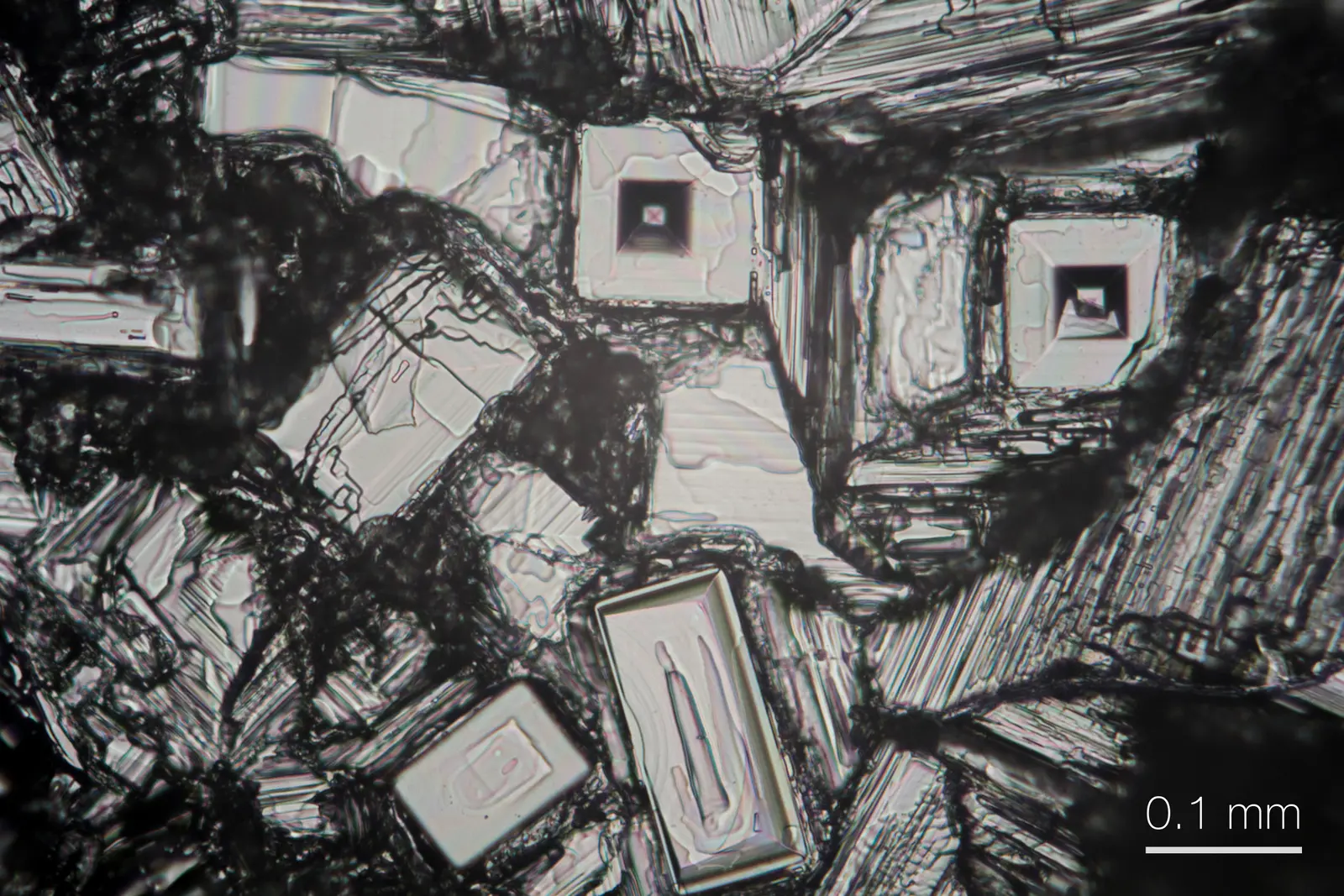
Sodium chloride crystals beside a printed 0.1 mm bar: two square crystals 0.10–0.11 mm across and a rectangular one 0.08 by 0.19 mm, computed from the bar [10−5–10−4 m].
Color: native (colorless crystals; no dye named)
"Light microscopy of sodium chloride crystals" by Ihor Panas — https://commons.wikimedia.org/wiki/File:Light_microscopy_of_sodium_chloride_crystals.jpg — CC BY-SA 4.0 (https://creativecommons.org/licenses/by-sa/4.0/)
The cube faces are also the stable surfaces, in the standard picture that Kvashnin and colleagues sum up in a 2019 computational study: the cube-face surface of NaCl is stable and nonpolar, while a surface cut across a cube corner is polar and normally unstable. That corner-cut surface is polar, they note, because of how atoms line up within one atomic plane; in the grid, each such layer holds ions of one kind (computed). Their own results add exceptions in surroundings very rich in sodium or chlorine.
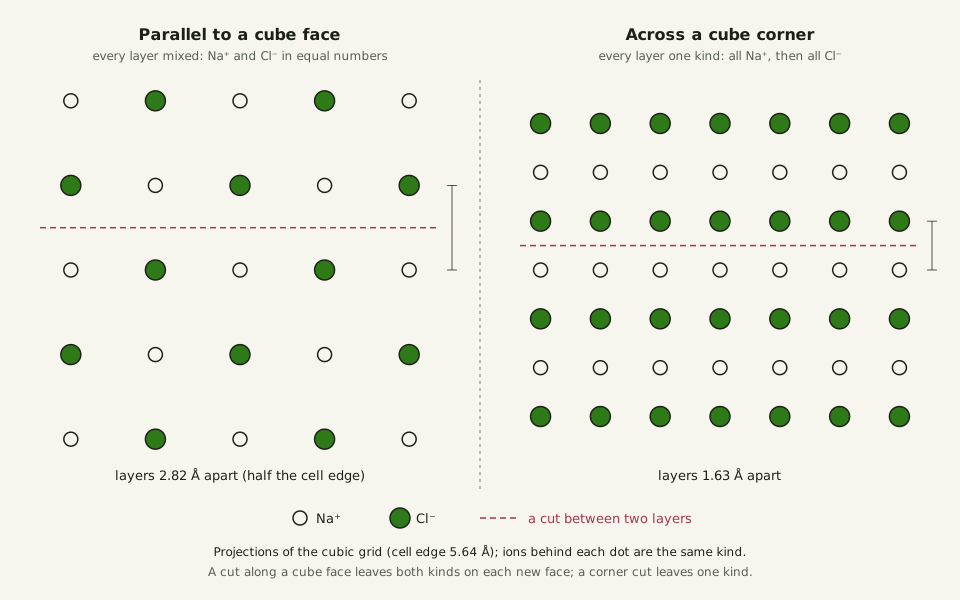
Slide the diagram sideways to read its labels, or open it full size.
Layers of ions in sodium chloride: mixed layers 2.82 Å apart parallel to a cube face, one-kind layers 1.63 Å apart across a corner, computed from the crystal grid [10−10 m].
Dashed: a cut between two layers. Data: sodium-chloride-lattice.csv (sources, version and license, JSON).
"Layers of salt: across a cube face and across a corner" by Ants, Cells & Atoms, https://antscellsandatoms.com/molecules/sodium-chloride/ — CC BY 4.0 (https://creativecommons.org/licenses/by/4.0/)
Data: Crystallography Open Database record 4300180 (Jürgens B, Irran E, Schneider J, Schnick W 2000, Inorg. Chem. 39:665), CC0, as listed in PubChem CID 5234, retrieved 2026-10-24; ion positions and layer spacings computed 2026-10-24 from space group Fm-3m and Z = 4
Data sources for this figure
Data: Crystallography Open Database records 2108652 (Tsirelson V, Stash A 2020, Acta Cryst. B 76:769), 4300180 and 4320809 (Jürgens B, Irran E, Schneider J, Schnick W 2000, Inorg. Chem. 39:665) and 2104025 (Shiraki K, Tsuchiya T, Ono S 2003, Acta Cryst. B 59:701), CC0, as listed in PubChem CID 5234, retrieved 2026-10-24; Density, melting point: Hazardous Substances Data Bank in PubChem CID 5234, citing the CRC Handbook of Chemistry and Physics, 94th ed.; molar mass and covalently bonded unit count computed by PubChem, retrieved 2026-10-24; Gas-phase NaCl r_e 2.361 Å: NIST CCCBDB Release 22 (SRD 101), citing the NIST Diatomic Spectral Database, retrieved 2026-10-24; Avogadro constant: CODATA 2022 recommended values, NIST, retrieved 2026-10-24; Spacings, ratios and the implied density computed 2026-10-24
Every layer parallel to a cube face holds sodium and chloride side by side (computed from the crystal grid), so a cut along a cube face leaves both kinds of ion on each new face. That is the direction in which halite splits. The snowflakes page follows the same thread, from grid to outline, in ice.
How many ions are in one grain?
Count them two ways for an example cube 0.1 mm on each edge, the size measured for the square crystals in the slide photo. Route A counts cells. About 177,000 cell edges of 5.60–5.66 Å fit along 0.1 mm, and each cell holds eight ions, so the cube holds 4.40×10¹⁶ to 4.55×10¹⁶ ions (computed).
Route B goes by mass. At 2.17 g/cm3, the density at 25 °C that PubChem's record lists from the CRC Handbook, the cube's mass is 2.17 µg. Divide by the molar mass, 58.44 g per mole of NaCl units, and multiply by the Avogadro constant, 6.02214076×10²³ units per mole in the 2022 CODATA values: that gives 2.24×10¹⁶ NaCl units, or 4.47×10¹⁶ ions (computed).
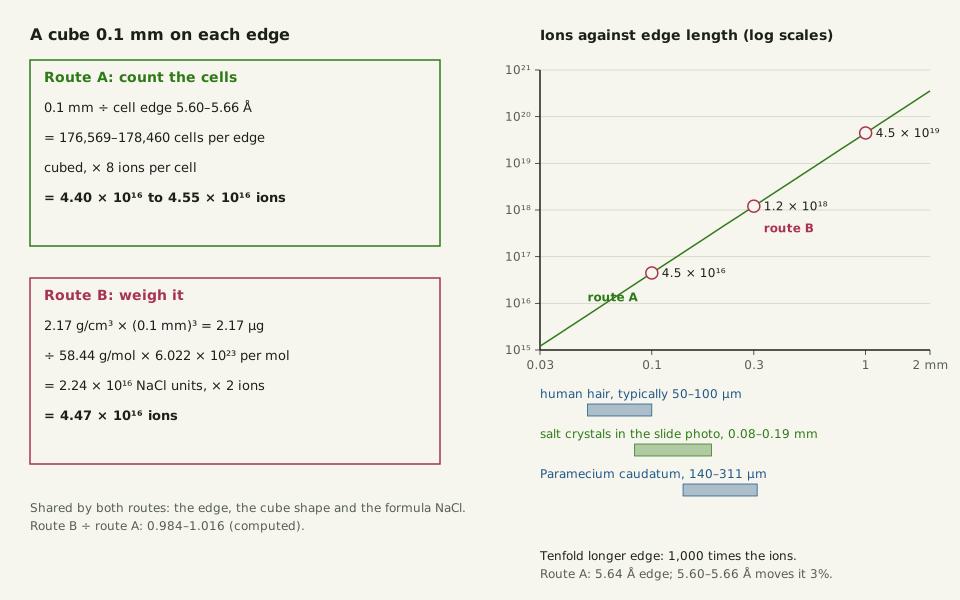
Slide the diagram sideways to read its labels, or open it full size.
Ions in a salt cube 0.1 mm on each edge [10−4 m]: 4.40×10¹⁶ to 4.55×10¹⁶ by counting cells, 4.47×10¹⁶ by weighing (computed).
Right: cubes 0.03–2 mm, beside a hair, the slide photo's crystals and Paramecium caudatum. Data: sodium-chloride-crystal-count.csv (sources, version and license, JSON), sodium-chloride-photo-sizes.csv (sources, version and license, JSON).
"How many ions in a salt crystal: two routes" by Ants, Cells & Atoms, https://antscellsandatoms.com/molecules/sodium-chloride/ — CC BY 4.0 (https://creativecommons.org/licenses/by/4.0/)
Data sources for this figure
Data: Crystallography Open Database records 2108652 (Tsirelson V, Stash A 2020, Acta Cryst. B 76:769), 4300180 and 4320809 (Jürgens B, Irran E, Schneider J, Schnick W 2000, Inorg. Chem. 39:665), CC0, as listed in PubChem CID 5234, retrieved 2026-10-24; Density 2.17 g/cm3 at 25 °C: Hazardous Substances Data Bank in PubChem CID 5234, citing the CRC Handbook of Chemistry and Physics, 94th ed.; molar mass 58.44 g/mol computed by PubChem, retrieved 2026-10-24; Avogadro constant 6.02214076e23 per mole: CODATA 2022 recommended values, NIST, retrieved 2026-10-24; Human hair, typically 50–100 µm: Li C et al. 2023, Journal of Biomedical Optics 28(11):116501, CC BY 4.0, https://doi.org/10.1117/1.JBO.28.11.116501, retrieved 2026-10-24; Paramecium caudatum length 140–311 µm: Velho Rodrigues MF, Lisicki M, Lauga E 2021, PLOS ONE 16(6):e0252291, CC BY 4.0, https://doi.org/10.1371/journal.pone.0252291, retrieved 2026-10-24; Crystal sizes measured against the printed 0.1 mm bar of Ihor Panas, Light microscopy of sodium chloride crystals, CC BY-SA 4.0, https://commons.wikimedia.org/wiki/File:Light_microscopy_of_sodium_chloride_crystals.jpg; counts and lengths computed 2026-10-24
Data sources for this figure
Data: Crystallography Open Database records 2108652 (Tsirelson V, Stash A 2020, Acta Cryst. B 76:769), 4300180 and 4320809 (Jürgens B, Irran E, Schneider J, Schnick W 2000, Inorg. Chem. 39:665), CC0, as listed in PubChem CID 5234, retrieved 2026-10-24; Density 2.17 g/cm3 at 25 °C: Hazardous Substances Data Bank in PubChem CID 5234, citing the CRC Handbook of Chemistry and Physics, 94th ed.; molar mass 58.44 g/mol computed by PubChem, retrieved 2026-10-24; Avogadro constant 6.02214076e23 per mole: CODATA 2022 recommended values, NIST, retrieved 2026-10-24; Human hair, typically 50–100 µm: Li C et al. 2023, Journal of Biomedical Optics 28(11):116501, CC BY 4.0, https://doi.org/10.1117/1.JBO.28.11.116501, retrieved 2026-10-24; Paramecium caudatum length 140–311 µm: Velho Rodrigues MF, Lisicki M, Lauga E 2021, PLOS ONE 16(6):e0252291, CC BY 4.0, https://doi.org/10.1371/journal.pone.0252291, retrieved 2026-10-24; Counts, masses and ratios computed 2026-10-24
Data: Scale bar and crystals in Ihor Panas, Light microscopy of sodium chloride crystals, CC BY-SA 4.0, https://commons.wikimedia.org/wiki/File:Light_microscopy_of_sodium_chloride_crystals.jpg; lengths computed 2026-10-24
The two routes share only the edge, the cube shape and the formula NaCl, and agree within 2%. Each tenfold step in edge length multiplies the count by a thousand: a 0.3 mm cube holds about 1.2×10¹⁸ ions, and a 1 mm cube about 4.5×10¹⁹.
A 0.1 mm crystal sits at the naked-eye line, beside a human hair, typically 50–100 µm across by Li and colleagues' 2023 account, and Paramecium caudatum, a paramecium whose whole body is one cell, 140–311 µm long in a 2021 database of unicellular swimmers.
 Illustration
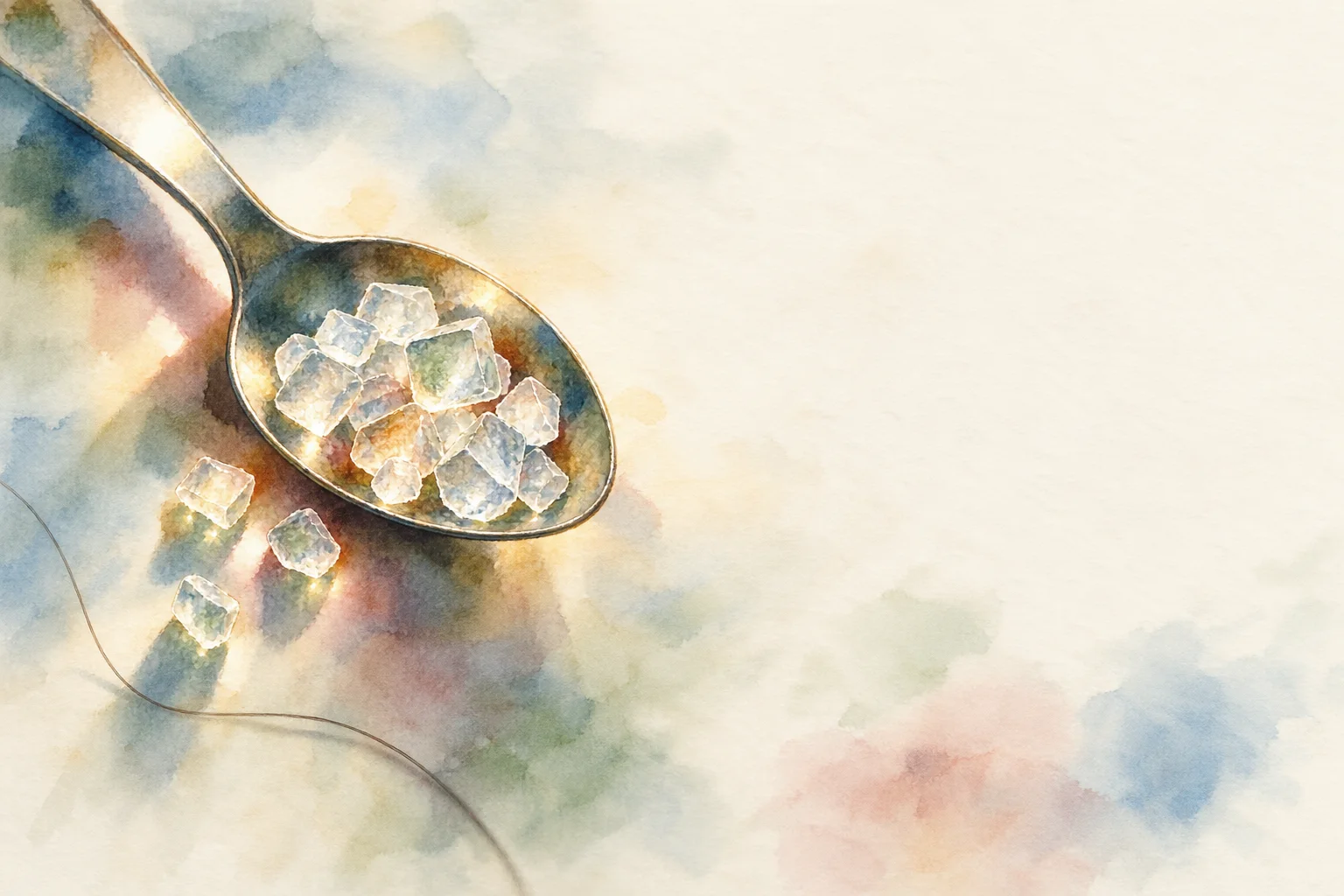
Coarse salt grains in a spoon, with a human hair lying beside it.
Illustration — not to scale
Illustration: Ants, Cells & Atoms. Generated schematic illustration — not a photograph, micrograph or specimen record. © Ants, Cells & Atoms, all rights reserved.
About 355,000 ions stand in one row along a single 0.1 mm edge (computed). Which of the three cell edges, 5.60 to 5.66 Å, fits salt on a kitchen table, PubChem's summary of the records does not say: it gives no temperatures, and the counts shift by about 3% across that range.
Sources
- PubChem, compound CID 5234 (Sodium Chloride), National Library of Medicine, including crystal records from the Crystallography Open Database (COD 2108652, 4300180, 4320809; CC0) and Hazardous Substances Data Bank entries; database described in Kim S, et al. "PubChem 2025 update." Nucleic Acids Research 53(D1):D1516–D1525 (2025). https://doi.org/10.1093/nar/gkae1059 Read: full text of the compound record (identity, structure code, computed molar mass and bonded units, density, melting point, occurrence, crystal records).
- Wikipedia contributors. "Sodium chloride." Wikipedia (read 2026-10-24). https://en.wikipedia.org/wiki/Sodium_chloride Read: full text; paraphrased only. Text license: CC BY-SA 4.0 (https://creativecommons.org/licenses/by-sa/4.0/).
- Wikidata. Item Q2314, sodium chloride: canonical SMILES (P233), chemical formula (P274) and PubChem CID (P662). CC0. https://www.wikidata.org/wiki/Q2314 (read 2026-10-24) Read: full text of the item record. Text license: CC0 1.0 (https://creativecommons.org/publicdomain/zero/1.0/).
- PubChem, compound CID 962 (Water) and CID 2244 (Aspirin), Covalently-Bonded Unit Count, National Library of Medicine; database described in Kim S, et al. "PubChem 2025 update." Nucleic Acids Research 53(D1):D1516–D1525 (2025). https://doi.org/10.1093/nar/gkae1059 Read: full text of the covalently bonded unit entry in each record.
- Wikipedia contributors. "X-ray crystallography." Wikipedia (read 2026-10-24). https://en.wikipedia.org/wiki/X-ray_crystallography Read: full text; paraphrased only. Text license: CC BY-SA 4.0 (https://creativecommons.org/licenses/by-sa/4.0/).
- NIST Computational Chemistry Comparison and Benchmark Database (CCCBDB), Standard Reference Database 101, Release 22 (May 2022). Experimental geometry of NaCl (sodium chloride), CAS 7647-14-5, listing the NIST Diatomic Spectral Database (https://doi.org/10.18434/T4T59X). https://cccbdb.nist.gov/expgeom2x.asp?casno=7647145 Read: full text of the experimental geometry page (value and reference code); the database it cites was not read.
- Wikipedia contributors. "Ionic radius." Wikipedia (read 2026-10-24). https://en.wikipedia.org/wiki/Ionic_radius Read: full text; paraphrased only. Text license: CC BY-SA 4.0 (https://creativecommons.org/licenses/by-sa/4.0/).
- Desarnaud J, Derluyn H, Carmeliet J, Bonn D, Shahidzadeh N. "Hopper Growth of Salt Crystals." The Journal of Physical Chemistry Letters 9(11):2961–2966 (2018). https://doi.org/10.1021/acs.jpclett.8b01082 Read: full text; paraphrased only. Text license: CC BY-NC-ND (ACS AuthorChoice) (http://pubs.acs.org/page/policy/authorchoice_ccbyncnd_termsofuse.html).
- Wikipedia contributors. "Halite." Wikipedia (read 2026-10-24). https://en.wikipedia.org/wiki/Halite Read: full text; paraphrased only. Text license: CC BY-SA 4.0 (https://creativecommons.org/licenses/by-sa/4.0/).
- Kvashnin AG, Kvashnin DG, Oganov AR. "Novel Unexpected Reconstructions of (100) and (111) Surfaces of NaCl: Theoretical Prediction." Scientific Reports 9:14267 (2019). https://doi.org/10.1038/s41598-019-50548-8 Read: full text. Text license: CC BY 4.0 (https://creativecommons.org/licenses/by/4.0/).
- Mohr PJ, Newell DB, Taylor BN, Tiesinga E. CODATA 2022 recommended values of the fundamental physical constants: Avogadro constant. National Institute of Standards and Technology. https://physics.nist.gov/cgi-bin/cuu/Value?na Read: full text of the value page.
- Li C, Du Y, Chen H, Han X, Wu W, Kong X, Zhang C, Yuan X. "Transmission infrared micro-spectroscopic study of individual human hair." Journal of Biomedical Optics 28(11):116501 (2023). https://doi.org/10.1117/1.JBO.28.11.116501 Read: full text. Text license: CC BY 4.0 (https://creativecommons.org/licenses/by/4.0/).
- Velho Rodrigues MF, Lisicki M, Lauga E. "The bank of swimming organisms at the micron scale (BOSO-Micro)." PLOS ONE 16(6):e0252291 (2021). https://doi.org/10.1371/journal.pone.0252291 Read: full text. Text license: CC BY 4.0 (https://creativecommons.org/licenses/by/4.0/).
Cite this page
Ants, Cells & Atoms. “Sodium Chloride: Why a Salt Crystal Has No Molecules.” Published 2026-10-25. https://antscellsandatoms.com/molecules/sodium-chloride/. Accessed (add the date you read it).
No DOI is issued for entries. Figures made here are CC BY 4.0; see each caption for the license of photographs.
Related entries
 Illustration
Water Molecule: The Bent Shape Behind Floating Ice
Image: Illustration: Ants, Cells & Atoms, all rights reserved
Illustration: Ants, Cells & Atoms. Generated schematic illustration — not a photograph, micrograph or specimen record. © Ants, Cells & Atoms, all rights reserved.
Acetylsalicylic Acid: A Form Made in 1853, 'Aspirin' in 1899
Image: “Filipendula ulmaria detail” by Marterum (2020) · CC0 1.0
"Filipendula ulmaria detail" by Marterum — https://commons.wikimedia.org/wiki/File:Filipendula_ulmaria_detail.jpg — CC0 1.0 (https://creativecommons.org/publicdomain/zero/1.0/)

Snowflakes: The Six-Fold Pattern Starts in the Molecule
Image: “SnowflakesWilsonBentley” by Wilson Bentley (1902) · Public domain
"SnowflakesWilsonBentley" by Wilson Bentley (1902) — https://commons.wikimedia.org/wiki/File:SnowflakesWilsonBentley.jpg — Public domain (photographs by Wilson Bentley, who died in 1931, published as Plate XIX of his snow-crystal studies in the annual summary of the Monthly Weather Review for 1902: public domain in the US (published before 1930) and in the EU (life of the author plus 70 years, ended 2001); the scan is from the NOAA Historic NWS Collection (image wea02087))
