Snowflakes: The Six-Fold Pattern Starts in the Molecule

Slide the ladder sideways to read its labels, or open it full size.
Snow crystals: about 0.3 mm for a simple prism to 3 mm for a large star or a long needle, in one field guide [10−4–10−3 m].
Log scale from 10 cm to 0.1 nm, each rung ten times smaller; dashed lines: naked eye about 0.1 mm, light microscope about 0.2 µm (how to read the Zoom ladder). Blue bands: cloud droplets, 10–20 µm, and the ice lattice cell, 0.452 by 0.736 nm. Data: snowflakes-sizes.csv (sources, version and license, JSON).
"Zoom ladder: snow crystals" by Ants, Cells & Atoms, https://antscellsandatoms.com/molecules/snowflakes/ — CC BY 4.0 (https://creativecommons.org/licenses/by/4.0/)
Data: Crystal sizes, cloud droplet diameter and ice lattice constants: Libbrecht KG, Snow Crystals, monograph, arXiv 1910.06389 v2 (2021), https://arxiv.org/abs/1910.06389, retrieved 2026-10-24
Data: Lattice constants, droplet and crystal sizes: Libbrecht KG, Snow Crystals, monograph, arXiv 1910.06389 v2 (2021), https://arxiv.org/abs/1910.06389, retrieved 2026-10-24; Diatoms usually 20–200 µm: Piegari G et al. 2019, Frontiers in Veterinary Science 6:404, CC BY 4.0, https://doi.org/10.3389/fvets.2019.00404, retrieved 2026-10-25; Cells in a row computed 2026-10-25
Bench card
- Name
- ice Ih as a snow crystal (one single crystal of ice)Source: Libbrecht KG 2019, Snow Crystals (monograph, arXiv 1910.06389 v2, 2021), https://arxiv.org/abs/1910.06389, sections 1.1 and 2.2
- Formula
- H2OSource: Wikidata Q283 (P274), as in the shared file molecule-identity.csv, https://www.wikidata.org/wiki/Q283
- PubChem CID
- 962 (water; identity only)Source: Wikidata Q283 (P662), as in the shared file molecule-identity.csv, https://www.wikidata.org/wiki/Q283
- Shape
- hexagonal lattice of ice Ih; each molecule takes part in four hydrogen bonds; crystals start as hexagonal prisms with two basal and six prism facetsSource: Libbrecht KG 2019, Snow Crystals (monograph, arXiv 1910.06389 v2, 2021), https://arxiv.org/abs/1910.06389, sections 1.1 and 2.2; four hydrogen bonds per molecule counted for this page from the bonding in section 2.2 (two tight and two weaker O-H bonds on each oxygen, each hydrogen with one strong and one weak bond), the same count as the shared file ice-lattice.csv
- Size
- lattice cell a 0.452 nm, c 0.736 nm, measured near 0 °C, spacings between equivalent lattice points [10−10 m]; crystals in a field guide about 0.3 mm (simple prisms) to 3 mm (large stars, long needles) [10−4–10−3 m]Source: Libbrecht KG 2019, Snow Crystals (monograph, arXiv 1910.06389 v2, 2021), https://arxiv.org/abs/1910.06389, eq. 2.1 and chapter 10, https://arxiv.org/abs/1910.06389
- Found in
- snow crystals and nearly all ice at Earth's surface (the only form of ice commonly found there)Source: Libbrecht KG 2019, Snow Crystals (monograph, arXiv 1910.06389 v2, 2021), https://arxiv.org/abs/1910.06389, section 2.2, https://arxiv.org/abs/1910.06389
snowflakes-bench.csv (CSV) · where each value comes from, and its license (JSON)
Data credits for this card
Data: Wikidata Q283 (formula P274, PubChem CID P662), CC0, retrieved 2026-10-25; Lattice, facets, sizes and occurrence: Libbrecht KG, Snow Crystals, monograph, arXiv 1910.06389 v2 (2021), https://arxiv.org/abs/1910.06389, retrieved 2026-10-24; Four hydrogen bonds per molecule: computed 2026-10-25 from the bonding described in Libbrecht KG, Snow Crystals, monograph, arXiv 1910.06389 v2 (2021), https://arxiv.org/abs/1910.06389, section 2.2 (two tight and two weaker O–H bonds on each oxygen)
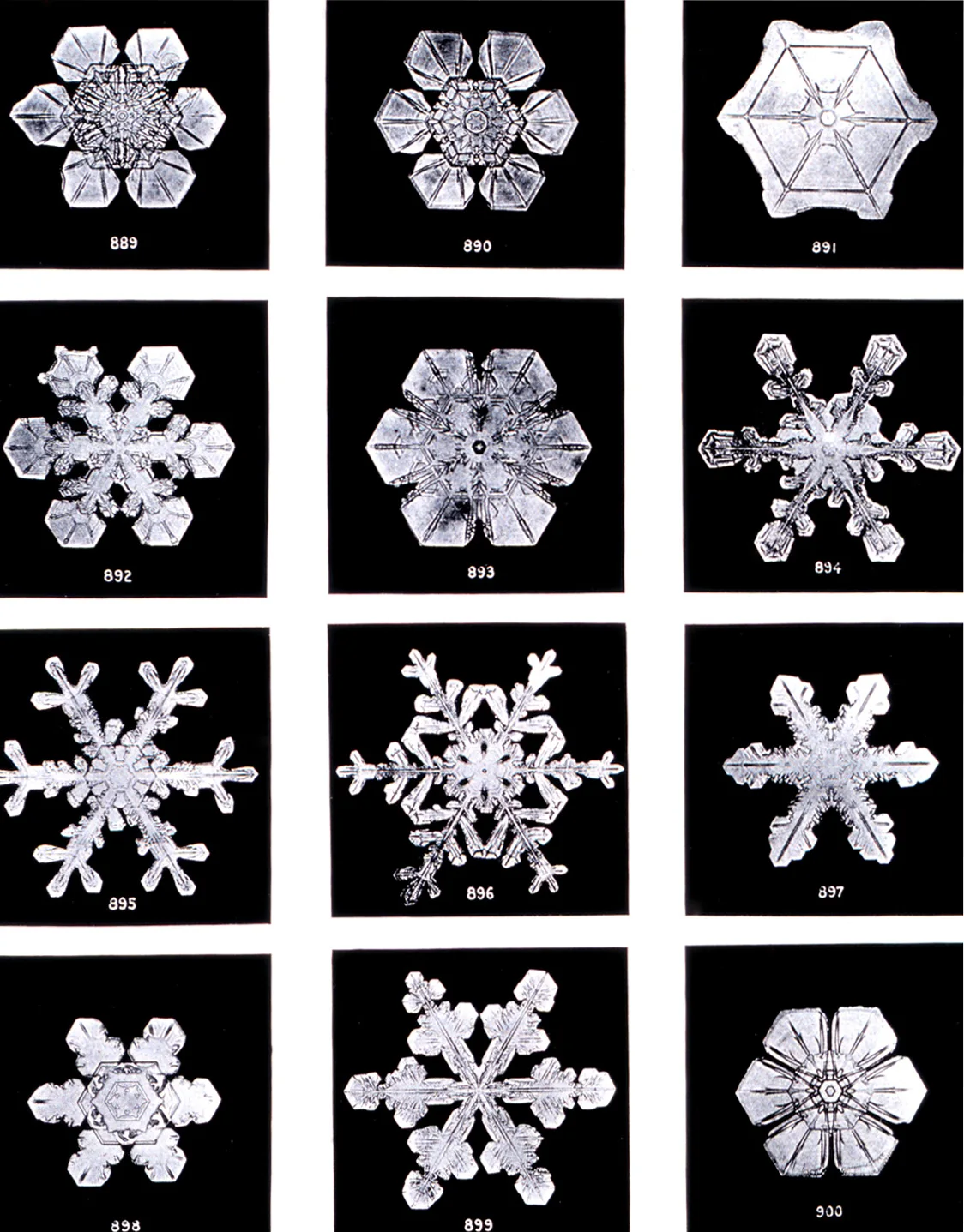
Twelve snow crystals on Plate XIX of Wilson Bentley's 1902 studies; no scale is printed, and in Libbrecht's guide good-sized star-shaped crystals measure about 2–3 mm [10−3 m].
Color: native (black-and-white photographs; Bentley blacked out the background of most of his photographs by scraping copy negatives, by Libbrecht's account)
“SnowflakesWilsonBentley” by Wilson Bentley (1902) · Public domain
Full credit
"SnowflakesWilsonBentley" by Wilson Bentley (1902) — https://commons.wikimedia.org/wiki/File:SnowflakesWilsonBentley.jpg — Public domain (photographs by Wilson Bentley, who died in 1931, published as Plate XIX of his snow-crystal studies in the annual summary of the Monthly Weather Review for 1902: public domain in the US (published before 1930) and in the EU (life of the author plus 70 years, ended 2001); the scan is from the NOAA Historic NWS Collection (image wea02087))

Bentley, a Vermont farmer, photographed more than 5,000 snow crystals through a microscope over 46 years, Libbrecht recounts, choosing only the most photogenic, about a hundred a winter on average. Most natural crystals are less tidy: in Libbrecht's guide, most specimens show some asymmetry, and well-formed stars are rare. A snowflake can also be a clump of many crystals stuck together. This page is about single crystals, in which, Libbrecht writes, the molecules all line up in one hexagonal array.
Where does the hexagon come from?
Start with one molecule. The two O–H bonds of a free water molecule meet at 104.5° (measured), close to the tetrahedral angle of 109.5°, Libbrecht notes, so in ice the four links around each oxygen point roughly to the corners of a tetrahedron. Each link between two oxygens holds one hydrogen. Two of the links carry the molecule's own hydrogens toward neighbours, and the other two carry neighbours' hydrogens toward it.
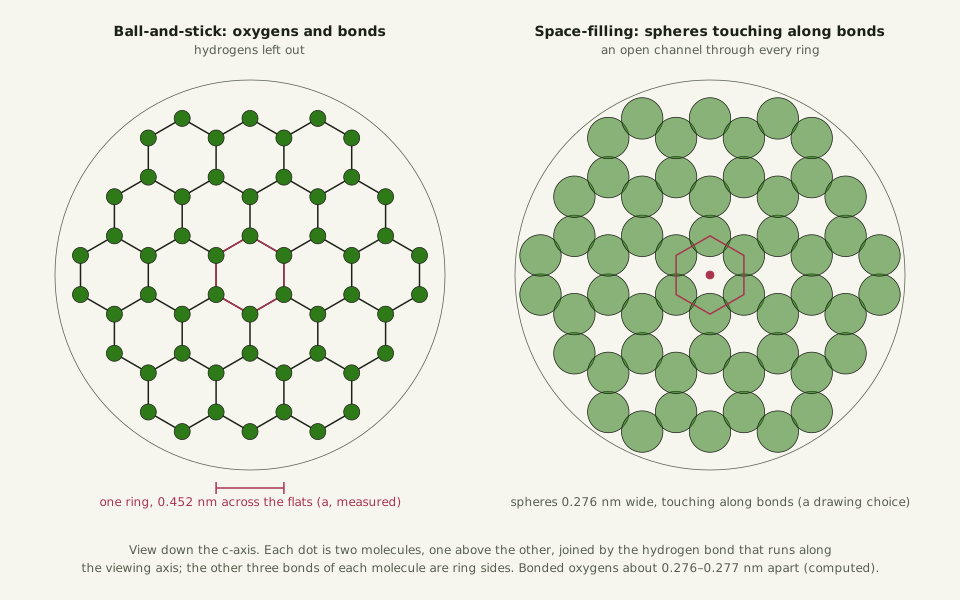
So each molecule takes part in four hydrogen bonds. Seen down the crystal's main axis, the c-axis, those bonds close into hexagonal rings with an oxygen at every corner, by Wikipedia's account of the ice Ih structure. Ice Ih is the only form of ice commonly found at Earth's surface, snow crystals included, according to Libbrecht. Its cell measures 0.452 nm along the side, the lattice constant a, and 0.736 nm along the c-axis (both measured near 0 °C), and each ring is 0.452 nm across its flats (computed).
Slide the diagram sideways to read its labels, or open it full size.
Ice Ih down the c-axis: hexagonal rings 0.452 nm across the flats (the measured lattice constant a), bonded oxygens about 0.28 nm apart (computed) [10−10 m].
Left, ball-and-stick; right, space-filling, with spheres drawn so that neighbours just touch. Of the two, the space-filling drawing is closer to the electron cloud. Each dot is two molecules stacked along the viewing axis. Data: snowflakes-sizes.csv (sources, version and license, JSON).
"Ice Ih down the c-axis, with sticks and as spheres" by Ants, Cells & Atoms, https://antscellsandatoms.com/molecules/snowflakes/ — CC BY 4.0 (https://creativecommons.org/licenses/by/4.0/)
Data: Lattice constants a = 0.452 nm and c = 0.736 nm, measured near 0 °C: Libbrecht KG, Snow Crystals, monograph, arXiv 1910.06389 v2 (2021), https://arxiv.org/abs/1910.06389, retrieved 2026-10-24; Structure type (hexagonal rings, four hydrogen bonds per molecule): Wikipedia, Phases of ice, paraphrased, CC BY-SA 4.0, retrieved 2026-10-25; oxygen positions and distances computed 2026-10-25
Data: Lattice constants, droplet and crystal sizes: Libbrecht KG, Snow Crystals, monograph, arXiv 1910.06389 v2 (2021), https://arxiv.org/abs/1910.06389, retrieved 2026-10-24; Diatoms usually 20–200 µm: Piegari G et al. 2019, Frontiers in Veterinary Science 6:404, CC BY 4.0, https://doi.org/10.3389/fvets.2019.00404, retrieved 2026-10-25; Cells in a row computed 2026-10-25
The left drawing puts sticks between the oxygens, the habit this site calls the stick fiction. Drawn as touching spheres on the right, the molecules still leave a channel open through every ring, room that Wikipedia's account says is almost enough for one more molecule. A snow crystal carries that six-fold pattern up to a size you can see: a row across a 2 mm plate holds about 4.4 million cells (computed).
How does a grid become a six-sided prism?
A snow crystal starts as a cloud droplet that freezes, then grows by taking water molecules straight from the vapour, Libbrecht explains. Each droplet is about 10–20 µm across, no wider than a small diatom: diatoms usually measure 20–200 µm, in a 2019 study by Piegari and colleagues. About 100,000 droplets evaporate to supply one large star-shaped crystal.
Molecules strike the young crystal everywhere, but they stick less readily to flat facets, surfaces lined up with the lattice that offer fewer open bonds, Libbrecht writes. Rough patches fill in first. The crystal ends up a hexagonal prism, with two basal facets on top and bottom and six prism facets around the sides. That shape, he writes, arises from the hexagonal lattice underneath.
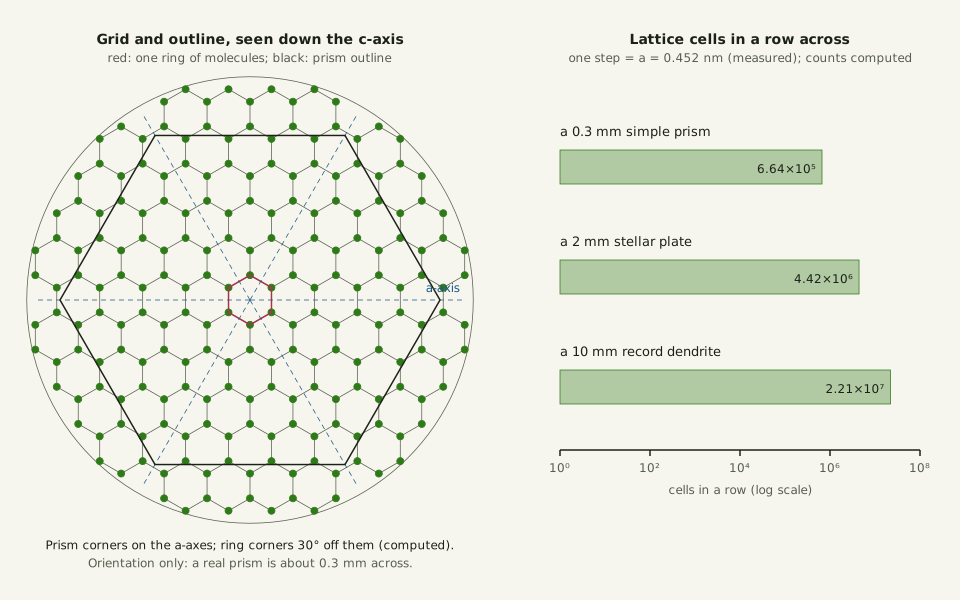
The outline is not one ring blown up. All six a-axes, the lattice directions in the flat basal plane, point to the prism's corners, Libbrecht notes, while the corners of each ring of molecules sit 30° off those axes (computed from the oxygen positions). What carries over from grid to outline is the six-fold symmetry. The sodium chloride page follows a cubic grid out to a cube; in ice the grid is hexagonal, and so is the outline.
Slide the diagram sideways to read its labels, or open it full size.
From grid to outline: prism corners on the lattice a-axes; a row across a 0.3 mm prism holds about 6.6×10⁵ cells of 0.452 nm, a 2 mm plate about 4.4×10⁶ (computed) [10−4–10−3 m].
Data: snowflakes-sizes.csv (sources, version and license, JSON).
"From the ice grid to a six-sided outline" by Ants, Cells & Atoms, https://antscellsandatoms.com/molecules/snowflakes/ — CC BY 4.0 (https://creativecommons.org/licenses/by/4.0/)
Data: Lattice constant a = 0.452 nm and the prism facets with corners on the a-axes: Libbrecht KG, Snow Crystals, monograph, arXiv 1910.06389 v2 (2021), https://arxiv.org/abs/1910.06389, retrieved 2026-10-24; Ring orientation and cells in a row computed 2026-10-25
Data: Lattice constants, droplet and crystal sizes: Libbrecht KG, Snow Crystals, monograph, arXiv 1910.06389 v2 (2021), https://arxiv.org/abs/1910.06389, retrieved 2026-10-24; Diatoms usually 20–200 µm: Piegari G et al. 2019, Frontiers in Veterinary Science 6:404, CC BY 4.0, https://doi.org/10.3389/fvets.2019.00404, retrieved 2026-10-25; Cells in a row computed 2026-10-25
Facets win while the crystal is small. As a rough rule of thumb, Libbrecht puts the start of branching past half a millimetre, sooner when the air is very humid. The six corners of a plate stick out into the moist air, catch vapour a little faster and so stick out farther, until six branches sprout. Bentley's crystal 814 below is a hexagonal plate with a short arm at each corner.
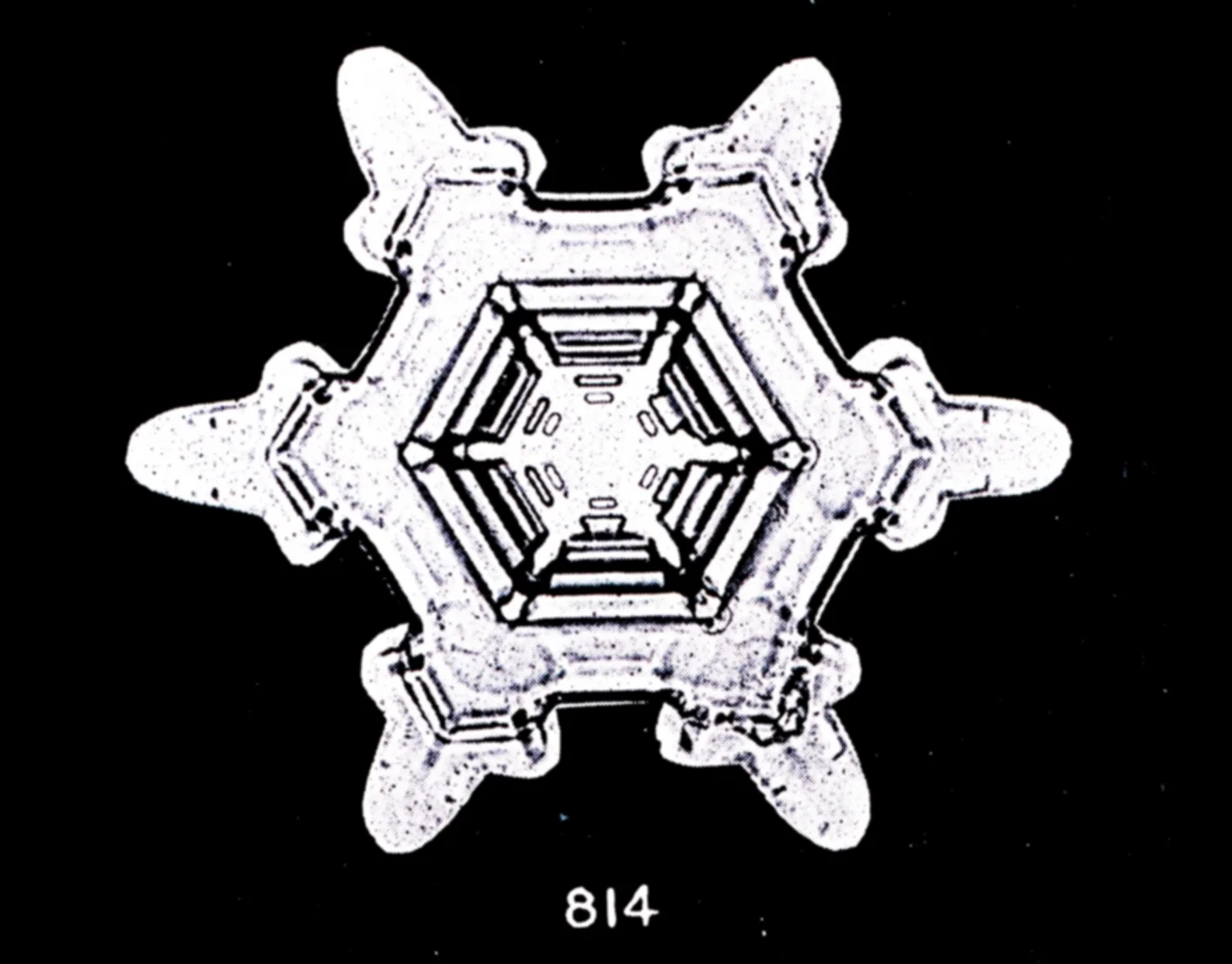
Snow crystal 814 from Bentley's 1902 studies, a hexagonal plate sprouting six short arms; branching starts past about 0.5 mm in Libbrecht's rule of thumb [10−4 m].
Color: native (black-and-white photograph printed white on black)
“Bentley Snowflake 814” by Wilson Bentley (1902) · Public domain
Full credit
"Bentley Snowflake 814" by Wilson Bentley (1902) — https://commons.wikimedia.org/wiki/File:Bentley_Snowflake_814.jpg — Public domain (photograph by Wilson Bentley, who died in 1931, published as image 814 of his snow-crystal studies in the annual summary of the Monthly Weather Review for 1902: public domain in the US (published before 1930; the Commons file carries PD-US) and in the EU (life of the author plus 70 years, ended 2001); scan from the NOAA photo library (nwind45))

Why are some snowflakes needles instead of stars?
Temperature sets the basic shape, and the shape flips more than once. Snow crystals grow plate-like near −2 °C, as slender columns near −5 °C, as especially thin plates near −15 °C and as columns again around −30 °C, Libbrecht summarises from lab studies that go back to Ukichiro Nakaya in the 1930s. Humidity sets how elaborate they get: simple faceted prisms when the air holds little spare vapour, branches when it holds plenty.
Needles form close to −5 °C in humid air, often up to 3 mm long, and on a coat sleeve they look like short bits of white hair. Large stars mainly appear within a few degrees of −15 °C, where a good-sized stellar plate might be 2 mm across, and that range is narrow enough that stellar plates are not in every snowfall. A capped column records both, a column grown near −5 °C and then plates on its ends once its cloud cooled below −10 °C.
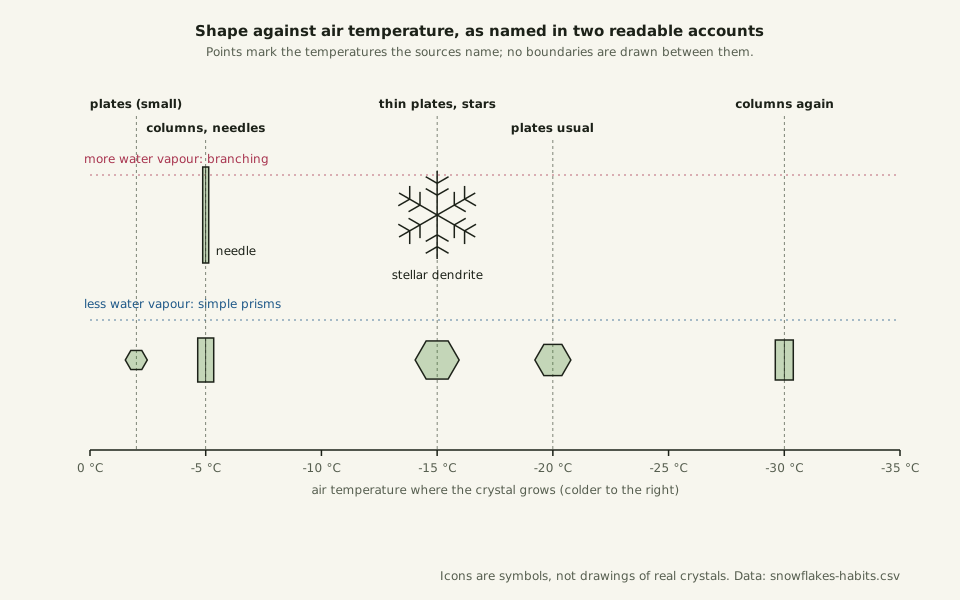
Slide the diagram sideways to read its labels, or open it full size.
Shape against air temperature: plates near −2 °C, columns and needles near −5 °C, thin plates and stars near −15 °C, columns again around −30 °C, for crystals about 0.3–3 mm [10−4–10−3 m].
Only the named temperatures are marked; more water vapour means more branching. Data: snowflakes-habits.csv (sources, version and license, JSON).
"Snow crystal shape against air temperature" by Ants, Cells & Atoms, https://antscellsandatoms.com/molecules/snowflakes/ — CC BY 4.0 (https://creativecommons.org/licenses/by/4.0/)
Data: Shapes against temperature and humidity: Libbrecht KG, A Quantitative Physical Model of the Snow Crystal Morphology Diagram, arXiv 1910.09067 v2 (2019), https://arxiv.org/abs/1910.09067, and Libbrecht KG, Snow Crystals, monograph, arXiv 1910.06389 v2 (2021), https://arxiv.org/abs/1910.06389, retrieved 2026-10-24
Data: Libbrecht KG, A Quantitative Physical Model of the Snow Crystal Morphology Diagram, arXiv 1910.09067 v2 (2019), https://arxiv.org/abs/1910.09067, retrieved 2026-10-24; Libbrecht KG, Snow Crystals, monograph, arXiv 1910.06389 v2 (2021), https://arxiv.org/abs/1910.06389, retrieved 2026-10-24
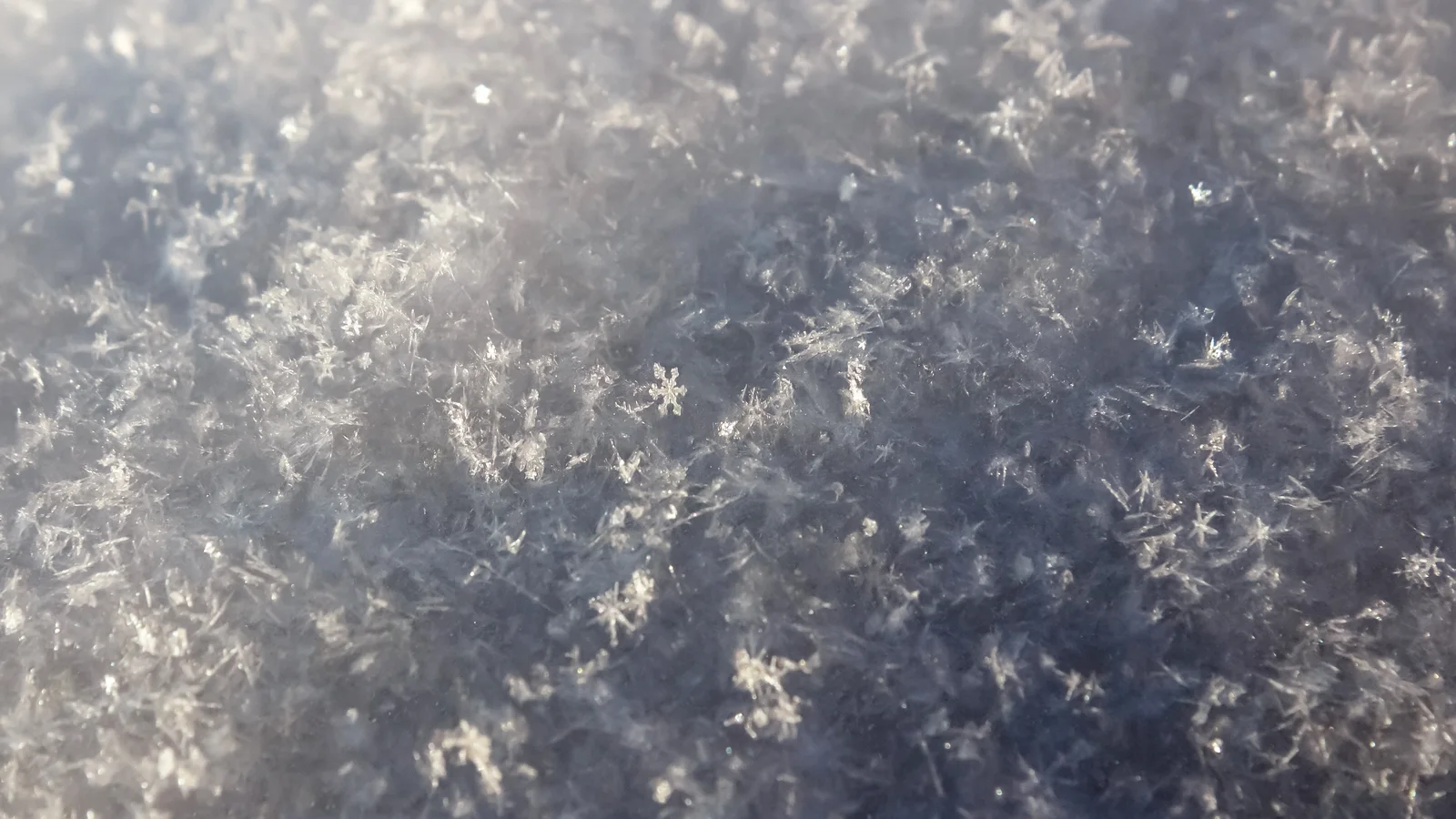
Newly fallen snow crystals on older frost at about −15 °C, as the photographer describes the scene; no scale is given, and stars in Libbrecht's guide measure about 2–3 mm [10−3 m].
Color: native (outdoor photograph; no colour processing stated)
"Newly fallen snow crystals in Tuntorp 1" by W.carter — https://commons.wikimedia.org/wiki/File:Newly_fallen_snow_crystals_in_Tuntorp_1.jpg — CC BY-SA 4.0 (https://creativecommons.org/licenses/by-sa/4.0/)

Why do a snowflake's six arms match?
No arm signals the others. Once six branches start, most growth happens near their tips, and each tip responds to the temperature and humidity around it, Libbrecht explains. The crystal carries all six arms through the same air at the same moments, so they meet the same changes and grow nearly alike. The match comes from a shared history, not from any link between the arms.
A crystal drifting through a cloud meets many such changes, so its arms record the path it took. An abrupt change can start matching side branches on all six. Real crystals often fall short of that. Rimed tips, rounded edges and lopsided arms are common, and Libbrecht cautions that six-fold symmetry is over-represented in popular photographs.
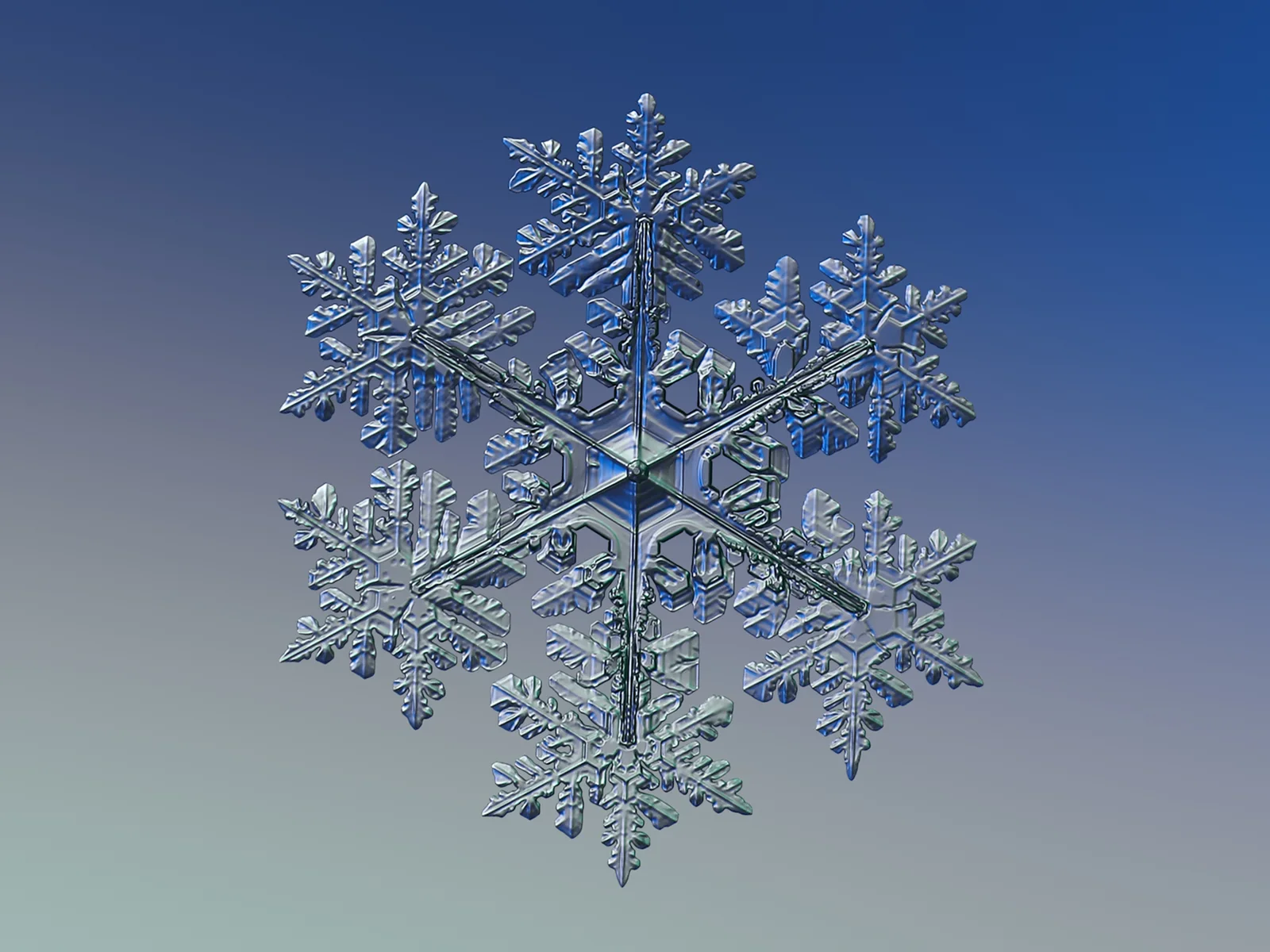
A six-armed snow crystal photographed in 2021, its arms branched almost alike; generous ones of this kind measure about 3 mm tip to tip in Libbrecht's guide [10−3 m].
Color: native (clear ice seen against a coloured background; the lighting is not described)
"Real snowflake - Flickr - Alexey Kljatov (6)" by Alexey Kljatov — https://commons.wikimedia.org/wiki/File:Real_snowflake_-_Flickr_-_Alexey_Kljatov_(6).jpg — CC BY 4.0 (https://creativecommons.org/licenses/by/4.0/)

Are no two snowflakes alike?
The saying probably goes back to Bentley's photographs, Libbrecht suggests, and his answer depends on what alike means. Down to the last molecule, no two crystals of ordinary size match. About 1 water molecule in 5,000 carries a deuterium atom and about 1 in 500 an oxygen-18 atom, so a small crystal of some 1018 molecules holds about 1015 odd ones, scattered at random. Only a crystal of a handful of molecules could be repeated exactly.
Loosen alike to mean alike under an optical microscope, where Libbrecht puts the smallest visible features at about 1 µm. The Zoom ladder's 0.2 µm line is a separate limit, for telling two points apart with green light and an oil-immersion lens. By that looser test, simple prisms can look alike. Libbrecht shows two nearly identical small plates that landed side by side in his lab.
Complex crystals almost certainly cannot. He compares their features to books on a shelf: 15 books can stand in over a trillion orders, and 100 books in just under 10158. A complex crystal often shows about a hundred separate features, against about 1024 snow crystals made each year.
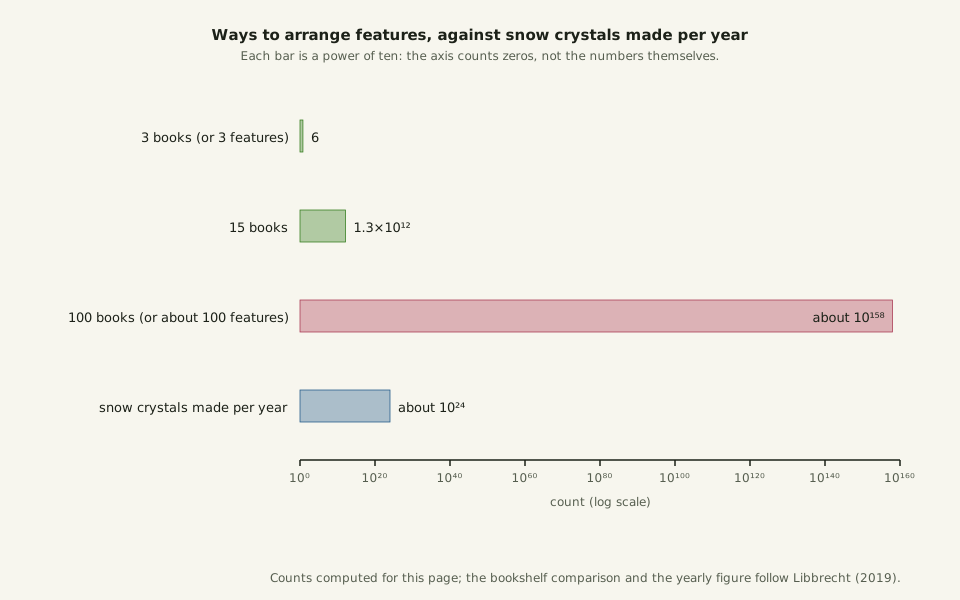
Slide the diagram sideways to read its labels, or open it full size.
Arrangements of a crystal's features as books on a shelf: 6 for 3, 1.3×10¹² for 15, about 10158 for 100, against about 1024 snow crystals a year, each about 0.3–3 mm [10−4–10−3 m] (counts computed).
Data: snowflakes-alike.csv (sources, version and license, JSON).
"Ways to arrange a crystal's features, on a log axis" by Ants, Cells & Atoms, https://antscellsandatoms.com/molecules/snowflakes/ — CC BY 4.0 (https://creativecommons.org/licenses/by/4.0/)
Data: Bookshelf comparison, about a hundred features and about 10^24 snow crystals a year: Libbrecht KG, Snow Crystals, monograph, arXiv 1910.06389 v2 (2021), https://arxiv.org/abs/1910.06389, retrieved 2026-10-24; Factorials computed 2026-10-25
Data: Libbrecht KG, Snow Crystals, monograph, arXiv 1910.06389 v2 (2021), https://arxiv.org/abs/1910.06389, section 1.5, retrieved 2026-10-24; Factorials and the isotope product computed 2026-10-25
Lab twins come closest. Crystals grown side by side on one surface and put through the same changes grew into near copies, Libbrecht reports, though not identical in every detail. For plain crystals the question stays open: he finds it easy to imagine that sifting a reasonable number of simple Antarctic crystals would turn up a pair that look identical under a microscope. His account does not say how many that would take.
Sources
- Libbrecht KG. Snow Crystals. Monograph, arXiv:1910.06389 [cond-mat.mtrl-sci], version 2 (2021; first posted 2019). https://arxiv.org/abs/1910.06389 Read: full text (preprint monograph, version 2).
- Wikidata. Item Q283, water: chemical formula (P274) and PubChem CID (P662). CC0. https://www.wikidata.org/wiki/Q283 (read 2026-10-25) Read: full text of the item record. Text license: CC0 1.0 (https://creativecommons.org/publicdomain/zero/1.0/).
- Wikipedia contributors. "Phases of ice" (reached from the title Ice Ih). Wikipedia (read 2026-10-25). https://en.wikipedia.org/wiki/Phases_of_ice Read: full text; paraphrased only. Text license: CC BY-SA 4.0 (https://creativecommons.org/licenses/by-sa/4.0/).
- Piegari G, De Biase D, d'Aquino I, Prisco F, Fico R, Ilsami R, Pozzato N, Genovese A, Paciello O. "Diagnosis of Drowning and the Value of the Diatom Test in Veterinary Forensic Pathology." Frontiers in Veterinary Science 6:404 (2019). https://doi.org/10.3389/fvets.2019.00404 Read: full text. Text license: CC BY 4.0 (https://creativecommons.org/licenses/by/4.0/).
- Libbrecht KG. "A Quantitative Physical Model of the Snow Crystal Morphology Diagram." arXiv:1910.09067 [cond-mat.mtrl-sci], version 2 (2019). https://arxiv.org/abs/1910.09067 Read: full text (preprint, version 2).
Cite this page
Ants, Cells & Atoms. “Snowflakes: The Six-Fold Pattern Starts in the Molecule.” Published 2026-10-25. https://antscellsandatoms.com/molecules/snowflakes/. Accessed (add the date you read it).
No DOI is issued for entries. Figures made here are CC BY 4.0; see each caption for the license of photographs.
Related entries
 Illustration
Water Molecule: The Bent Shape Behind Floating Ice
Image: Illustration: Ants, Cells & Atoms, all rights reserved
Illustration: Ants, Cells & Atoms. Generated schematic illustration — not a photograph, micrograph or specimen record. © Ants, Cells & Atoms, all rights reserved.
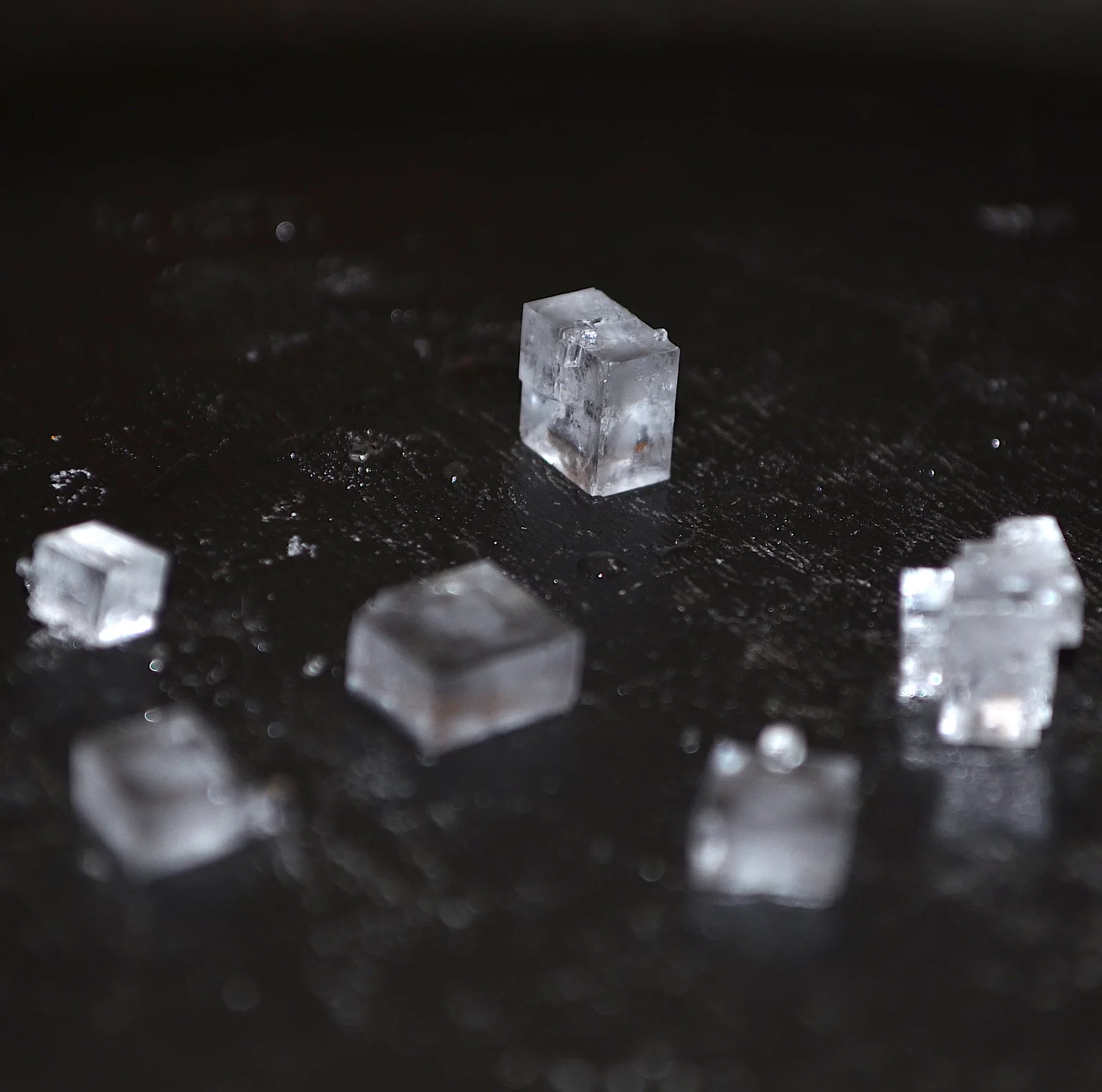
Sodium Chloride: Why a Salt Crystal Has No Molecules
Image: “Crystals of NaCl” by Alessandro e Damiano (2017) · CC BY 4.0
"Crystals of NaCl" by Alessandro e Damiano — https://commons.wikimedia.org/wiki/File:Crystals_of_NaCl.jpg — CC BY 4.0 (https://creativecommons.org/licenses/by/4.0/)

Acetylsalicylic Acid: A Form Made in 1853, 'Aspirin' in 1899
Image: “Filipendula ulmaria detail” by Marterum (2020) · CC0 1.0
"Filipendula ulmaria detail" by Marterum — https://commons.wikimedia.org/wiki/File:Filipendula_ulmaria_detail.jpg — CC0 1.0 (https://creativecommons.org/publicdomain/zero/1.0/)
