Acetylsalicylic Acid: A Form Made in 1853, 'Aspirin' in 1899

Slide the ladder sideways to read its labels, or open it full size.
Acetylsalicylic acid: 0.79–0.80 nm between the farthest nuclei, 1.03–1.04 nm with van der Waals radii, in computed shapes [10−10–10−9 m].
Log scale from 10 cm to 0.1 nm, each rung ten times smaller; dashed lines: naked eye about 0.1 mm, light microscope about 0.2 µm (how to read the Zoom ladder). Data: aspirin-conformer.csv (sources, version and license, JSON).
"Zoom ladder: acetylsalicylic acid" by Ants, Cells & Atoms, https://antscellsandatoms.com/molecules/aspirin/ — CC BY 4.0 (https://creativecommons.org/licenses/by/4.0/)
Data sources for this figure
Data: Structure: Wikidata Q18216, canonical SMILES (P233), CC0, retrieved 2026-10-24; Bond lengths and angles of benzene, phenol, acetic acid and methyl formate: NIST Computational Chemistry Comparison and Benchmark Database, Release 22 (SRD 101), experimental geometries citing Herzberg 1966 and Hellwege & Hellwege 1976, retrieved 2026-10-24; van der Waals radii H 120, C 170, O 152 pm: Bondi 1964, as listed in PubChem element records 1, 6 and 8, retrieved 2026-10-24; Shapes and lengths computed 2026-10-24
Data sources for this figure
Data: Structure: Wikidata Q18216, canonical SMILES (P233), CC0, retrieved 2026-10-24; Bond lengths and angles of benzene, phenol, acetic acid and methyl formate: NIST Computational Chemistry Comparison and Benchmark Database, Release 22 (SRD 101), experimental geometries citing Herzberg 1966 and Hellwege & Hellwege 1976, retrieved 2026-10-24; van der Waals radii H 120, C 170, O 152 pm: Bondi 1964, as listed in PubChem element records 1, 6 and 8, retrieved 2026-10-24; Formula and heavy-atom count checked against PubChem CID 2244, National Library of Medicine, retrieved 2026-10-24; Shapes, ranges and rule tests computed 2026-10-24
Bench card
- Name
- aspirin (acetylsalicylic acid; 2-acetyloxybenzoic acid)Source: Wikidata Q18216 and PubChem CID 2244 record, https://www.wikidata.org/wiki/Q18216
- Formula
- C9H8O4Source: Wikidata Q18216 (P274), matching PubChem CID 2244, https://www.wikidata.org/wiki/Q18216
- PubChem CID
- 2244Source: Wikidata Q18216 (P662), checked against the PubChem record, https://www.wikidata.org/wiki/Q18216
- Shape
- benzene ring with a carboxyl group and, on the next ring carbon, an acetoxy group; three single bonds can turnSource: PubChem CID 2244 (rotatable bond count 3, computed by PubChem); shapes computed for this page, https://doi.org/10.1093/nar/gkae1059
- Size
- longest dimension 0.79–0.80 nm nucleus to nucleus, 1.03–1.04 nm with van der Waals radii, across computed shapes as two single bonds and the methyl group turn (not measured) [10−10–10−9 m]Source: computed for this page from the Wikidata SMILES with bond lengths and angles measured in benzene, phenol, acetic acid and methyl formate (NIST CCCBDB), https://www.wikidata.org/wiki/Q18216
- Found in
- made from salicylic acid and acetic anhydride; reported in Glycyrrhiza glabra (LOTUS); willow bark holds the related salicin (CID 439503)Source: PubChem CID 2244 (Hazardous Substances Data Bank; LOTUS natural products database); salicin in willow bark: Wood 2015, https://doi.org/10.1098/rstb.2014.0317
aspirin-bench.csv (CSV) · where each value comes from, and its license (JSON)
Data: Wikidata Q18216 (formula P274, PubChem CID P662), CC0, retrieved 2026-10-24; PubChem CID 2244: rotatable bond count, Hazardous Substances Data Bank manufacturing entry and LOTUS natural products occurrence, National Library of Medicine, retrieved 2026-10-24; Wood JN 2015, Philosophical Transactions of the Royal Society B 370:20140317, CC BY 4.0, https://doi.org/10.1098/rstb.2014.0317, retrieved 2026-10-24; Size computed 2026-10-24
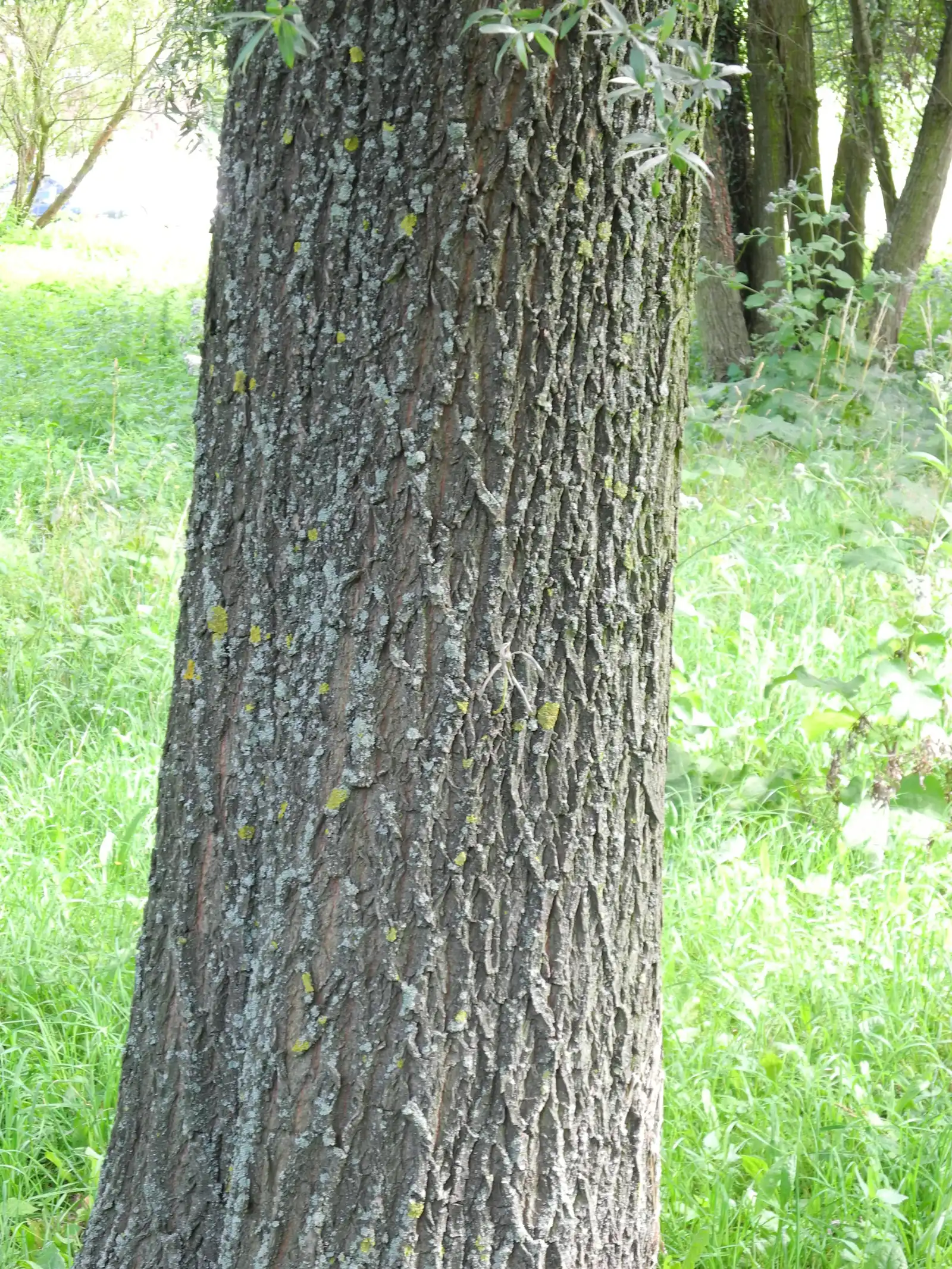
Bark of a white willow, Salix alba, the tree salicin is named after; the photo gives no size, and one acetylsalicylic acid molecule spans 0.79–1.04 nm from farthest nuclei to van der Waals outline (computed) [10−10–10−9 m].
Color: native (outdoor photograph; no dye)
"Salix alba bark (Andreas Plank)" by Andreas Plank — https://commons.wikimedia.org/wiki/File:Salix_alba_bark_(Andreas_Plank).jpg — CC BY-SA 3.0 (https://creativecommons.org/licenses/by-sa/3.0/)

Salicin takes its name from the Latin name of the white willow, Salix alba, Wikipedia's article on salicylic acid says. Aspirin is not pressed out of the bark, though. It is made from salicylic acid, a compound a step or two away from salicin.
 Illustration
Strips of willow bark beside a laboratory flask.
Illustration — not to scale
Illustration: Ants, Cells & Atoms. Generated schematic illustration — not a photograph, micrograph or specimen record. © Ants, Cells & Atoms, all rights reserved.
Is aspirin made from willow bark?
Not directly. Salicin is a glucoside: a glucose unit joined to salicyl alcohol, a benzene ring that carries a CH2OH group. That is how the ChEBI description in PubChem's record of salicin puts it.
Wood's history credits Johann Andreas Buchner with first isolating a substance from the bark. It gives 1827 in its text and cites a Buchner paper of 1828, and a 2021 commentary by Rezabakhsh and colleagues dates salicin to 1828. In 1829 Henri Leroux obtained about 30 g of purified salicin from 1.5 kg of bark, Wood adds.
Salicin then had to lose its sugar. By Wikipedia's account of salicylic acid, the Italian chemist Raffaele Piria split salicin into a sugar and a second compound that becomes salicylic acid when oxidised. German researchers also isolated salicylic acid from meadowsweet in 1839, the same article says.
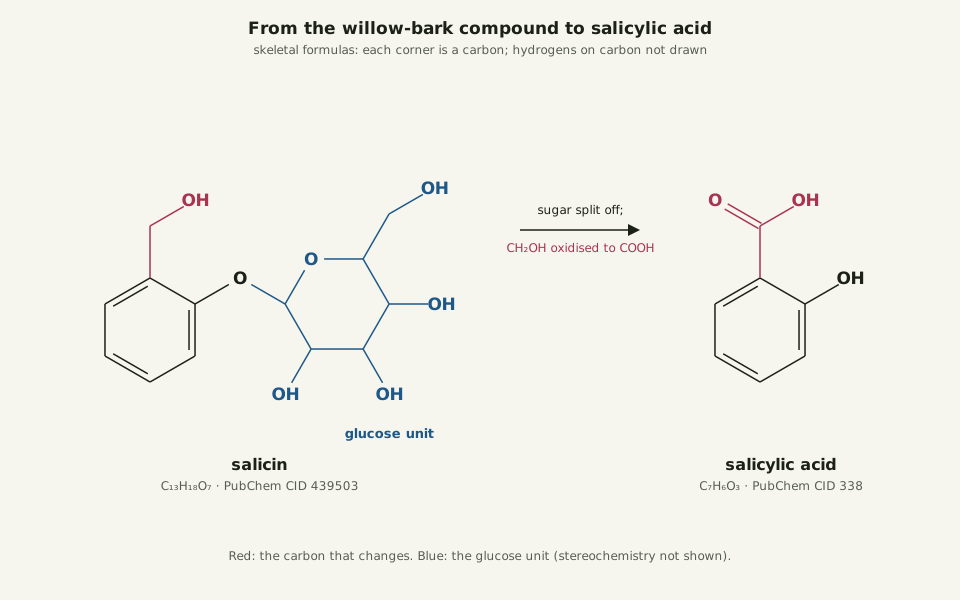
Slide the diagram sideways to read its labels, or open it full size.
Salicin (C13H18O7, CID 439503) beside salicylic acid (C7H6O3, CID 338): the same ring, without the glucose unit, with COOH in place of CH2OH.
Skeletal formulas drawn from the Wikidata structures; the sugar's stereochemistry is not shown.
"Salicin and salicylic acid" by Ants, Cells & Atoms, https://antscellsandatoms.com/molecules/aspirin/ — CC BY 4.0 (https://creativecommons.org/licenses/by/4.0/)
Data: Structures: Wikidata Q419173 (P2017) and Q193572 (P233), CC0, retrieved 2026-10-24; Formulas and identifiers: PubChem CID 439503 and CID 338, National Library of Medicine, retrieved 2026-10-24; 2D layout computed 2026-10-24
Salicylic acid later came from flasks as well. Hermann Kolbe described and synthesized it in 1859, by Fijałkowski and colleagues' 2022 review. In 1874 Friedrich von Heyden set out to produce synthetic salicylic acid in his own company, Rezabakhsh and colleagues note.
PubChem's record of salicylic acid lists it both as obtained from white willow bark and as prepared synthetically. Acetylsalicylic acid is made by reacting salicylic acid with acetic anhydride, the Hazardous Substances Data Bank entry in PubChem's record states.
What did Gerhardt make in 1853?
Charles Gerhardt, a French chemist, published a paper on anhydrous organic acids in 1853. It appeared in the Annalen der Chemie und Pharmacie and is cited here only from its bibliographic record. Later sources describe what he made.
Rezabakhsh and colleagues say he was the first to treat sodium salicylate with acetyl chloride to make acetylsalicylic acid. Wood calls the result a form of acetylsalicylic acid made during his studies of anhydrides.
Wikipedia's article on Gerhardt describes his acetylsalicylic acid as unstable and impure. By Wood's account, a pure version came from von Gilm in 1859, and in 1869 Schröder, Prinzhorn and Kraut described its structure after repeating both men's work.
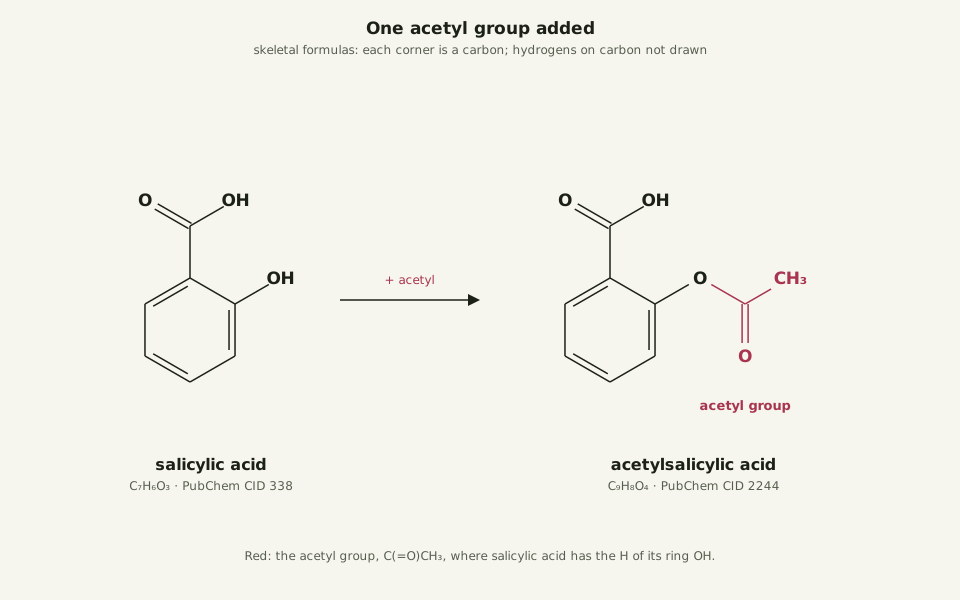
Slide the diagram sideways to read its labels, or open it full size.
Salicylic acid (C7H6O3, CID 338) and acetylsalicylic acid (C9H8O4, CID 2244): one acetyl group, in red, replaces the H of the ring's OH.
Skeletal formulas drawn from the Wikidata structures.
"Salicylic acid and acetylsalicylic acid" by Ants, Cells & Atoms, https://antscellsandatoms.com/molecules/aspirin/ — CC BY 4.0 (https://creativecommons.org/licenses/by/4.0/)
Data: Structures: Wikidata Q193572 and Q18216 (P233), CC0, retrieved 2026-10-24; Formulas and identifiers: PubChem CID 338 and CID 2244, National Library of Medicine, retrieved 2026-10-24; 2D layout computed 2026-10-24
PubChem lists the compound today under the systematic name 2-acetyloxybenzoic acid. An acetyl group, C(=O)CH3, sits where salicylic acid has the hydrogen of its ring's OH group, which takes the formula from C7H6O3 to C9H8O4. Everything else, the six-carbon ring and the COOH group beside it, stays as it was.
Who at Bayer made it pure in 1897?
On 10 August 1897, Felix Hoffmann, a chemist at Bayer, recorded making acetylsalicylic acid in a pure, stable form. Fijałkowski and colleagues call that date the compound's birthday. Arthur Eichengrün, a Bayer colleague, later said that Hoffmann had worked under his direction, and Wood's history says it now seems the compound was made at Bayer earlier, under Eichengrün.
Wikipedia's article on Hoffmann says he was first named the inventor in a footnote of a 1934 German encyclopedia. Eichengrün gave his own version in a 1949 paper in Pharmazie, the same article says, and died that year. Wood adds that Eichengrün claimed his part had been removed from the archives in the Nazi period, and that Walter Sneader's 2000 reappraisal in the BMJ supports him. Sneader's paper is cited here only from its bibliographic record.
Bayer went on highlighting Hoffmann's role, Wood notes. Wikipedia's article on Eichengrün says the company points to Hoffmann's laboratory journal entry of 10 August 1897 and to the American patent application, which names him. As of the 2015 history, the question of credit was still open.
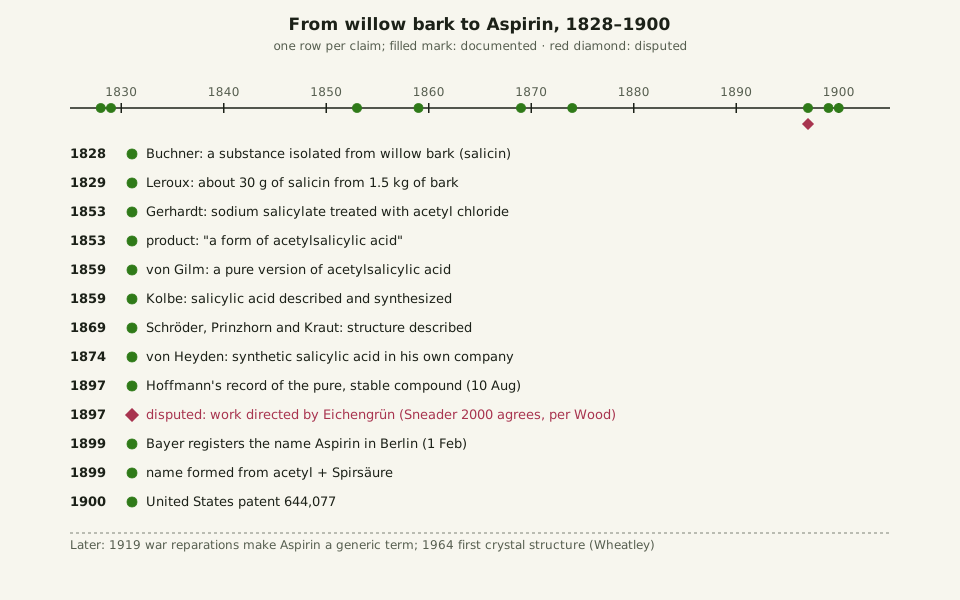
Slide the diagram sideways to read its labels, or open it full size.
Acetylsalicylic acid from 1828 to 1900: one row per claim, with the 1897 credit disputed.
Data: aspirin-timeline.csv (sources, version and license, JSON).
"From willow bark to Aspirin, 1828 to 1900" by Ants, Cells & Atoms, https://antscellsandatoms.com/molecules/aspirin/ — CC BY 4.0 (https://creativecommons.org/licenses/by/4.0/)
Data sources for this figure
Data: Wood JN 2015, From plant extract to molecular panacea, Philosophical Transactions of the Royal Society B 370:20140317, CC BY 4.0, https://doi.org/10.1098/rstb.2014.0317, retrieved 2026-10-24; Rezabakhsh A, Mahmoodpoor A, Soleimanpour H 2021, Historical perspective of aspirin, Journal of Cardiovascular and Thoracic Research 13(2):179–180, CC BY 4.0, https://doi.org/10.34172/jcvtr.2021.28, retrieved 2026-10-24; Fijałkowski Ł et al. 2022, Acetylsalicylic Acid–Primus Inter Pares in Pharmacology, Molecules 27(23):8412, CC BY 4.0, https://doi.org/10.3390/molecules27238412, retrieved 2026-10-24
| Year | Event | Who | Status | Source |
|---|---|---|---|---|
| 1828 | a substance isolated from willow bark (1827 in Wood's text) | Johann Andreas Buchner | documented | Wood 2015 (Buchner, his 1828 paper); Rezabakhsh et al. 2021 (1828) |
| 1829 | about 30 g of purified salicin from 1.5 kg of bark | Henri Leroux | documented | Wood 2015 |
| 1853 | sodium salicylate treated with acetyl chloride | Charles Gerhardt | documented | Rezabakhsh et al. 2021 |
| 1853 | product described as a form of acetylsalicylic acid | Charles Gerhardt | documented | Wood 2015 |
| 1859 | a pure version of acetylsalicylic acid | von Gilm | documented | Wood 2015 |
| 1859 | salicylic acid described and synthesized | Hermann Kolbe | documented | Fijałkowski et al. 2022 |
| 1869 | structure described, repeating earlier work | Schröder, Prinzhorn and Kraut | documented | Wood 2015 |
| 1874 | decided to make synthetic salicylic acid in his own company | Friedrich von Heyden | documented | Rezabakhsh et al. 2021 |
| 1897 | pure, stable compound recorded (10 August) | Felix Hoffmann | documented | Wood 2015; Fijałkowski et al. 2022 |
| 1897 | work directed by Eichengrün | Arthur Eichengrün | disputed | Wood 2015, citing Sneader 2000 |
| 1899 | name Aspirin registered in Berlin (1 February) | Bayer | documented | Fijałkowski et al. 2022 |
| 1899 | name formed from acetyl and Spirsäure | Bayer | documented | Wood 2015 (name); Fijałkowski et al. 2022 (year) |
| 1900 | United States patent 644,077 | Bayer | documented | Fijałkowski et al. 2022 |
| 1919 | war reparations make Aspirin a generic term | — | documented | Wood 2015 |
| 1964 | first crystal structure | P. J. Wheatley | documented | Fijałkowski et al. 2022 |
Where does the name Aspirin come from?
On 1 February 1899 Bayer registered the trademark name Aspirin in Berlin, by Fijałkowski and colleagues' account. The compound received United States patent 644,077 in 1900, the same review adds. The name joins acetyl with Spirsäure, a German name for salicylic acid, Wood writes. Wikipedia's article on aspirin ties the spir- to meadowsweet, then placed in the genus Spiraea, and the -in to a common ending for drug names of the time.
GBIF now lists Spiraea ulmaria as a synonym under Filipendula ulmaria, the name meadowsweet goes by today.
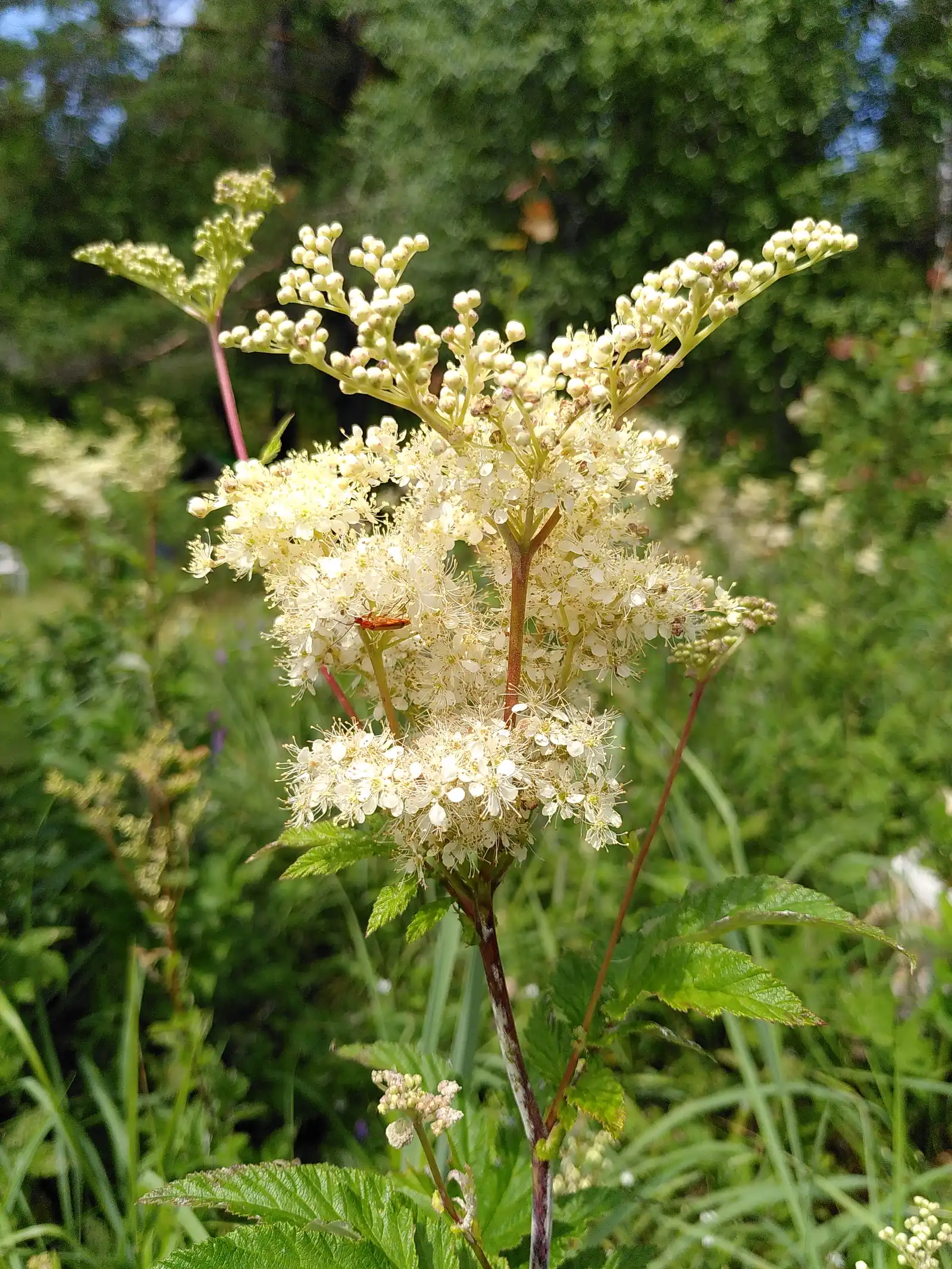
Meadowsweet, Filipendula ulmaria, once classed as Spiraea ulmaria, in flower; the photographer gives no size for the plant.
Color: native (outdoor photograph; no dye)
"Filipendula ulmaria detail" by Marterum — https://commons.wikimedia.org/wiki/File:Filipendula_ulmaria_detail.jpg — CC0 1.0 (https://creativecommons.org/publicdomain/zero/1.0/)

Whether the capitalised Aspirin is still a trademark depends on the country. Reparations after the First World War made Aspirin a generic term for the product of many companies, Wood writes, without naming the countries. As of 2026, Wikipedia's article on aspirin says Bayer lost its rights to the name in some countries in actions taken between 1918 and 1921. Aspirin with a capital A remains Bayer's registered trademark in many others, the same article says.
How big is an aspirin molecule?
Acetylsalicylic acid has 21 atoms: 9 carbon, 8 hydrogen and 4 oxygen. PubChem counts it as one covalently bonded unit where sodium chloride counts two. PubChem also lists three rotatable bonds, single bonds that let part of the molecule turn, so it has no single shape.
The shapes are computed for this page from the Wikidata structure, with bond lengths and angles measured in benzene, phenol, acetic acid and methyl formate (NIST CCCBDB). Two of the three bonds turn in 10° steps, the methyl group in 30°; the ester bond keeps the methyl formate arrangement. Of 5,184 settings, 2,328 keep atoms three or more bonds apart at least three quarters of their summed van der Waals radii apart, and none is compared with measured coordinates of aspirin.
Across those shapes the farthest nuclei, a ring hydrogen and a methyl hydrogen, stay 0.79–0.80 nm apart (computed). That ring hydrogen sits on the line of the ring-to-oxygen bond, one of the turning axes. So the span barely changes. With van der Waals spheres the outline is 1.03–1.04 nm; where an atom's edge lies is the atom page's question.
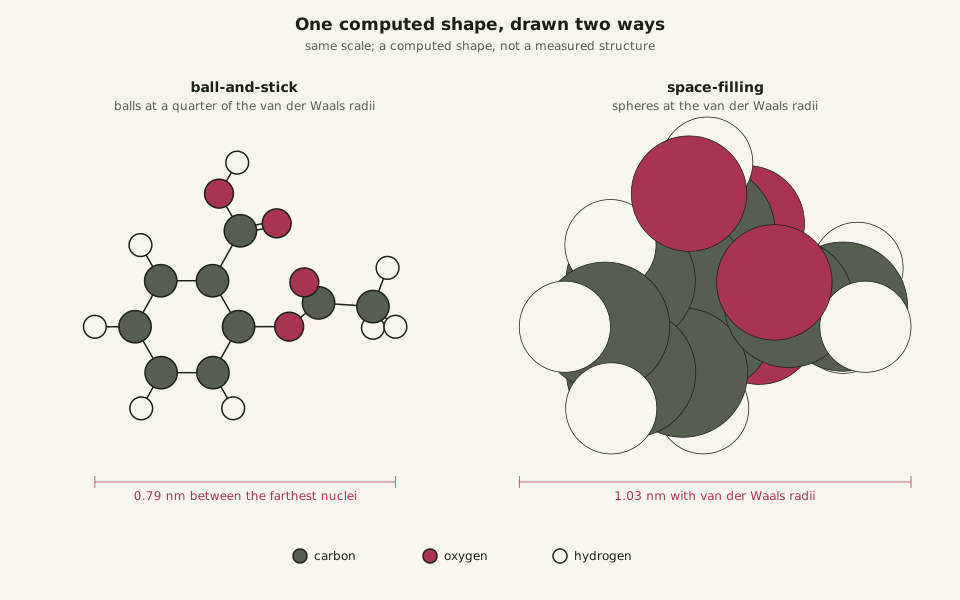
Slide the diagram sideways to read its labels, or open it full size.
One computed shape of acetylsalicylic acid: 0.79 nm between the farthest nuclei with balls and sticks, 1.03 nm with van der Waals spheres [10−10–10−9 m].
Of the two, the space-filling drawing is closer to the electron cloud. Radii H 1.20, C 1.70, O 1.52 Å. Data: aspirin-coordinates.csv (sources, version and license, JSON), aspirin-conformer.csv (sources, version and license, JSON).
"Acetylsalicylic acid, with sticks and without" by Ants, Cells & Atoms, https://antscellsandatoms.com/molecules/aspirin/ — CC BY 4.0 (https://creativecommons.org/licenses/by/4.0/)
Data sources for this figure
Data: Structure: Wikidata Q18216, canonical SMILES (P233), CC0, retrieved 2026-10-24; Bond lengths and angles of benzene, phenol, acetic acid and methyl formate: NIST Computational Chemistry Comparison and Benchmark Database, Release 22 (SRD 101), experimental geometries citing Herzberg 1966 and Hellwege & Hellwege 1976, retrieved 2026-10-24; van der Waals radii H 120, C 170, O 152 pm: Bondi 1964, as listed in PubChem element records 1, 6 and 8, retrieved 2026-10-24; Coordinates and lengths computed 2026-10-24
Data sources for this figure
Data: Structure: Wikidata Q18216, canonical SMILES (P233), CC0, retrieved 2026-10-24; Bond lengths and angles of benzene, phenol, acetic acid and methyl formate: NIST Computational Chemistry Comparison and Benchmark Database, Release 22 (SRD 101), experimental geometries citing Herzberg 1966 and Hellwege & Hellwege 1976, retrieved 2026-10-24; van der Waals radii H 120, C 170, O 152 pm: Bondi 1964, as listed in PubChem element records 1, 6 and 8, retrieved 2026-10-24; Coordinates computed 2026-10-24
Data sources for this figure
Data: Structure: Wikidata Q18216, canonical SMILES (P233), CC0, retrieved 2026-10-24; Bond lengths and angles of benzene, phenol, acetic acid and methyl formate: NIST Computational Chemistry Comparison and Benchmark Database, Release 22 (SRD 101), experimental geometries citing Herzberg 1966 and Hellwege & Hellwege 1976, retrieved 2026-10-24; van der Waals radii H 120, C 170, O 152 pm: Bondi 1964, as listed in PubChem element records 1, 6 and 8, retrieved 2026-10-24; Formula and heavy-atom count checked against PubChem CID 2244, National Library of Medicine, retrieved 2026-10-24; Shapes, ranges and rule tests computed 2026-10-24
With balls and sticks the molecule looks like an open frame; with spheres the atoms overlap and hide every bond. This site calls the habit of drawing bonds as rods the stick fiction, and sets both drawings side by side, as on the water molecule page.
Measured shapes exist in crystals. Aspirin's first crystal structure appeared in 1964 and was confirmed more accurately about 20 years later, and 30 sat in the Cambridge Structural Database by 2022, Fijałkowski and colleagues write. Which turn of the ring-to-oxygen bond each crystal holds, and whether a lone molecule in a vapour keeps it, the computed range here cannot settle.
Sources
- Wood JN. "From plant extract to molecular panacea: a commentary on Stone (1763) 'An account of the success of the bark of the willow in the cure of the agues'." Philosophical Transactions of the Royal Society B 370(1666):20140317 (2015). https://doi.org/10.1098/rstb.2014.0317 Read: full text. Text license: CC BY 4.0 (https://creativecommons.org/licenses/by/4.0/).
- Fijałkowski Ł, Skubiszewska M, Grześk G, Koech FK, Nowaczyk A. "Acetylsalicylic Acid–Primus Inter Pares in Pharmacology." Molecules 27(23):8412 (2022). https://doi.org/10.3390/molecules27238412 Read: full text (sections 2 and 3). Text license: CC BY 4.0 (https://creativecommons.org/licenses/by/4.0/).
- Wikipedia contributors. "Salicylic acid." Wikipedia (read 2026-10-24). https://en.wikipedia.org/wiki/Salicylic_acid Read: full text; paraphrased only. Text license: CC BY-SA 4.0 (https://creativecommons.org/licenses/by-sa/4.0/).
- PubChem, compound CID 439503 (Salicin), National Library of Medicine, including the ChEBI description; database described in Kim S, et al. "PubChem 2025 update." Nucleic Acids Research 53(D1):D1516–D1525 (2025). https://doi.org/10.1093/nar/gkae1059 Read: full text of the compound record.
- Rezabakhsh A, Mahmoodpoor A, Soleimanpour H. "Historical perspective of aspirin: A journey from discovery to clinical practice Ancient and modern history." Journal of Cardiovascular and Thoracic Research 13(2):179–180 (2021). https://doi.org/10.34172/jcvtr.2021.28 Read: full text. Text license: CC BY 4.0 (https://creativecommons.org/licenses/by/4.0/).
- PubChem, compound CID 2244 (Aspirin), National Library of Medicine, including entries from the Hazardous Substances Data Bank and the LOTUS natural products database; database described in Kim S, et al. "PubChem 2025 update." Nucleic Acids Research 53(D1):D1516–D1525 (2025). https://doi.org/10.1093/nar/gkae1059 Read: full text of the compound record (identity, computed properties, manufacturing and occurrence); medical sections not used.
- PubChem, compound CID 338 (Salicylic Acid), National Library of Medicine; database described in Kim S, et al. "PubChem 2025 update." Nucleic Acids Research 53(D1):D1516–D1525 (2025). https://doi.org/10.1093/nar/gkae1059 Read: full text of the compound record.
- Gerhardt C. "Untersuchungen über die wasserfreien organischen Säuren." Annalen der Chemie und Pharmacie 87:149–179 (1853). https://doi.org/10.1002/jlac.18530870206 Read: bibliographic record only.
- Wikipedia contributors. "Charles Frédéric Gerhardt." Wikipedia (read 2026-10-24). https://en.wikipedia.org/wiki/Charles_Fr%C3%A9d%C3%A9ric_Gerhardt Read: full text; paraphrased only. Text license: CC BY-SA 4.0 (https://creativecommons.org/licenses/by-sa/4.0/).
- Wikipedia contributors. "Felix Hoffmann." Wikipedia (read 2026-10-24). https://en.wikipedia.org/wiki/Felix_Hoffmann Read: full text; paraphrased only. Text license: CC BY-SA 4.0 (https://creativecommons.org/licenses/by-sa/4.0/).
- Sneader W. "The discovery of aspirin: a reappraisal." BMJ 321(7276):1591–1594 (2000). https://doi.org/10.1136/bmj.321.7276.1591 Read: bibliographic record only.
- Wikipedia contributors. "Arthur Eichengrün." Wikipedia (read 2026-10-24). https://en.wikipedia.org/wiki/Arthur_Eichengr%C3%BCn Read: full text; paraphrased only. Text license: CC BY-SA 4.0 (https://creativecommons.org/licenses/by-sa/4.0/).
- Wikipedia contributors. "Aspirin." Wikipedia (read 2026-10-24). https://en.wikipedia.org/wiki/Aspirin Read: full text of the history, brand and trademark sections; paraphrased only. Text license: CC BY-SA 4.0 (https://creativecommons.org/licenses/by-sa/4.0/).
- GBIF Secretariat. GBIF Backbone Taxonomy. Checklist dataset https://doi.org/10.15468/39omei, accessed 2026-10-24; Salix alba L., usage key 5372513; Filipendula ulmaria (L.) Maxim., usage key 2987999; Spiraea ulmaria L., usage key 2988053 (synonym of Filipendula ulmaria subsp. ulmaria, usage key 2988000); Glycyrrhiza glabra L., usage key 2965732. Read: dataset record (species match). Text license: CC BY 4.0 (https://creativecommons.org/licenses/by/4.0/).
- PubChem, compound CID 5234 (Sodium Chloride), Covalently-Bonded Unit Count, National Library of Medicine; database described in Kim S, et al. "PubChem 2025 update." Nucleic Acids Research 53(D1):D1516–D1525 (2025). https://doi.org/10.1093/nar/gkae1059 Read: full text of the covalently bonded unit entry.
- Wikidata. Items Q18216 (aspirin), Q193572 (salicylic acid) and Q419173 (salicin): SMILES (P233, P2017), chemical formula (P274) and PubChem CID (P662). CC0. https://www.wikidata.org/wiki/Q18216 (read 2026-10-24) Read: full text of the three item records. Text license: CC0 1.0 (https://creativecommons.org/publicdomain/zero/1.0/).
- NIST Computational Chemistry Comparison and Benchmark Database (CCCBDB), Standard Reference Database 101, Release 22 (May 2022). Experimental geometries of benzene (CAS 71-43-2, listing Herzberg 1966), phenol (CAS 108-95-2), acetic acid (CAS 64-19-7) and methyl formate (CAS 107-31-3) (listing Hellwege & Hellwege 1976, Landolt-Börnstein II/7). https://cccbdb.nist.gov/expgeom2x.asp?casno=71432 Read: full text of the four experimental geometry pages (values and reference codes); the books they cite were not read.
- PubChem, element records 1 (Hydrogen), 6 (Carbon) and 8 (Oxygen), Atomic Radius, National Library of Medicine; van der Waals radii contributed by the Los Alamos National Laboratory periodic table, originally from Bondi A. "van der Waals Volumes and Radii." The Journal of Physical Chemistry 68(3):441–451 (1964). https://doi.org/10.1093/nar/gkae1059 Read: full text of the Atomic Radius section of each element record.
Cite this page
Ants, Cells & Atoms. “Acetylsalicylic Acid: A Form Made in 1853, 'Aspirin' in 1899.” Published 2026-10-25. https://antscellsandatoms.com/molecules/aspirin/. Accessed (add the date you read it).
No DOI is issued for entries. Figures made here are CC BY 4.0; see each caption for the license of photographs.
Related entries
 Illustration
Water Molecule: The Bent Shape Behind Floating Ice
Image: Illustration: Ants, Cells & Atoms, all rights reserved
Illustration: Ants, Cells & Atoms. Generated schematic illustration — not a photograph, micrograph or specimen record. © Ants, Cells & Atoms, all rights reserved.
Sodium Chloride: Why a Salt Crystal Has No Molecules
Image: “Crystals of NaCl” by Alessandro e Damiano (2017) · CC BY 4.0
"Crystals of NaCl" by Alessandro e Damiano — https://commons.wikimedia.org/wiki/File:Crystals_of_NaCl.jpg — CC BY 4.0 (https://creativecommons.org/licenses/by/4.0/)

Snowflakes: The Six-Fold Pattern Starts in the Molecule
Image: “SnowflakesWilsonBentley” by Wilson Bentley (1902) · Public domain
"SnowflakesWilsonBentley" by Wilson Bentley (1902) — https://commons.wikimedia.org/wiki/File:SnowflakesWilsonBentley.jpg — Public domain (photographs by Wilson Bentley, who died in 1931, published as Plate XIX of his snow-crystal studies in the annual summary of the Monthly Weather Review for 1902: public domain in the US (published before 1930) and in the EU (life of the author plus 70 years, ended 2001); the scan is from the NOAA Historic NWS Collection (image wea02087))
