Water Strider: The Dimples Under Its Feet Hold Its Weight

Slide the ladder sideways to read its labels, or open it full size.
Water strider: body about 8–15 mm long [10−3–10−2 m]; each supporting leg wets about 7.5 mm of its length and is about 0.1 mm across.
Log scale from 10 cm to 0.1 nm; dashed lines are the naked-eye and light-microscope limits explained on the Zoom ladder page; the shaded band is the syrup line for water at 20 °C and 1–10 body lengths per second. Data: water-strider-sizes.csv (sources, version and license, JSON).
"Zoom ladder: water strider" by Ants, Cells & Atoms, https://antscellsandatoms.com/insects/water-strider/ — CC BY 4.0 (https://creativecommons.org/licenses/by/4.0/)
Data sources for this figure
Data: Fairbairn DJ, Roff DA, Wolak ME 2023, Heredity 131:109–118, CC BY 4.0, https://doi.org/10.1038/s41437-023-00626-5 (Aquarius remigis segment means; body lengths summed for this page); Yang E et al. 2016, Nature Communications 7:13698, CC BY 4.0, https://doi.org/10.1038/ncomms13698 (wetted leg length, leg radius, breaking depth); IAPWS R1-76(2014), R6-95(2018), R12-08: surface tension, density and viscosity of water computed for this page, attribution to the International Association for the Properties of Water and Steam; CODATA 2022 recommended values, NIST SRD 121: standard acceleration of gravity, retrieved 2026-10-24
Data: Fairbairn DJ, Roff DA, Wolak ME 2023, Heredity 131:109–118, CC BY 4.0, https://doi.org/10.1038/s41437-023-00626-5, retrieved 2026-10-24; Yang E et al. 2016, Nature Communications 7:13698, CC BY 4.0, https://doi.org/10.1038/ncomms13698, retrieved 2026-10-24; IAPWS R1-76(2014), R6-95(2018), R12-08, attribution to the International Association for the Properties of Water and Steam; values computed 2026-10-24; CODATA 2022 recommended values, NIST SRD 121, retrieved 2026-10-24
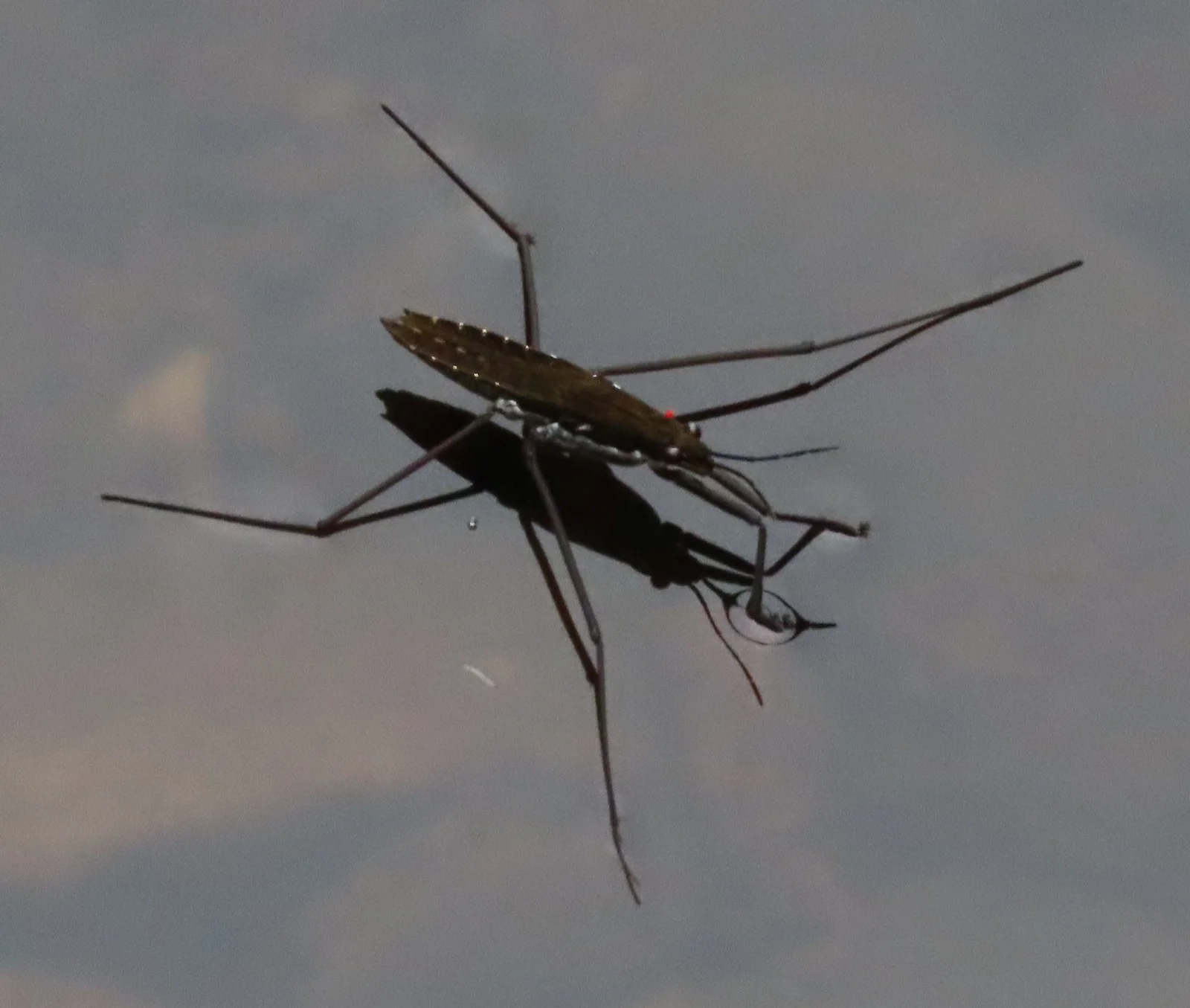
A common water strider, Aquarius remigis: wingless adults average about 11.5 mm (males) to 14.3 mm (females) in body length [10−2 m].
Color: native
"Aquarius remigis 140810489" by Jason Swanson — https://commons.wikimedia.org/wiki/File:Aquarius_remigis_140810489.jpg — CC0 1.0 (https://creativecommons.org/publicdomain/zero/1.0/)

What holds a water strider up?
A water strider stands on six legs, and at rest all six touch the water, by the account in Yang and colleagues' 2016 study of jumping striders. The middle pair is the longest and does the rowing. The front pair is short and grips prey, as Wikipedia's articles on the family and on Gerris lacustris describe it (read 2026-10-24).
On Aquarius remigis, a stream species of North America, the middle thigh alone averages about 9 mm, by the segment means Fairbairn, Roff and Wolak report in 2023. The body behind it is about 11.5 mm in males and 14.3 mm in females, sums of their head, thorax and abdomen means computed for this page.
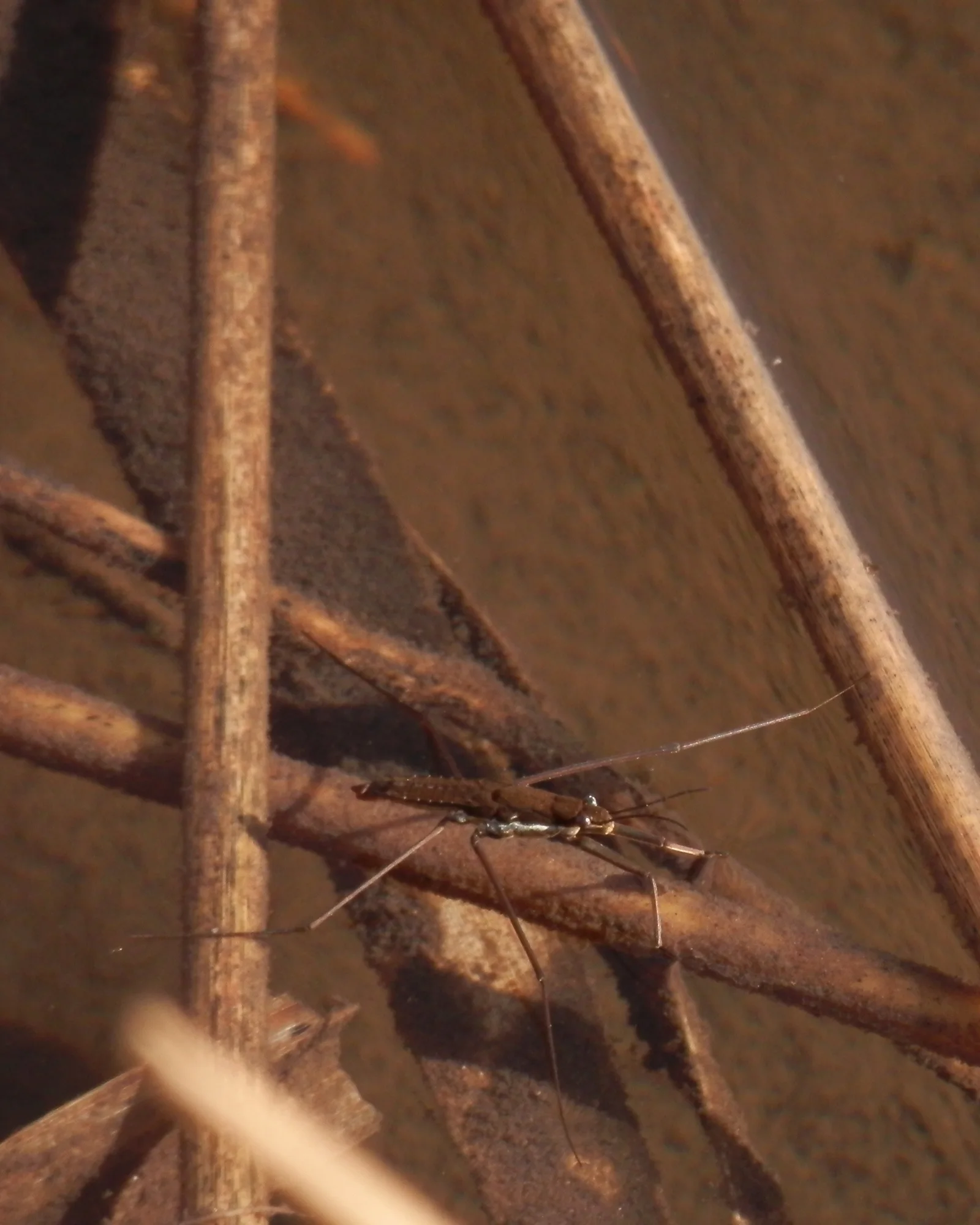
A water strider on the surface; adults of Aquarius remigis are about 11–14 mm long [10−2 m], and the middle pair of legs is the longest.
Color: native
"Common Water Strider (Aquarius remigis) - Guelph, Ontario 2014-05-06" by Ryan Hodnett — https://commons.wikimedia.org/wiki/File:Common_Water_Strider_(Aquarius_remigis)_-_Guelph,_Ontario_2014-05-06.jpg — CC BY-SA 4.0 (https://creativecommons.org/licenses/by-sa/4.0/)

Each leg lies along the surface instead of poking through it. Where the water meets the leg, a line of contact runs along both sides. Surface tension pulls on every millimetre of that line. Water at 20 °C has a surface tension of 72.74 mN per metre, by the 2014 IAPWS release.
A leg that wets 7.5 mm of its length, the representative value Yang and colleagues give for Gerris gracilicornis, can therefore take a pull of up to about 1.1 mN, counting both sides. That is nearly four times the 0.29 mN weight of a 30 mg strider, the body mass they use for the same species. The insect has four such legs behind it.
The laws of physics are the same for a strider and a person at the edge of the same pond. What changes with size is which term wins. Surface tension grows with the length of the contact line, and weight grows with the volume of the body, so shrinking a body tenfold cuts its weight a thousandfold and its contact line only tenfold. At 10 mm the line wins, and the same square-cube arithmetic is why the lifting of an ant looks heroic.
The 72.74 mN per metre belongs to the liquid, not to the insect. The Water Molecule entry traces where it comes from.
How much can surface tension carry?
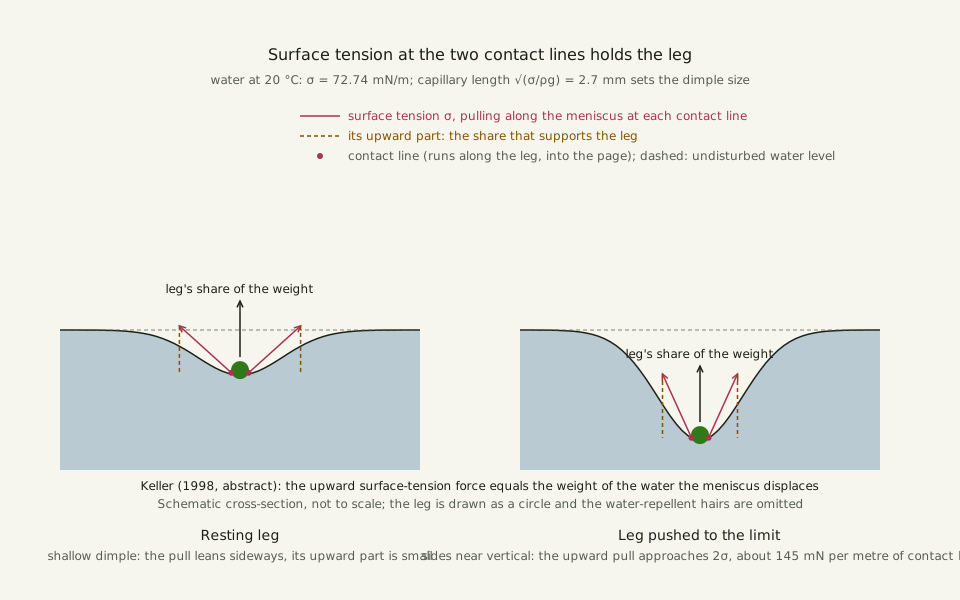
The pull on the contact line is not aimed straight up. It acts along the water surface where the surface meets the leg, and only the upward part of that pull carries weight. A resting leg sits in a shallow dent, the surface leans gently, and the upward part is small.
Press the leg down and the dent deepens. The surface at the rim steepens, and the upward part grows. The most the line can give per metre is twice the surface tension, once for each side of the leg, with both sides pulled vertical: about 145 mN per metre of leg in water at 20 °C.
Slide the diagram sideways to read its labels, or open it full size.
One leg in its dimple, in cross-section: the pull along each contact line steepens as the leg sinks, up to about 2σ, or 145 mN per metre of leg, in water at 20 °C [10−3 m] dimples.
Left, a resting leg; right, a leg pushed until the surface at the rim is nearly vertical. The dimple's width and depth are set by the 2.7 mm capillary length of water, computed for this page from the IAPWS releases and CODATA g.
"How a dimple holds a leg up" by Ants, Cells & Atoms, https://antscellsandatoms.com/insects/water-strider/ — CC BY 4.0 (https://creativecommons.org/licenses/by/4.0/)
Data sources for this figure
Data: IAPWS R1-76(2014) surface tension and IAPWS R6-95(2018) density, attribution to the International Association for the Properties of Water and Steam; values computed 2026-10-24; CODATA 2022 recommended values, NIST SRD 121, standard acceleration of gravity, retrieved 2026-10-24; Keller JB 1998, Physics of Fluids 10:3009–3010, https://doi.org/10.1063/1.869820 (statement named on the figure; abstract); Yang E et al. 2016, Nature Communications 7:13698, CC BY 4.0, https://doi.org/10.1038/ncomms13698 (the same statement applied to the four legs of a strider), retrieved 2026-10-24
The same upward pull can be described a second way. By Keller's account in 1998 (abstract), the upward part of the surface-tension force on a partly submerged body equals the weight of liquid its meniscus displaces, and it points up when the meniscus is pressed down. Yang and colleagues apply the same statement to the strider in 2016: the upward force on the four legs is equivalent to the weight of water displaced by the legs.
The title of this page is that sentence. A strider does not float like a boat, because its body never touches the water. Even so, the water bent down around its legs has to weigh exactly what the insect weighs.
A long thin leg can be pushed to about the square root of two times the capillary length before the surface closes over it, the critical depth Baek and colleagues use in 2020. The capillary length is the square root of surface tension over density times g. For water at 20 °C it is 2.73 mm, computed for this page, so the limit is about 3.9 mm.
Yang and colleagues watched legs break through at an average depth of 3.7 mm in their high-speed films, close to that limit. A leg pressed to the limit sits in a trough about 4 mm deep and a few millimetres wide, and the weight of water in that trough is what path B below adds up.
Why don't its legs get wet?
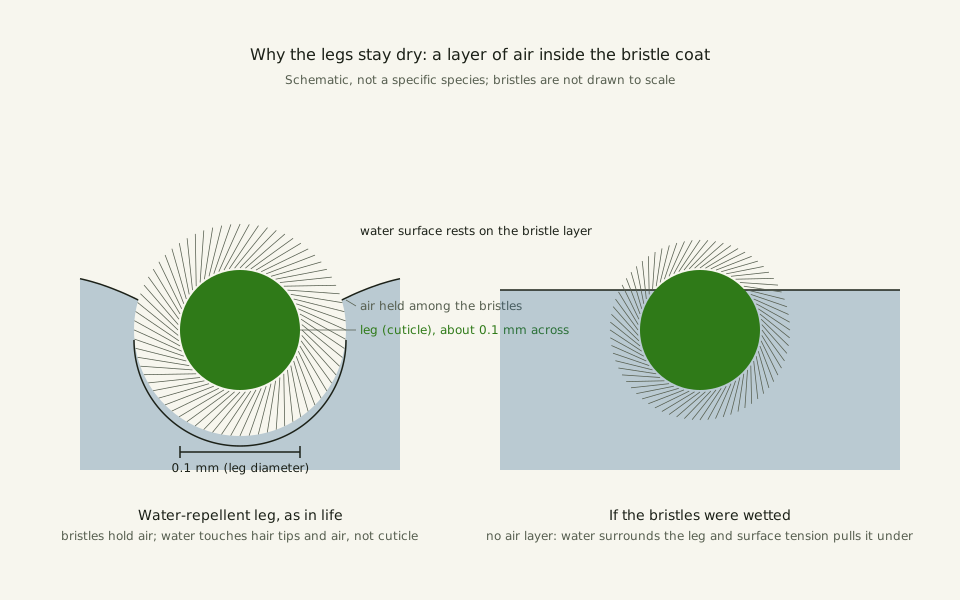
Everything above depends on dry legs. Once water wets a leg and closes over it, no contact line is left to hang from, and surface tension no longer holds it up. The legs stay dry because they are coated in bristles.
By their arrangement and density, the bristles trap a layer of air between the leg and the water, as the 2018 genome paper on Gerris buenoi by Armisén and colleagues puts it. Yang and colleagues describe the legs as superhydrophobic (strongly water-repelling) and hairy, citing a 2004 study by Gao and Jiang. By that study's account (abstract), the legs of Gerris remigis, the species now listed as Aquarius remigis, carry large numbers of oriented microsetae (small hairs) with fine nanogrooves, and this layered structure matters more than any secreted wax.
Slide the diagram sideways to read its labels, or open it full size.
A supporting leg end-on, about 0.1 mm across [10−4 m]: bristles hold air, and the water surface rests on hair tips and air rather than on the cuticle.
Schematic, not a specific species; the bristles are not drawn to scale, because the studies read for this page do not give their dimensions. The leg radius of about 50 µm at mid-tibia is from Yang and colleagues, 2016.
"A water-repellent leg, end on" by Ants, Cells & Atoms, https://antscellsandatoms.com/insects/water-strider/ — CC BY 4.0 (https://creativecommons.org/licenses/by/4.0/)
Data: Yang E et al. 2016, Nature Communications 7:13698, CC BY 4.0, https://doi.org/10.1038/ncomms13698, retrieved 2026-10-24; Armisén D et al. 2018, BMC Genomics 19:832, CC BY 4.0, https://doi.org/10.1186/s12864-018-5163-2, retrieved 2026-10-24
A supporting leg is about 0.1 mm across at mid-tibia, twice the 50 µm radius Yang and colleagues measured, and the bristles on it are smaller still. In this site's shorthand, every scale shares one statute book, but the court that rules a 0.1 mm leg almost never cites gravity. In plain terms, the Bond number at the leg's width, a ratio of gravity to surface tension for water at that size, is about 0.001, computed for this page. At 0.1 mm surface tension wins outright; the bristles matter because they keep the water from ever reaching the cuticle.
Wikipedia's article adds that the whole body carries several thousand such hairs per square millimetre. It also says a strider pushed under by a wave comes back up on the air the hairs trap (read 2026-10-24). Bristles a few micrometres across sit on the same rungs of the ladder as the threads of spider silk. The air held among them is a cousin of the air a water-living insect must keep breathing, a problem the How Do Insects Breathe entry takes up from the inside.
Two ways to check the numbers
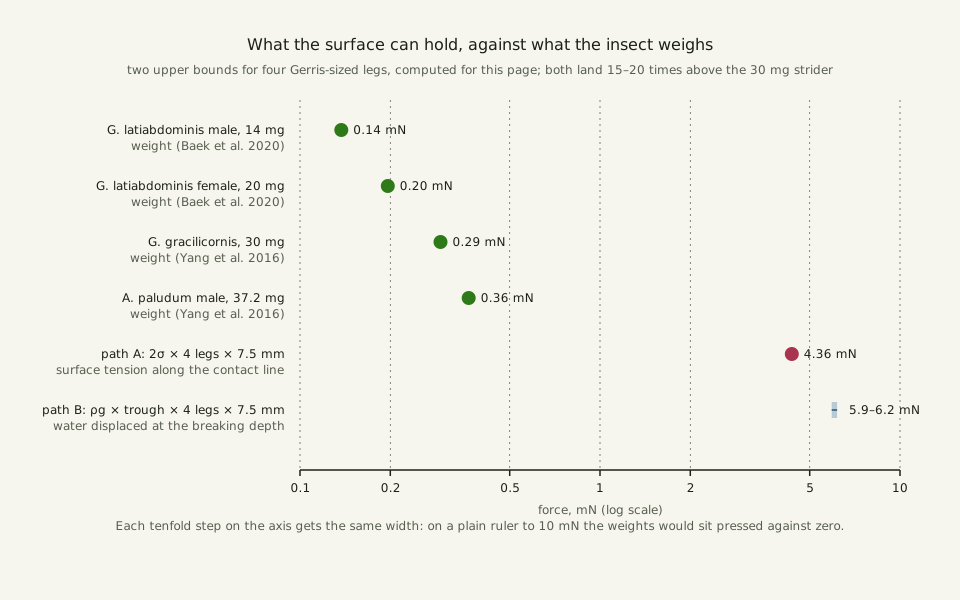
Path A adds up the contact line. Four supporting legs that each wet 7.5 mm give 30 mm of leg, two sides each, and at 72.74 mN per metre the most the surface can pull is about 4.4 mN.
For path B, weigh the water instead. A leg pushed to the 3.7 mm breaking depth displaces a trough that this page approximates as a rectangle 3.7 mm deep and two capillary lengths, 5.5 mm, wide. Water at 998 kg per cubic metre, by the IAPWS-95 formulation computed for this page, then gives about 5.9 mN for the same 30 mm of leg, or 6.2 mN at the theoretical 3.9 mm. The two routes use different main inputs, surface tension in one and density, gravity and a filmed depth in the other, with only the trough width borrowing the capillary length, and they land within a factor of two.
Slide the diagram sideways to read its labels, or open it full size.
What the surface can hold under four legs that each wet 7.5 mm [10−3 m], against the insects' weights of 0.14–0.36 mN; both estimates land near 4–6 mN, about 15–20 times the 0.29 mN weight of the 30 mg Gerris gracilicornis those leg lengths come from.
Weights are body masses from Yang and colleagues (2016) and Baek and colleagues (2020) times g. Data and arithmetic: water-strider-support.csv (sources, version and license, JSON).
"Weight against what the surface can hold" by Ants, Cells & Atoms, https://antscellsandatoms.com/insects/water-strider/ — CC BY 4.0 (https://creativecommons.org/licenses/by/4.0/)
Data: Yang E et al. 2016, Nature Communications 7:13698, CC BY 4.0, https://doi.org/10.1038/ncomms13698, retrieved 2026-10-24; Baek M et al. 2020, Scientific Reports 10:18657, CC BY 4.0, https://doi.org/10.1038/s41598-020-75564-x, retrieved 2026-10-24; IAPWS R1-76(2014), R6-95(2018), attribution to the International Association for the Properties of Water and Steam; values computed 2026-10-24; CODATA 2022 recommended values, NIST SRD 121, retrieved 2026-10-24
Data: Yang E et al. 2016, Nature Communications 7:13698, CC BY 4.0, https://doi.org/10.1038/ncomms13698, retrieved 2026-10-24; Baek M et al. 2020, Scientific Reports 10:18657, CC BY 4.0, https://doi.org/10.1038/s41598-020-75564-x, retrieved 2026-10-24; IAPWS R1-76(2014), R6-95(2018), R12-08, attribution to the International Association for the Properties of Water and Steam; values computed 2026-10-24; CODATA 2022 recommended values, NIST SRD 121, retrieved 2026-10-24
What the insects weigh
Against those 4–6 mN stand the insects. A 30 mg Gerris gracilicornis weighs 0.29 mN and a 37.2 mg male Aquarius paludum 0.36 mN, from the masses in Yang and colleagues. A Gerris latiabdominis male weighs about 0.14 mN and a female about 0.20 mN, masses computed for this page from the added-weight figures in Baek and colleagues, whose wires of 7.5 and 10.5 mg were about half the body mass.
The surface can hold 15–20 times what the 30 mg strider weighs, by either route. Yang and colleagues reach the same order from the other direction: in their scaling the weight is about a tenth of the capillary force. Their mass index for a typical strider, about 0.5, converts by their own formula to a weight near one sixteenth of the most surface tension could hold.
The margin is used. Baek and colleagues note that a mating male rides on the female's back for hours or days, and they cite reports that females can bear more than twice their own mass. Their experimental wires added about half the body mass without any insect going under.
Two-route agreement within a factor of two is also the standard this site applies when counting the cells in a human body. Here the agreement is expected: both routes are the same physics seen from the contact line and from the displaced water, so a gap larger than the rectangle approximation would have signalled an arithmetic error.
How does it move without sinking?
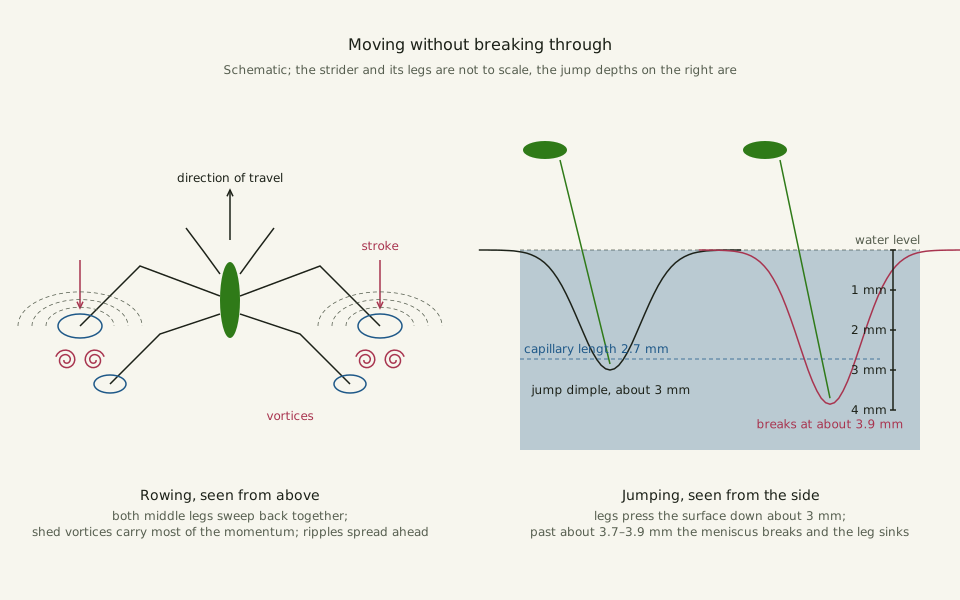
Standing still is the easy case; the strider also rows. Gerridae move with a rowing gait, both middle legs sculling at the same time, by the comparative study of Crumière and colleagues in 2016 and the genome paper of 2018, and in these rowers the middle legs are the longest.
By the account of Hu, Chan and Bush in 2003 (abstract), a strider hands its momentum to the water mostly through hemispherical vortices shed by its driving legs, with capillary waves carrying less. A stroke leaves a pair of dimples behind, and the water under them is pushed back as the insect goes forward.
Slide the diagram sideways to read its labels, or open it full size.
Rowing seen from above and a jump seen from the side: a jump dimple reaches about 3 mm and the surface breaks at about 3.7–3.9 mm [10−3 m], close to the square root of two times the 2.7 mm capillary length.
Stroke and vortices drawn from the descriptions in Yang and colleagues (2016), Crumière and colleagues (2016) and Armisén and colleagues (2018); depths from Yang and colleagues and Baek and colleagues.
"Rowing stroke and jump" by Ants, Cells & Atoms, https://antscellsandatoms.com/insects/water-strider/ — CC BY 4.0 (https://creativecommons.org/licenses/by/4.0/)
Data sources for this figure
Data: Yang E et al. 2016, Nature Communications 7:13698, CC BY 4.0, https://doi.org/10.1038/ncomms13698, retrieved 2026-10-24; Baek M et al. 2020, Scientific Reports 10:18657, CC BY 4.0, https://doi.org/10.1038/s41598-020-75564-x, retrieved 2026-10-24; Armisén D et al. 2018, BMC Genomics 19:832, CC BY 4.0, https://doi.org/10.1186/s12864-018-5163-2, retrieved 2026-10-24; IAPWS R1-76(2014), R6-95(2018), attribution to the International Association for the Properties of Water and Steam; values computed 2026-10-24
The jump
The same dents power the jump. When a backswimmer or fish attacks from below, the strider pushes its middle and hind legs down. The dimples deepen to about 3 mm in a Gerris gracilicornis jump, the representative value Yang and colleagues use, and the body leaves at a speed of the order of a metre per second, the scale they give.
Push too fast and a leg passes 3.7–3.9 mm before the push ends; the surface breaks, and the take-off speed drops sharply. In their films of 39 jumps, several broke the surface this way, and the rest left it unbroken. In the later experiments of Baek and colleagues the surface still broke in 25 % of jumps, late enough that the take-off speed was already set.
A leg stroke at Reynolds 15
A leg descending at 0.15 m per second, Yang and colleagues' representative value, is a 0.1 mm cylinder moving through water at 20 °C with a Reynolds number (the ratio of inertia to the water's stickiness) of about 15, computed for this page. That is well above the syrup line, where the Reynolds number falls to 1: for water at 20 °C and a swimmer moving 1–10 body lengths per second, that line sits near 0.3–1 mm. At Reynolds 15 inertia and stickiness both count, so the leg can shove water and leave a wake instead of only dragging it.
The Bumblebee Flight entry scores a beating wing at its own Reynolds number. Below the surface, the smaller drifters among the plankton, anything under about 0.3 mm moving at 1–10 body lengths per second in water at 20 °C, live below Reynolds 1, where a 10 µm swimmer at that pace meets water that behaves like syrup.
The resting case has the fewest measurements in the studies read here. By this page's arithmetic a resting 30 mg strider needs its dents to displace about 30 mm3 of water. Spread over 30 mm of leg, with each trough two capillary lengths wide, that is a mean depth of only about 0.2 mm. A side-on measurement of those resting dents, leg by leg, is in none of the studies read for this page.
Sources
- Yang E, Son JH, Lee S, Jablonski PG, Kim H. "Water striders adjust leg movement speed to optimize takeoff velocity for their morphology." Nature Communications 7:13698 (2016). https://doi.org/10.1038/ncomms13698 Read: full text. Text license: CC BY 4.0 (https://creativecommons.org/licenses/by/4.0/).
- Baek M, Lawin KM, Codden CJ, Lim H, Yang E, Kim H, Lee S, Jablonski PG. "Water strider females use individual experience to adjust jumping behaviour to their weight within physical constraints of water surface tension." Scientific Reports 10:18657 (2020). https://doi.org/10.1038/s41598-020-75564-x Read: full text. Text license: CC BY 4.0 (https://creativecommons.org/licenses/by/4.0/).
- Fairbairn DJ, Roff DA, Wolak ME. "Tests for associations between sexual dimorphism and patterns of quantitative genetic variation in the water strider, Aquarius remigis." Heredity 131(2):109–118 (2023). https://doi.org/10.1038/s41437-023-00626-5 Read: full text. Text license: CC BY 4.0 (https://creativecommons.org/licenses/by/4.0/).
- Armisén D, Rajakumar R, Friedrich M, et al. "The genome of the water strider Gerris buenoi reveals expansions of gene repertoires associated with adaptations to life on the water." BMC Genomics 19:832 (2018). https://doi.org/10.1186/s12864-018-5163-2 Read: full text. Text license: CC BY 4.0 (https://creativecommons.org/licenses/by/4.0/).
- Crumière AJJ, Santos ME, Sémon M, Armisén D, Moreira FFF, Khila A. "Diversity in Morphology and Locomotory Behavior Is Associated with Niche Expansion in the Semi-aquatic Bugs." Current Biology 26(24):3336–3342 (2016). https://doi.org/10.1016/j.cub.2016.09.061 Read: full text.
- Keller JB. "Surface tension force on a partly submerged body." Physics of Fluids 10(11):3009–3010 (1998). https://doi.org/10.1063/1.869820 Read: abstract.
- Bush JWM, Hu DL. "Walking on Water: Biolocomotion at the Interface." Annual Review of Fluid Mechanics 38:339–369 (2006). https://doi.org/10.1146/annurev.fluid.38.050304.092157 Read: abstract.
- Hu DL, Chan B, Bush JWM. "The hydrodynamics of water strider locomotion." Nature 424(6949):663–666 (2003). https://doi.org/10.1038/nature01793 Read: abstract.
- Gao X, Jiang L. "Water-repellent legs of water striders." Nature 432(7013):36 (2004). https://doi.org/10.1038/432036a Read: abstract.
- Wikipedia contributors. "Gerridae." Wikipedia (read 2026-10-24). https://en.wikipedia.org/wiki/Gerridae Read: full text. Text license: CC BY-SA 4.0 (https://creativecommons.org/licenses/by-sa/4.0/).
- Wikipedia contributors. "Gerris lacustris." Wikipedia (read 2026-10-24). https://en.wikipedia.org/wiki/Gerris_lacustris Read: full text. Text license: CC BY-SA 4.0 (https://creativecommons.org/licenses/by-sa/4.0/).
- International Association for the Properties of Water and Steam. IAPWS R1-76(2014), Revised Release on Surface Tension of Ordinary Water Substance (2014). http://www.iapws.org/relguide/Surf-H2O.html Read: full text (PDF).
- International Association for the Properties of Water and Steam. IAPWS R6-95(2018), Revised Release on the IAPWS Formulation 1995 for the Thermodynamic Properties of Ordinary Water Substance for General and Scientific Use (2018). http://www.iapws.org/relguide/IAPWS-95.html Read: full text (PDF).
- International Association for the Properties of Water and Steam. IAPWS R12-08, Release on the IAPWS Formulation 2008 for the Viscosity of Ordinary Water Substance (2008). http://www.iapws.org/relguide/viscosity.html Read: full text (PDF).
- CODATA 2022 recommended values, NIST Standard Reference Database 121. "Standard acceleration of gravity." https://physics.nist.gov/cgi-bin/cuu/Value?gn Read: dataset record.
- GBIF Backbone Taxonomy. Aquarius remigis (Say, 1832), taxon key 5154117. https://www.gbif.org/species/5154117 Read: dataset record. Text license: CC BY 4.0 (https://creativecommons.org/licenses/by/4.0/).
- GBIF Backbone Taxonomy. Gerris lacustris (Linnaeus, 1758), taxon key 5154105. https://www.gbif.org/species/5154105 Read: dataset record. Text license: CC BY 4.0 (https://creativecommons.org/licenses/by/4.0/).
Cite this page
Ants, Cells & Atoms. “Water Strider: The Dimples Under Its Feet Hold Its Weight.” Published 2026-10-25. https://antscellsandatoms.com/insects/water-strider/. Accessed (add the date you read it).
No DOI is issued for entries. Figures made here are CC BY 4.0; see each caption for the license of photographs.
Related entries
How Do Insects Breathe? Through Air Tubes, Not Lungs
Image: “Flickr - ggallice - Spiracles” by Geoff Gallice (2011) · CC BY 2.0
"Flickr - ggallice - Spiracles" by Geoff Gallice — https://commons.wikimedia.org/wiki/File:Flickr_-_ggallice_-_Spiracles.jpg — CC BY 2.0 (https://creativecommons.org/licenses/by/2.0/)

Ants: Strong for Their Weight, Mostly Because They're Small
Image: “Rote Waldameisen mit Beute 01” by Stephan Sprinz (2026) · CC BY 4.0
"Rote Waldameisen mit Beute 01" by Stephan Sprinz — https://commons.wikimedia.org/wiki/File:Rote_Waldameisen_mit_Beute_01.jpg — CC BY 4.0 (https://creativecommons.org/licenses/by/4.0/)

Compound Eye: One as Sharp as Yours Would Span About 7–12 m
Image: “Vespula germanica SEM Eye 01” by SecretDisc (2007) · CC BY 2.5
"Vespula germanica SEM Eye 01" by SecretDisc — https://commons.wikimedia.org/wiki/File:Vespula_germanica_SEM_Eye_01.jpg — CC BY 2.5 (https://creativecommons.org/licenses/by/2.5/)
