Spider Silk: Dragline Is Tougher Than High-Tensile Steel

Slide the ladder sideways to read its labels, or open it full size.
Dragline silk fibres: mean diameters of about 2–5.5 µm [10−6 m] in two studies.
Log scale from 10 cm to 0.1 nm; dashed lines are the naked-eye and light-microscope limits explained on the Zoom ladder page. Data: spider-silk-thread-sizes.csv (sources, version and license, JSON).
"Zoom ladder: spider silk" by Ants, Cells & Atoms, https://antscellsandatoms.com/insects/spider-silk/ — CC BY 4.0 (https://creativecommons.org/licenses/by/4.0/)
Data sources for this figure
Data: Hennecke K et al. 2013, PLoS ONE 8(4):e61100, CC BY 4.0, https://doi.org/10.1371/journal.pone.0061100 (dragline fibres, mean 1.994 µm), retrieved 2026-10-25; Greco G, Pugno NM 2020, Molecules 25(12):2938, CC BY 4.0, https://doi.org/10.3390/molecules25122938 (dragline threads, set means 3.0–5.5 µm), retrieved 2026-10-25; Brough HA, Cheneler D, Hardy JG 2024, Biomacromolecules 25(11):6987-7014, CC BY 4.0, https://doi.org/10.1021/acs.biomac.4c01122 (nanofibrils 20–150 nm; beta-sheet crystals 2–5 nm), retrieved 2026-10-25; Li C et al. 2023, Journal of Biomedical Optics 28(11):116501, CC BY 4.0, https://doi.org/10.1117/1.JBO.28.11.116501 (human hair, typically 50–100 µm; shared reference-objects.csv), retrieved 2026-10-25; Strand diameter of 7 mm chosen for this page, computed 2026-10-25
Data sources for this figure
Data: Hennecke K et al. 2013, PLoS ONE 8(4):e61100, CC BY 4.0, https://doi.org/10.1371/journal.pone.0061100, retrieved 2026-10-25; Greco G, Pugno NM 2020, Molecules 25(12):2938, CC BY 4.0, https://doi.org/10.3390/molecules25122938, retrieved 2026-10-25; Brough HA, Cheneler D, Hardy JG 2024, Biomacromolecules 25(11):6987-7014, CC BY 4.0, https://doi.org/10.1021/acs.biomac.4c01122, retrieved 2026-10-25; Li C et al. 2023, Journal of Biomedical Optics 28(11):116501, CC BY 4.0, https://doi.org/10.1117/1.JBO.28.11.116501 (via the shared reference-objects.csv), retrieved 2026-10-25; Valli J et al. 2021, Journal of Biological Chemistry 297(1):100791, CC BY 4.0, https://doi.org/10.1016/j.jbc.2021.100791 (via the shared reference-objects.csv), retrieved 2026-10-25; Ratios and the 0.2 µm misreading computed for this page, computed 2026-10-25
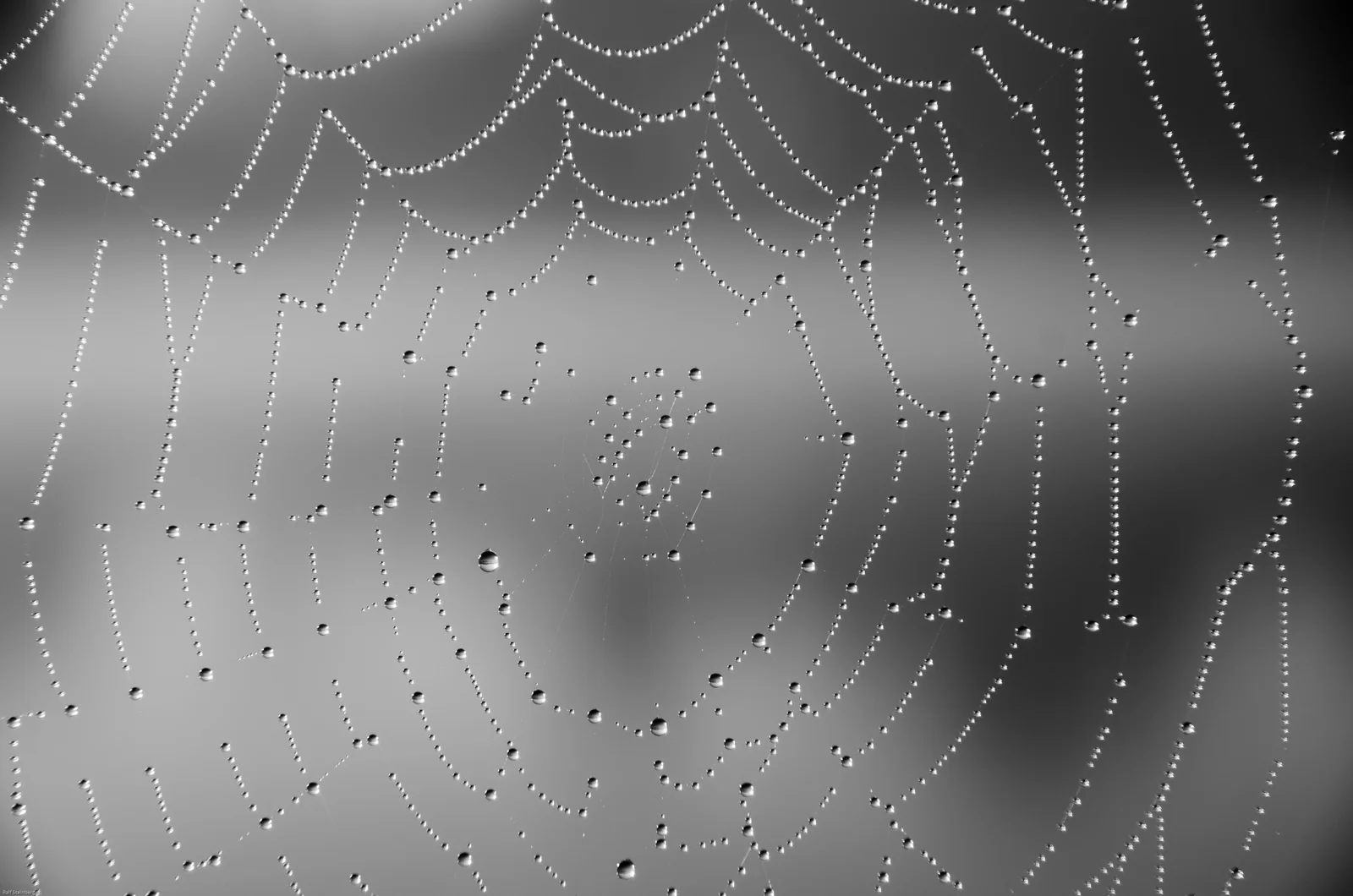
Dew on an orb web; webs like this are usually framed with dragline, whose fibres averaged about 2–5.5 µm across [10−6 m] in two studies.
Color: native (black-and-white photograph, no color)
"Spider web with morning dew (31532538535)" by Ralf Steinberger — https://commons.wikimedia.org/wiki/File:Spider_web_with_morning_dew_(31532538535).jpg — CC BY 2.0 (https://creativecommons.org/licenses/by/2.0/)

How thick is a strand of spider silk?
Spiders are arachnids, not insects: the GBIF Backbone Taxonomy places the order Araneae in the class Arachnida, and this site's insect section covers them too. Most spiders spin dragline silk from their major ampullate glands, Agnarsson and colleagues write (2010). The same silk is a lifeline as a spider moves about and the frame of most prey-catching webs. Greco and Pugno collected it in the lab simply by letting spiders drop from a surface (2020).
Under a scanning electron microscope, 105 single dragline fibres from adult female Nephila spiders averaged 1.994 µm across, with a standard deviation of 0.37 µm, by Hennecke and colleagues' measurements (2013). Greco and Pugno measured threads of the wandering spider Cupiennius salei under a light microscope; the mean diameters of their sample sets ran from 3.0 to 5.5 µm. The shortest samples were the thickest. Citing earlier work on the same species, Greco and Pugno link this to extra fibres near the point where a thread is attached.
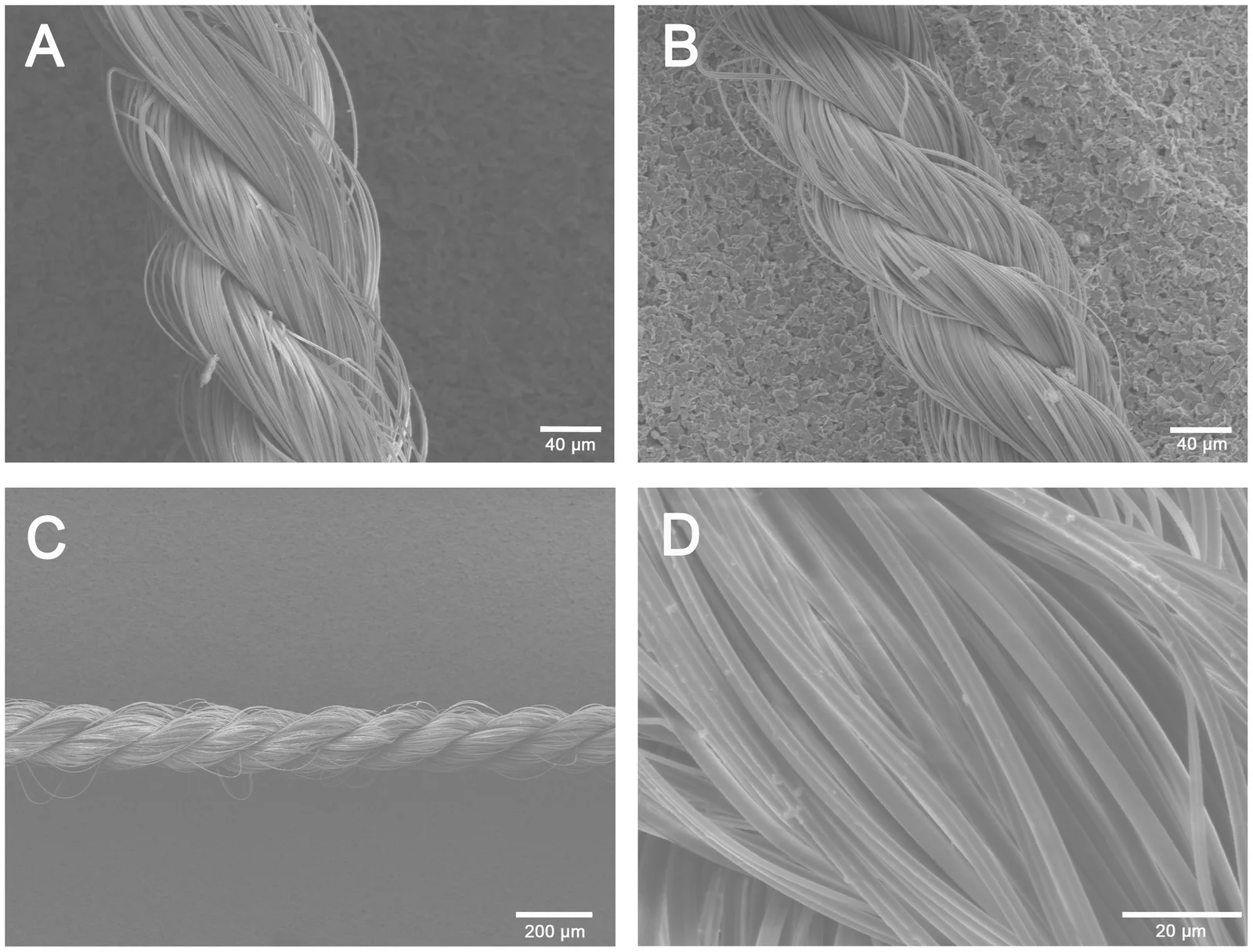
Dragline fibres of Nephila spiders, 1.994 µm across on average [10−6 m], braided into test sutures of 240 (A) and 360 (B) fibres, a longer stretch of braid (C) and fibres up close (D). Size in this image: 40 µm (A, B), 200 µm (C) and 20 µm (D) scale bars.
Color: native (electron micrograph, no color)
"Figure 1. SEM of single spider silk fibres and braided spider silk sutures" by Hennecke K, Redeker J, Kuhbier JW, Strauss S, Allmeling C, Kasper C, Reimers K, Vogt PM — https://doi.org/10.1371/journal.pone.0061100 — CC BY 4.0 (https://creativecommons.org/licenses/by/4.0/)
Set beside a human hair, typically 50–100 µm across by Li and colleagues' figure (2023), a dragline fibre is 9 to 50 times thinner (computed). A 2.0 µm fibre is also only 8 to 12 times the 0.17–0.25 µm limit that Valli and colleagues give for a standard fluorescence light microscope (2021), so measuring one is close work.
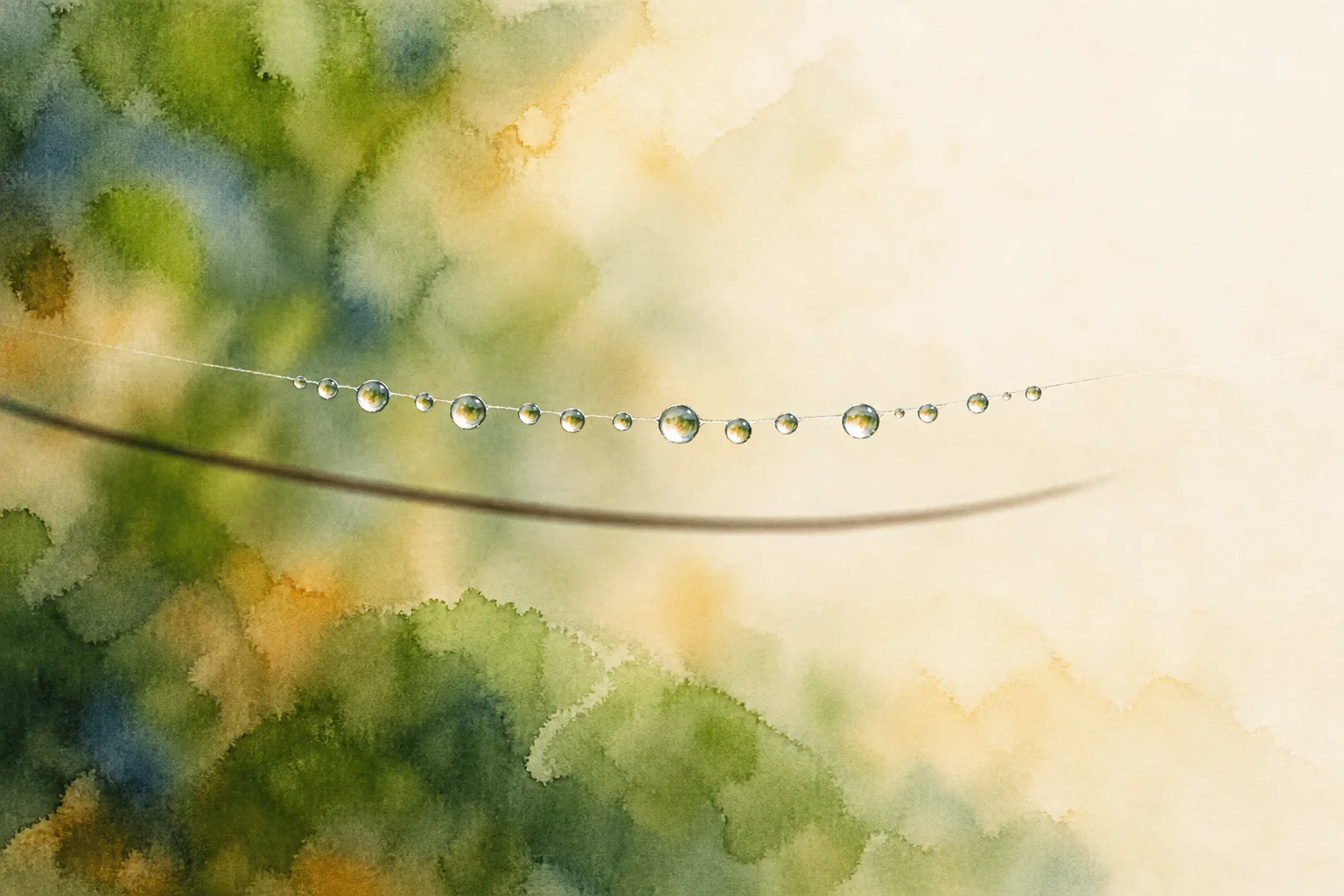 Illustration
A silk thread beaded with dew beside a human hair.
Illustration — not to scale
Illustration: Ants, Cells & Atoms. Generated schematic illustration — not a photograph, micrograph or specimen record. © Ants, Cells & Atoms, all rights reserved.
On the ladder, the fibre sits between the 10 µm air tubes and the sub-micrometre tracheoles of How Do Insects Breathe, on the rung where the water strider page finds its leg hairs. The How Big Is a Cell? page puts most cells between 0.4 and 100 µm, a span that takes in both the fibre and the hair.
What does "strong" mean for a thread?
Three different numbers get called strength. Tensile strength is the pull per unit of cross-section at which a fibre breaks, given here in gigapascals (GPa). How far the fibre has stretched by then is its extensibility; Agnarsson's group reports true values, with stress taken on the stretched, thinner fibre and strain as the natural log of final over starting length. Toughness is the energy it absorbs before breaking, per cubic metre: Agnarsson and colleagues divide that energy by the sample's starting volume.
A 2024 review by Brough and colleagues puts these numbers side by side in one table, citing a 1999 paper by Gosline and colleagues and the 2010 measurements by Agnarsson's group. The table below copies four of its rows and adds Darwin's bark spider from the 2010 paper.
| Material | Strength (GPa) | Stretch at break | Toughness (MJ/m3) | Source |
|---|---|---|---|---|
| Orb-weaver dragline silk, range across species | 0.7–1.6 | 0.17–0.52 | 110–350 | Brough and colleagues 2024 |
| Darwin's bark spider dragline, forcibly pulled, mean | 1.65 (true stress) | 0.52 (true strain) | 354 | Agnarsson and colleagues 2010 |
| High-tensile steel | 1.5 | 0.008 | 6 | Brough and colleagues 2024 |
| Kevlar 49 fibre | 3.6 | 0.027 | 50 | Brough and colleagues 2024 |
| Nylon | 0.9 | 0.18 | 80 | Brough and colleagues 2024 |
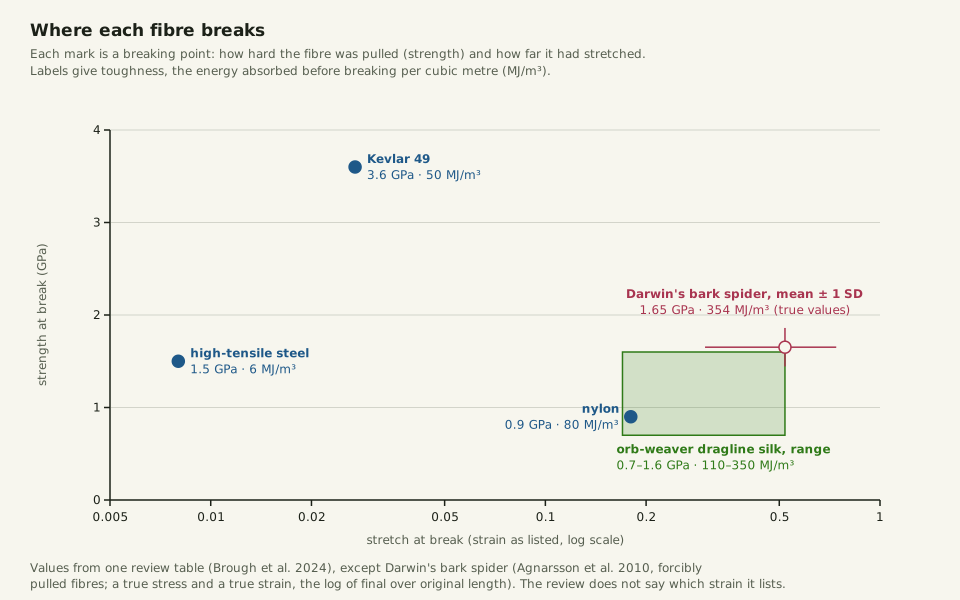
Read across the rows and no fibre wins on every count. Of these, Kevlar 49 is the strongest at 3.6 GPa. High-tensile steel matches the upper end of dragline strength but stretches less than 1% and absorbs only about 6 MJ/m3. Dragline silk's stretch at break, 0.17–0.52 in the table, is about nylon's 0.18 or more, while it carries a stress close to steel's, so it absorbs 110–350 MJ/m3, about 18 to 58 times the steel's figure (computed).
Agnarsson and colleagues tie toughness to the web. On average, orb weavers spin stronger and tougher dragline than other spiders in their compilation, which may reflect the job of an orb web's radial threads: stopping flying insects.
Slide the diagram sideways to read its labels, or open it full size.
Where each fibre breaks: dragline silk at 0.7–1.6 GPa and a stretch of 0.17–0.52, high-tensile steel at 1.5 GPa and under 1% stretch.
Strength against stretch at break, stretch on a log scale; labels give toughness. Data: spider-silk-vs-steel.csv (sources, version and license, JSON).
"Where each fibre breaks: strength, stretch and toughness" by Ants, Cells & Atoms, https://antscellsandatoms.com/insects/spider-silk/ — CC BY 4.0 (https://creativecommons.org/licenses/by/4.0/)
Data: Brough HA, Cheneler D, Hardy JG 2024, Biomacromolecules 25(11):6987-7014, Table 1 (citing Agnarsson et al. 2010 and Gosline et al. 1999), CC BY 4.0, https://doi.org/10.1021/acs.biomac.4c01122, retrieved 2026-10-25; Agnarsson I, Kuntner M, Blackledge TA 2010, PLoS ONE 5(9):e11234, CC BY 4.0, https://doi.org/10.1371/journal.pone.0011234, retrieved 2026-10-25
Data sources for this figure
Data: Brough HA, Cheneler D, Hardy JG 2024, Biomacromolecules 25(11):6987-7014, Table 1 (citing Agnarsson et al. 2010 and Gosline et al. 1999), CC BY 4.0, https://doi.org/10.1021/acs.biomac.4c01122, retrieved 2026-10-25; Fraternali F et al. 2020, Nanomaterials 10(8):1510, Table 1 (citing Omenetto and Kaplan 2010, and Elices et al. 2005 for the Nephila clavipes row), CC BY 4.0, https://doi.org/10.3390/nano10081510, retrieved 2026-10-25; Agnarsson I, Kuntner M, Blackledge TA 2010, PLoS ONE 5(9):e11234, CC BY 4.0, https://doi.org/10.1371/journal.pone.0011234, retrieved 2026-10-25; Greco G, Pugno NM 2020, Molecules 25(12):2938, Table 1, CC BY 4.0, https://doi.org/10.3390/molecules25122938, retrieved 2026-10-25
Is spider silk stronger than steel?
One 2024 review of medical uses for spider silk says dragline fibres have "a strength five times greater than steel" (Branković and colleagues). The sentence does not say which spider or which steel, or whether the comparison is by thickness or by weight. The answer changes with what is held equal.
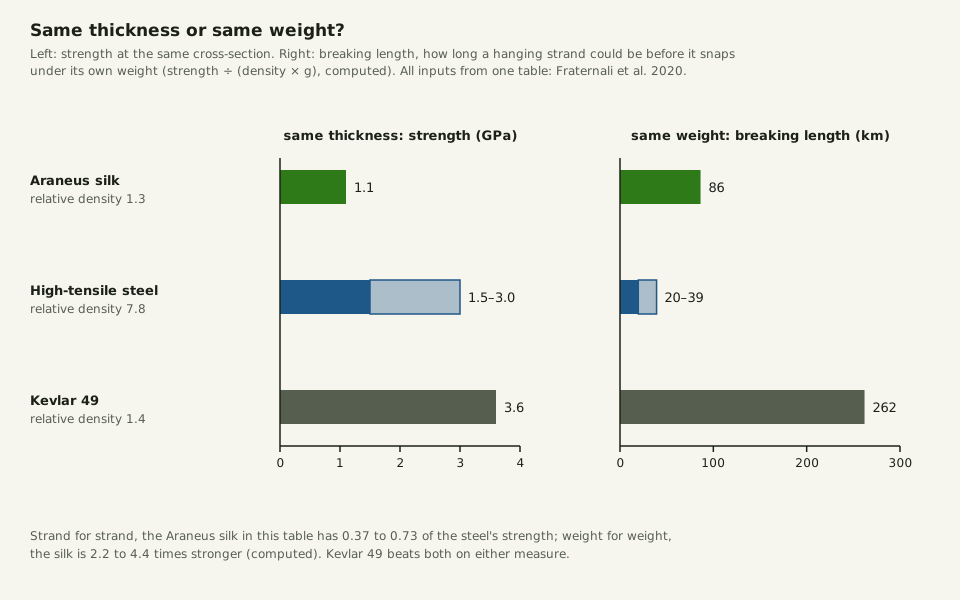
Hold thickness equal first. In a table by Fraternali and colleagues (2020), dragline silk from Araneus, the orb-weaver genus of the European garden spider, breaks at 1.1 GPa and high-tensile steel at 1.5–3.0 GPa. The table cites a 2010 review by Omenetto and Kaplan for both rows. Strand for strand, the silk has 0.37 to 0.73 of the steel's strength (computed).
Weight for weight, the order flips. The same table gives the silk a relative density (density compared with water) of 1.3 and the steel 7.8, so the silk, about a sixth as dense, comes out 2.2 to 4.4 times stronger (computed). A hanging strand of that silk could be about 86 km long before it snapped under its own weight, against 20–39 km for the steel (computed with standard gravity from CODATA 2022). The same weight-for-weight trap runs through claims about how much ants can lift.
Slide the diagram sideways to read its labels, or open it full size.
Same thickness or same weight: Araneus dragline, high-tensile steel and Kevlar 49 from one table; breaking length is computed.
Breaking length is the longest hanging strand that holds its own weight: strength ÷ (density × g). Data: spider-silk-weight-for-weight.csv (sources, version and license, JSON).
"Same thickness or same weight: spider silk against steel and Kevlar" by Ants, Cells & Atoms, https://antscellsandatoms.com/insects/spider-silk/ — CC BY 4.0 (https://creativecommons.org/licenses/by/4.0/)
Data: Fraternali F et al. 2020, Nanomaterials 10(8):1510, Table 1 (citing Omenetto and Kaplan 2010), CC BY 4.0, https://doi.org/10.3390/nano10081510, retrieved 2026-10-25; Standard acceleration of gravity, CODATA 2022, https://physics.nist.gov/cgi-bin/cuu/Value?gn, retrieved 2026-10-25; Breaking lengths computed for this page, computed 2026-10-25
Data sources for this figure
Data: Fraternali F et al. 2020, Nanomaterials 10(8):1510, Table 1 (citing Omenetto and Kaplan 2010, and Elices et al. 2005 for the Nephila clavipes row), CC BY 4.0, https://doi.org/10.3390/nano10081510, retrieved 2026-10-25; Brough HA, Cheneler D, Hardy JG 2024, Biomacromolecules 25(11):6987-7014, Table 1, CC BY 4.0, https://doi.org/10.1021/acs.biomac.4c01122, retrieved 2026-10-25; Agnarsson I, Kuntner M, Blackledge TA 2010, PLoS ONE 5(9):e11234, CC BY 4.0, https://doi.org/10.1371/journal.pone.0011234, retrieved 2026-10-25; Standard acceleration of gravity, CODATA 2022, https://physics.nist.gov/cgi-bin/cuu/Value?gn, retrieved 2026-10-25; All values computed for this page, computed 2026-10-25
The margin shifts with the spider. Against the 1.5 GPa steel in Brough's table, the orb-weaver range of 0.7–1.6 GPa runs from 0.47 to 1.07 of the steel's strength. Darwin's bark spider's 1.65 GPa mean is a true stress, so its 0.55 to 1.10 of Fraternali's 1.5–3.0 GPa steel is only a rough comparison (both computed).
The strongest silk in Fraternali's table, Nephila clavipes (GBIF now lists it as Trichonephila clavipes), is given 1.8 GPa from another study. That figure only reaches the low end of the steel's 1.5–3.0 GPa: 0.60 to 1.20 of it (computed). Kevlar 49, at 3.6 GPa and a relative density of 1.4, beats the Araneus silk both ways.
Could a pencil-thick strand stop a jumbo jet?
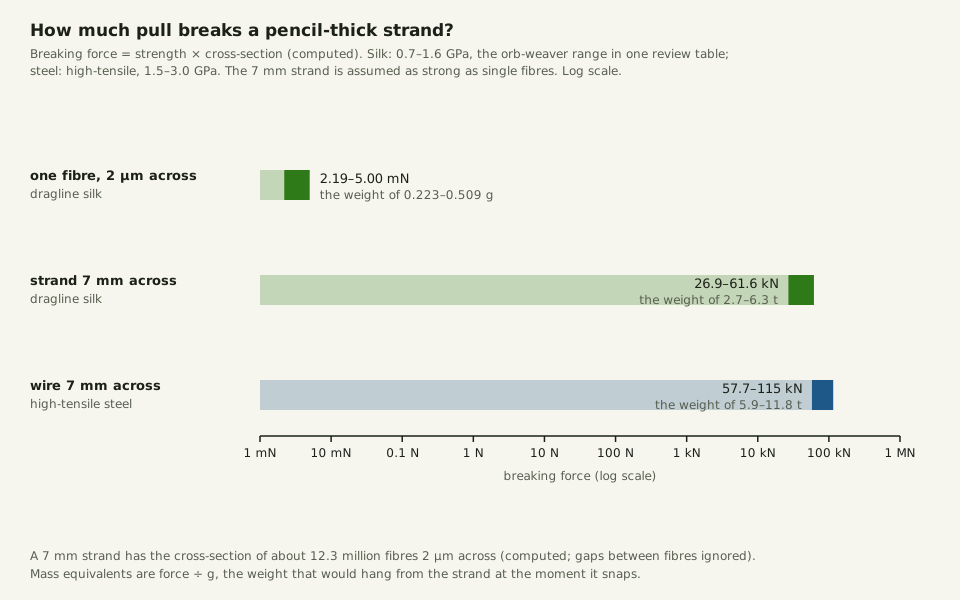
Take the claim that a strand of spider silk as thick as a pencil could stop a jumbo jet in flight. A standard hexagonal pencil is about 7 mm across its corners, by Wikipedia's article on pencils (read 2026-10-25). A strand 7 mm across has a cross-section of 38.5 mm2. At the orb-weaver range of 0.7–1.6 GPa it would break under a pull of about 27–62 kN, the weight of 2.7–6.3 tonnes (computed for this page).
That figure assumes the whole strand is as strong as single fibres; it would take about 12.3 million fibres 2 µm across to fill it (computed). One such fibre would break at about 2.2–5.0 mN, the weight of 0.22–0.51 g. A high-tensile steel wire of the same 7 mm would hold 58–115 kN (computed), more than the silk strand.
Slide the diagram sideways to read its labels, or open it full size.
Breaking force of a silk strand 7 mm across [10−3 m]: about 27–62 kN, against 58–115 kN for a high-tensile steel wire of the same thickness (computed).
Log scale from 1 mN to 1 MN; the strand is assumed as strong as single fibres. Data: spider-silk-pencil-strand.csv (sources, version and license, JSON).
"How much pull breaks a pencil-thick strand of spider silk?" by Ants, Cells & Atoms, https://antscellsandatoms.com/insects/spider-silk/ — CC BY 4.0 (https://creativecommons.org/licenses/by/4.0/)
Data sources for this figure
Data: Brough HA, Cheneler D, Hardy JG 2024, Biomacromolecules 25(11):6987-7014, Table 1 (orb-weaver dragline 0.7–1.6 GPa), CC BY 4.0, https://doi.org/10.1021/acs.biomac.4c01122, retrieved 2026-10-25; Fraternali F et al. 2020, Nanomaterials 10(8):1510, Table 1 (high-tensile steel 1.5–3.0 GPa), CC BY 4.0, https://doi.org/10.3390/nano10081510, retrieved 2026-10-25; Hennecke K et al. 2013, PLoS ONE 8(4):e61100, CC BY 4.0, https://doi.org/10.1371/journal.pone.0061100 (fibre diameter), retrieved 2026-10-25; Standard acceleration of gravity, CODATA 2022, https://physics.nist.gov/cgi-bin/cuu/Value?gn, retrieved 2026-10-25; Forces and mass equivalents computed for this page, computed 2026-10-25
Data sources for this figure
Data: Brough HA, Cheneler D, Hardy JG 2024, Biomacromolecules 25(11):6987-7014, Table 1, CC BY 4.0, https://doi.org/10.1021/acs.biomac.4c01122, retrieved 2026-10-25; Fraternali F et al. 2020, Nanomaterials 10(8):1510, Table 1, CC BY 4.0, https://doi.org/10.3390/nano10081510, retrieved 2026-10-25; Hennecke K et al. 2013, PLoS ONE 8(4):e61100, CC BY 4.0, https://doi.org/10.1371/journal.pone.0061100, retrieved 2026-10-25; Standard acceleration of gravity, CODATA 2022, https://physics.nist.gov/cgi-bin/cuu/Value?gn, retrieved 2026-10-25; All values computed for this page from a strand diameter of 7 mm chosen for this page, computed 2026-10-25
Wikipedia's article on the Boeing 747 gives its maximum take-off weight as 333 tonnes for the first model and 440 tonnes for the 747-8 (read 2026-10-25). The silk strand would snap under about one fiftieth to one hundred and sixtieth of that weight (computed for this page). Stopping a moving plane is also a question of energy, which silk's toughness offers, but the strand can never pull harder than its breaking force. At 62 kN it could slow a 333-tonne jet by at most about 0.18 m/s2, under 2% of the pull of gravity (computed for this page).
What inside the thread makes it tough?
The answer lies far below the fibre's width. Gosline and colleagues describe the dragline proteins as built from repeated motifs that include runs of 8–10 alanines and glycine-rich stretches of 24–35 amino acids (1999, abstract). By their account, when the protein is spun into a fibre, the alanine runs form β-sheet crystals that tie the chains into a network. Brough and colleagues' review pictures these crystals as stacks of pleated sheets that act as stiff nodes, joined by flexible glycine-rich links.
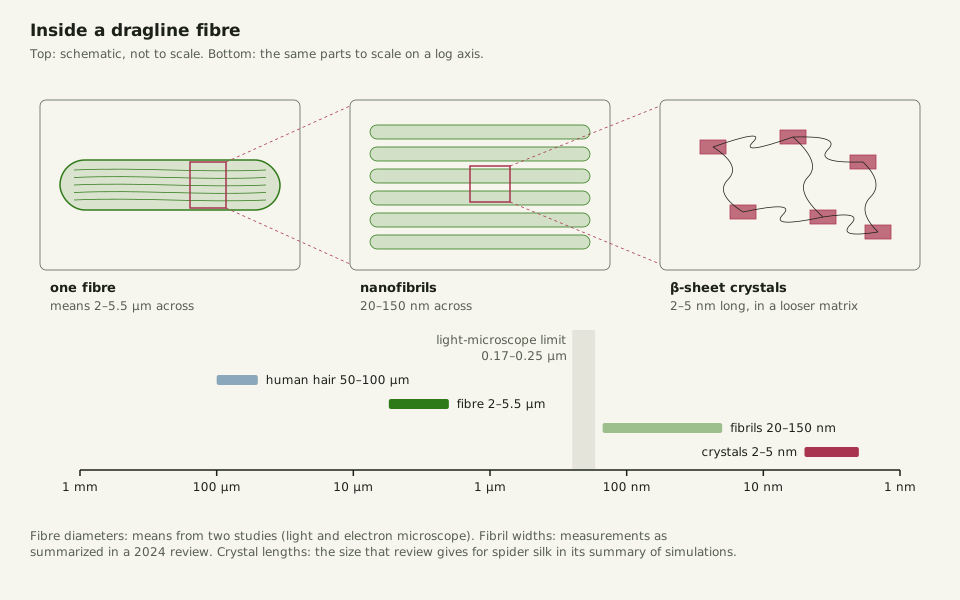
In its summary of computer simulations, the same review gives those crystals in spider silks as 2–5 nm long. It puts the nanofibrils, the strands twisted together to make a fibre, at 20–150 nm across in experimental measurements. Both sit below the light microscope's limit. On a linear axis drawn to the 100 µm width of a hair, a 5 nm crystal would sit 0.005% of the way from zero (computed), which is why the figure below uses a log axis.
Slide the diagram sideways to read its labels, or open it full size.
Inside a dragline fibre: nanofibrils 20–150 nm across and β-sheet crystals 2–5 nm long [10−9 m], under the light-microscope limit.
Top: schematic, not to scale; bottom: sizes to scale on a log axis. Data: spider-silk-thread-sizes.csv (sources, version and license, JSON).
"Inside a dragline fibre: fibrils and crystals" by Ants, Cells & Atoms, https://antscellsandatoms.com/insects/spider-silk/ — CC BY 4.0 (https://creativecommons.org/licenses/by/4.0/)
Data sources for this figure
Data: Brough HA, Cheneler D, Hardy JG 2024, Biomacromolecules 25(11):6987-7014, CC BY 4.0, https://doi.org/10.1021/acs.biomac.4c01122 (nanofibrils, beta-sheet crystals; the stiff-node and flexible-link picture as a principle only), retrieved 2026-10-25; Hennecke K et al. 2013, PLoS ONE 8(4):e61100, CC BY 4.0, https://doi.org/10.1371/journal.pone.0061100, retrieved 2026-10-25; Greco G, Pugno NM 2020, Molecules 25(12):2938, CC BY 4.0, https://doi.org/10.3390/molecules25122938, retrieved 2026-10-25; Li C et al. 2023, Journal of Biomedical Optics 28(11):116501, CC BY 4.0, https://doi.org/10.1117/1.JBO.28.11.116501 (via the shared reference-objects.csv), retrieved 2026-10-25; Valli J et al. 2021, Journal of Biological Chemistry 297(1):100791, CC BY 4.0, https://doi.org/10.1016/j.jbc.2021.100791 (via the shared reference-objects.csv), retrieved 2026-10-25
Data sources for this figure
Data: Hennecke K et al. 2013, PLoS ONE 8(4):e61100, CC BY 4.0, https://doi.org/10.1371/journal.pone.0061100, retrieved 2026-10-25; Greco G, Pugno NM 2020, Molecules 25(12):2938, CC BY 4.0, https://doi.org/10.3390/molecules25122938, retrieved 2026-10-25; Brough HA, Cheneler D, Hardy JG 2024, Biomacromolecules 25(11):6987-7014, CC BY 4.0, https://doi.org/10.1021/acs.biomac.4c01122, retrieved 2026-10-25; Li C et al. 2023, Journal of Biomedical Optics 28(11):116501, CC BY 4.0, https://doi.org/10.1117/1.JBO.28.11.116501 (via the shared reference-objects.csv), retrieved 2026-10-25; Valli J et al. 2021, Journal of Biological Chemistry 297(1):100791, CC BY 4.0, https://doi.org/10.1016/j.jbc.2021.100791 (via the shared reference-objects.csv), retrieved 2026-10-25; Ratios and the 0.2 µm misreading computed for this page, computed 2026-10-25
The hydrogen bonds that hold β-sheets together are weak one by one, the review notes, but resist large stresses together; in simulations of small crystals, those bonds broke and re-formed in a stick–slip motion that spent energy. A multiscale model predicted fibres are toughest when 10–40% of the protein is crystalline, as in spider silks. Silkworm silk has larger crystals. The bond behaviour and the 10–40% figure come from models; the crystals themselves sit about three rungs below the fibre on the ladder.
Why do measurements of the same silk disagree?
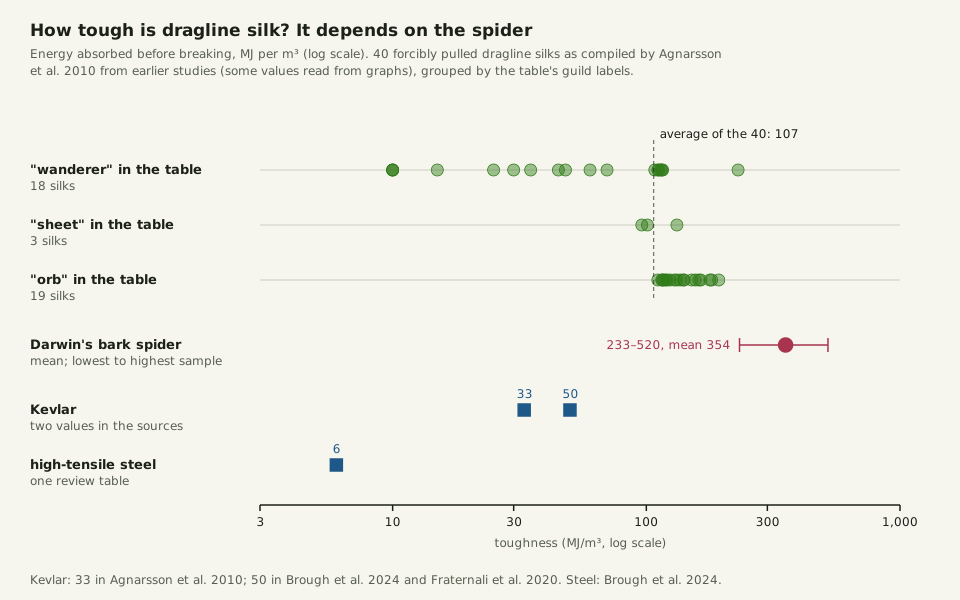
Toughness varies more than 20-fold across the 40 dragline silks Agnarsson and colleagues compiled, from 10 to 230 MJ/m3. Their own record came from Darwin's bark spider, Caerostris darwini: forcibly pulled dragline averaged 354 MJ/m3, with samples from 233 to 520. Its strength was high but not exceptional; its stretch was about twice that of other orb spiders' dragline.
Slide the diagram sideways to read its labels, or open it full size.
Toughness of 40 dragline silks from earlier studies, 10–230 MJ/m3, with Darwin's bark spider at 354 (233–520).
Log scale; silks grouped by the table's labels; some values were read from graphs in the original studies. Data: spider-silk-toughness-by-species.csv (sources, version and license, JSON).
"Toughness of dragline silk across species, with Darwin's bark spider, Kevlar and steel" by Ants, Cells & Atoms, https://antscellsandatoms.com/insects/spider-silk/ — CC BY 4.0 (https://creativecommons.org/licenses/by/4.0/)
Data: Agnarsson I, Kuntner M, Blackledge TA 2010, PLoS ONE 5(9):e11234, Table 1 and Figure 4 legend, CC BY 4.0, https://doi.org/10.1371/journal.pone.0011234, retrieved 2026-10-25; Brough HA, Cheneler D, Hardy JG 2024, Biomacromolecules 25(11):6987-7014, Table 1, CC BY 4.0, https://doi.org/10.1021/acs.biomac.4c01122, retrieved 2026-10-25; Fraternali F et al. 2020, Nanomaterials 10(8):1510, Table 1, CC BY 4.0, https://doi.org/10.3390/nano10081510, retrieved 2026-10-25
Data: Agnarsson I, Kuntner M, Blackledge TA 2010, PLoS ONE 5(9):e11234, Table 1 (compiling Swanson et al. 2006 and 2009 and Agnarsson et al. 2008), CC BY 4.0, https://doi.org/10.1371/journal.pone.0011234, retrieved 2026-10-25; GBIF Backbone Taxonomy, GBIF Secretariat, CC BY 4.0, https://doi.org/10.15468/39omei (current names), retrieved 2026-10-25
Even the yardstick moves: Kevlar gets 33 MJ/m3 from Agnarsson's group, 50 in Brough's and Fraternali's tables. Test speed matters too. Pulled very fast, Araneus diadematus dragline could absorb up to 1,000 MJ/m3, against 193 at the slower rates Agnarsson's group used, by that group's account of Gosline's work.
Greco and Pugno's tests gave Araneus diadematus 655 MPa, against 1.1 GPa for Fraternali's Araneus silk, and their Cupiennius salei samples tested over 1.5 cm averaged 515 MPa, against 932 MPa over 0.55 cm.
Every silk strength figure here divides a force by a cross-section, and the cross-section comes from a diameter a few micrometres wide. Agnarsson's group averaged six readings along each fibre under polarized light at 1,000×; Greco and Pugno assumed their threads were round. Misread a 2.0 µm fibre by 0.2 µm, about what a light microscope resolves, and its area, and the strength computed from it, shifts by about 20% (computed). Which number belongs to "spider silk" still rests on that width.
Sources
- GBIF Backbone Taxonomy. Araneae (order), taxon key 1496, class Arachnida. https://doi.org/10.15468/39omei https://www.gbif.org/species/1496 Read: dataset record. Text license: CC BY 4.0 (https://creativecommons.org/licenses/by/4.0/).
- Agnarsson I, Kuntner M, Blackledge TA. "Bioprospecting finds the toughest biological material: extraordinary silk from a giant riverine orb spider." PLoS ONE 5(9):e11234 (2010). https://doi.org/10.1371/journal.pone.0011234 Read: full text. Text license: CC BY 4.0 (https://creativecommons.org/licenses/by/4.0/).
- Greco G, Pugno NM. "Mechanical properties and Weibull scaling laws of unknown spider silks." Molecules 25(12):2938 (2020). https://doi.org/10.3390/molecules25122938 Read: full text. Text license: CC BY 4.0 (https://creativecommons.org/licenses/by/4.0/).
- Hennecke K, Redeker J, Kuhbier JW, Strauss S, Allmeling C, Kasper C, Reimers K, Vogt PM. "Bundles of spider silk, braided into sutures, resist basic cyclic tests: potential use for flexor tendon repair." PLoS ONE 8(4):e61100 (2013). https://doi.org/10.1371/journal.pone.0061100 Read: full text. Text license: CC BY 4.0 (https://creativecommons.org/licenses/by/4.0/).
- Li C, Du Y, Chen H, Han X, Wu W, Kong X, Zhang C, Yuan X. "Transmission infrared micro-spectroscopic study of individual human hair." Journal of Biomedical Optics 28(11):116501 (2023). https://doi.org/10.1117/1.JBO.28.11.116501 Read: full text. Text license: CC BY 4.0 (https://creativecommons.org/licenses/by/4.0/).
- Valli J, Garcia-Burgos A, Rooney LM, Vale de Melo e Oliveira B, Duncan RR, Rickman C. "Seeing beyond the limit: A guide to choosing the right super-resolution microscopy technique." Journal of Biological Chemistry 297(1):100791 (2021). https://doi.org/10.1016/j.jbc.2021.100791 Read: full text. Text license: CC BY 4.0 (https://creativecommons.org/licenses/by/4.0/).
- Brough HA, Cheneler D, Hardy JG. "Progress in multiscale modeling of silk materials." Biomacromolecules 25(11):6987–7014 (2024). https://doi.org/10.1021/acs.biomac.4c01122 Read: full text. Text license: CC BY 4.0 (https://creativecommons.org/licenses/by/4.0/).
- Gosline JM, Guerette PA, Ortlepp CS, Savage KN. "The mechanical design of spider silks: from fibroin sequence to mechanical function." Journal of Experimental Biology 202(23):3295–3303 (1999). https://doi.org/10.1242/jeb.202.23.3295 Read: abstract.
- Branković M, Zivic F, Grujovic N, Stojadinovic I, Milenkovic S, Kotorcevic N. "Review of spider silk applications in biomedical and tissue engineering." Biomimetics 9(3):169 (2024). https://doi.org/10.3390/biomimetics9030169 Read: full text. Text license: CC BY 4.0 (https://creativecommons.org/licenses/by/4.0/).
- Fraternali F, Stehling N, Amendola A, Tiban Anrango BA, Holland C, Rodenburg C. "Tensegrity modelling and the high toughness of spider dragline silk." Nanomaterials 10(8):1510 (2020). https://doi.org/10.3390/nano10081510 Read: full text. Text license: CC BY 4.0 (https://creativecommons.org/licenses/by/4.0/).
- Omenetto FG, Kaplan DL. "New opportunities for an ancient material." Science 329(5991):528–531 (2010). https://doi.org/10.1126/science.1188936 Read: abstract.
- CODATA 2022 recommended values, NIST Standard Reference Database 121. "Standard acceleration of gravity." https://physics.nist.gov/cgi-bin/cuu/Value?gn Read: dataset record.
- Wikipedia contributors. "Pencil." Wikipedia (read 2026-10-25). https://en.wikipedia.org/wiki/Pencil Read: full text; paraphrased only. Text license: CC BY-SA 4.0 (https://creativecommons.org/licenses/by-sa/4.0/).
- Wikipedia contributors. "Boeing 747." Wikipedia (read 2026-10-25). https://en.wikipedia.org/wiki/Boeing_747 Read: full text; paraphrased only. Text license: CC BY-SA 4.0 (https://creativecommons.org/licenses/by-sa/4.0/).
Cite this page
Ants, Cells & Atoms. “Spider Silk: Dragline Is Tougher Than High-Tensile Steel.” Published 2026-10-25. https://antscellsandatoms.com/insects/spider-silk/. Accessed (add the date you read it).
No DOI is issued for entries. Figures made here are CC BY 4.0; see each caption for the license of photographs.
Related entries
Water Strider: The Dimples Under Its Feet Hold Its Weight
Image: “Aquarius remigis 140810489” by Jason Swanson (2021) · CC0 1.0
"Aquarius remigis 140810489" by Jason Swanson — https://commons.wikimedia.org/wiki/File:Aquarius_remigis_140810489.jpg — CC0 1.0 (https://creativecommons.org/publicdomain/zero/1.0/)

How Do Insects Breathe? Through Air Tubes, Not Lungs
Image: “Flickr - ggallice - Spiracles” by Geoff Gallice (2011) · CC BY 2.0
"Flickr - ggallice - Spiracles" by Geoff Gallice — https://commons.wikimedia.org/wiki/File:Flickr_-_ggallice_-_Spiracles.jpg — CC BY 2.0 (https://creativecommons.org/licenses/by/2.0/)

Ants: Strong for Their Weight, Mostly Because They're Small
Image: “Rote Waldameisen mit Beute 01” by Stephan Sprinz (2026) · CC BY 4.0
"Rote Waldameisen mit Beute 01" by Stephan Sprinz — https://commons.wikimedia.org/wiki/File:Rote_Waldameisen_mit_Beute_01.jpg — CC BY 4.0 (https://creativecommons.org/licenses/by/4.0/)
