Ants: Strong for Their Weight, Mostly Because They're Small

Slide the ladder sideways to read its labels, or open it full size.
A worker ant: seed-harvester workers in one lab colony measured 2–15 mm long [10−3–10−2 m].
Log scale from 10 cm to 0.1 nm; each rung is ten times smaller than the one to its left. Dashed lines: naked eye about 0.1 mm and light microscope about 0.2 µm, explained on the Zoom ladder page. Blue band: paper fragments 15 and 30 mm long carried by leaf-cutter workers.
"Zoom ladder: how strong are ants" by Ants, Cells & Atoms, https://antscellsandatoms.com/insects/ant-strength/ — CC BY 4.0 (https://creativecommons.org/licenses/by/4.0/)
Data sources for this figure
Data: Merienne H, Latil G, Moretto P, Fourcassié V 2021, PeerJ 9:e10664, CC BY 4.0, https://doi.org/10.7717/peerj.10664 (workers in the colony 2-15 mm long), retrieved 2026-10-25; Moll K, Roces F, Federle W 2013, PLoS ONE 8(1):e52816, CC BY 4.0, https://doi.org/10.1371/journal.pone.0052816 (paper fragments 15 and 30 mm long), retrieved 2026-10-25; Sender R, Fuchs S, Milo R 2016, PLoS Biology 14(8):e1002533, CC BY 4.0, https://doi.org/10.1371/journal.pbio.1002533 (reference man 70 kg, 170 cm), retrieved 2026-10-25
Bench card
- Question
- How many times its own weight can a worker ant carry or bite with, and how much of that ratio would survive at human size?
- Method
- measured ratios scaled with the square-cube law by body mass, by two routes: one from carried loads, one from maximum bite force
- Inputs
- 6 (load ratio and body-mass range for the carrying route; fitted bite force and body-mass range for the bite route; standard gravity; 70 kg reference body)Source: ant-strength-scaling.csv on this page
ant-strength-bench.csv (CSV) · where each value comes from, and its license (JSON)
Data credits for this card
Data: Merienne H, Latil G, Moretto P, Fourcassié V 2021, PeerJ 9:e10664, CC BY 4.0, https://doi.org/10.7717/peerj.10664, retrieved 2026-10-25; Püffel F, Roces F, Labonte D 2023, Journal of Experimental Biology 226(13):jeb245140, CC BY 4.0, https://doi.org/10.1242/jeb.245140, retrieved 2026-10-25; Sender R, Fuchs S, Milo R 2016, PLoS Biology 14(8):e1002533, CC BY 4.0, https://doi.org/10.1371/journal.pbio.1002533 (reference man 70 kg, 170 cm), retrieved 2026-10-25; answer range and input count, computed 2026-10-25
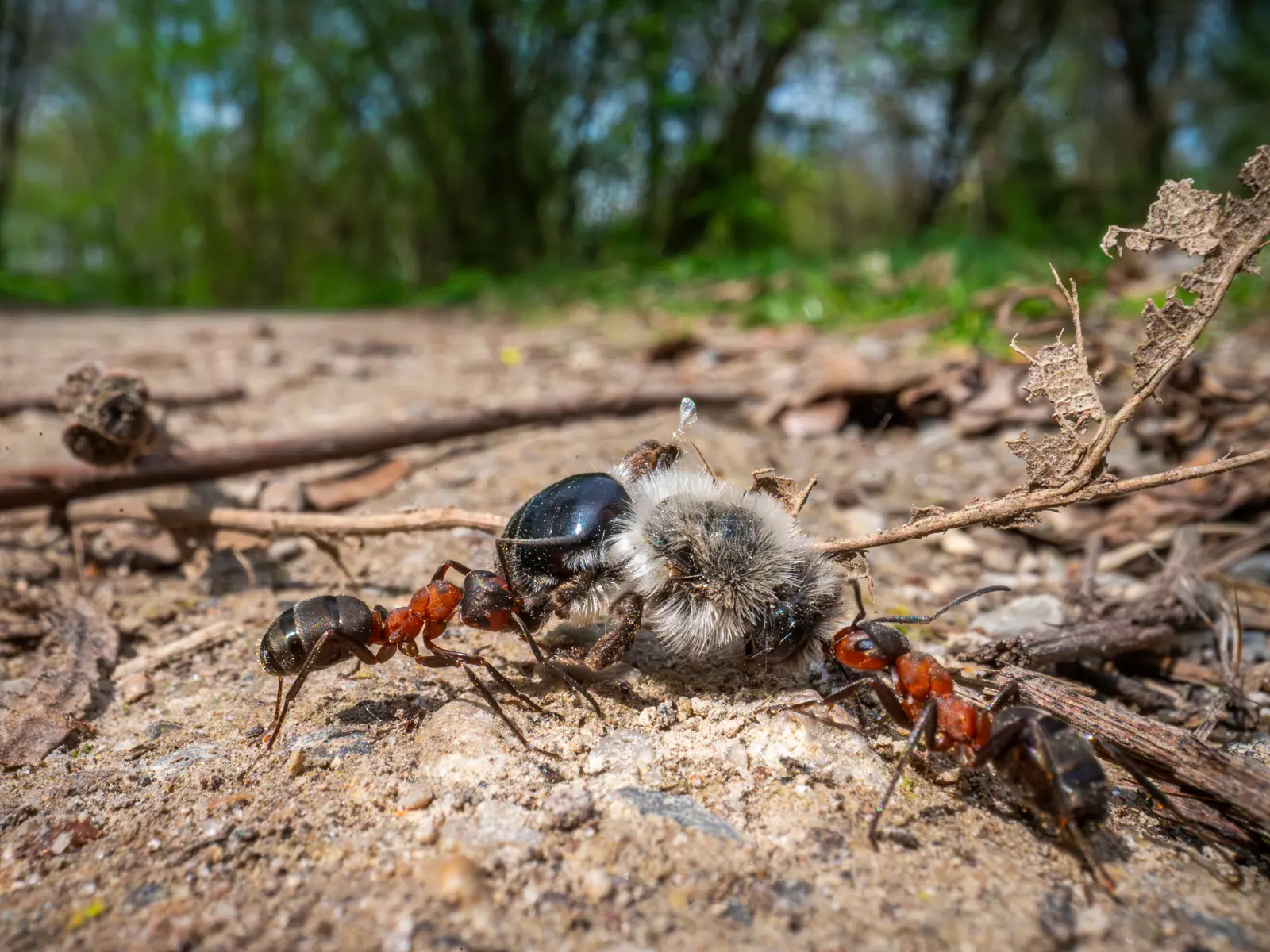
Red wood ants, Formica rufa, moving a dead bee; workers of this species are 4.5–9 mm long [10−3 m].
Color: native
"Rote Waldameisen mit Beute 01" by Stephan Sprinz — https://commons.wikimedia.org/wiki/File:Rote_Waldameisen_mit_Beute_01.jpg — CC BY 4.0 (https://creativecommons.org/licenses/by/4.0/)

The two ants in the photograph are red wood ants, Formica rufa, whose workers measure 4.5–9 mm in Collingwood's 1979 account of the ants of Fennoscandia and Denmark. Each is far smaller than the bee it is moving. Ant workers are famous for lifting and carrying heavy loads, as Peeters and colleagues put it in 2020, but the numbers depend on what is measured: walking with a load, gripping, biting or breaking.
How much can one ant carry?
The lab test used 52 Messor barbarus workers of 1.7–33.0 mg, from a seed-harvester colony collected on the French Mediterranean coast. Each walked a platform first unloaded, then with a lead weight glued to its mandibles. The weights ran from 0.2 to 6 times the ant's own mass, so its legs held up 1.2 to 7 times its weight, counting the body (Merienne and colleagues 2021).
The experimenters chose those loads, so 6 is the heaviest load tested, not the most an ant could take. With heavy loads, the ants' walking became much more jerky, especially in big workers. Outside the lab, workers of this species routinely carry items of up to 13 times their own mass over dozens of metres, Merienne and colleagues write, citing a 2016 field study.
That field study, by Bernadou and colleagues, found that ants drag rather than carry items once they are heavy or long enough. Larger workers start dragging at lower loads relative to their own mass (abstract).
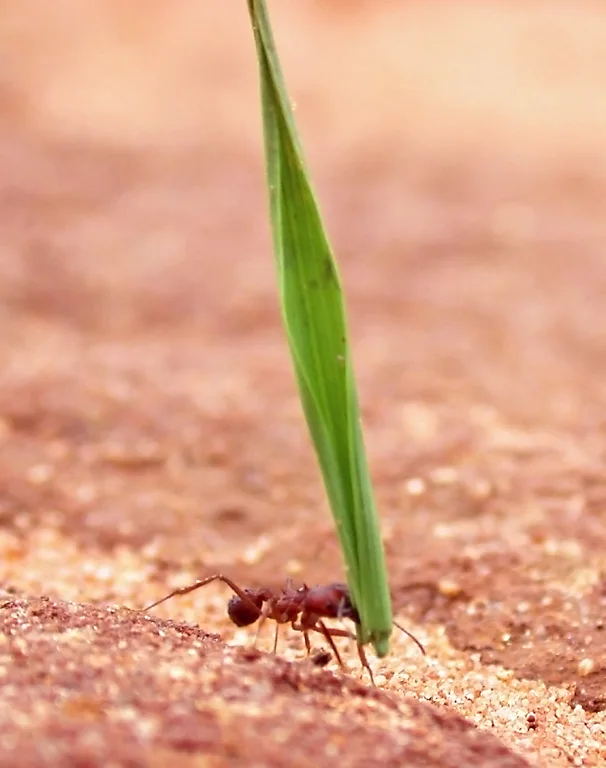
A leaf-cutter worker, Acromyrmex balzani, carrying a grass blade upright; the sources on this page give no length for this species, but foragers of another leaf-cutter, Atta vollenweideri, measured 5.0–7.6 mm in a lab colony [10−3 m].
Color: native
"Leafcutter ant carrying leaf" by Alex Wild — https://commons.wikimedia.org/wiki/File:Leafcutter_ant_carrying_leaf.jpg — CC0 1.0 (https://creativecommons.org/publicdomain/zero/1.0/)

Grass-cutting ants hold their loads upright in their jaws, and in a lab study, Atta vollenweideri workers of 3.5–5.5 mg carried paper fragments of about 5 mg, 15 or 30 mm long, while the colony's foragers measured 5.0–7.6 mm (Moll, Roces and Federle 2013). By mass, that is only 0.9–1.4 times their own (computed), yet the ants ran close to their limit of stability. They held long fragments more upright and kept extra legs on the ground.
In force terms, a leaf-cutter's typical load is small. A 5 mg forager may carry a fragment of about 15 mg, three times its body weight, by the account of Püffel and colleagues in a 2023 study of maturing workers. Lifting it takes only 0.15 mN, they note, small even next to the bite of a newly emerged worker.
Which ratio measures strength?
Shi and colleagues, in a 2024 robotics paper, write that leaf-cutter ants can lift 50 times their body weight, citing no source. In the other sources here, 50 appears only as the top of a range: African weaver ants, Oecophylla longinoda, capture insects 20 to 50 times their own weight, a figure Dejean and colleagues cite from a 1995 study. That is prey captured, not a weight one ant was shown to lift.
Other tasks give far bigger ratios. Hunting workers of the arboreal ant Azteca andreae average 1.393 mg. Waiting in ambush on Cecropia obtusa leaves, single workers bit a thread tied to a weight and held on to as much as 8.0 g for at least 5 seconds, or 5,714 times their weight (Dejean and colleagues 2010).
Their hooked claws catch in the downy underside of the leaf; on a sheet of plastic, they succeeded less often. Working together, a colony captured an 18.61 g locust, 13,350 times the weight of one worker.
Biting gives the strongest figure for a single muscle. Püffel, Roces and Labonte measured the bites of 248 Atta vollenweideri workers of 1.5–46.8 mg (2023). Corrected for how and where each ant bit the sensor, their bite forces ran from 19 to 901 mN. The fitted maximum works out to about 2,000–2,800 times body weight across that size range (computed for this page).
A joint can bear even more: the neck of the Allegheny mound ant, Formica exsectoides, can withstand about 5,000 times the ant's weight, by Nguyen and colleagues' account (2014, abstract). That figure measures how much one joint can bear. Comparisons by weight need the same care for spider silk: computed from published tables, Araneus dragline is about 2–4 times stronger than high-tensile steel by weight, but by thickness the strongest silk only reaches the steel's low end.
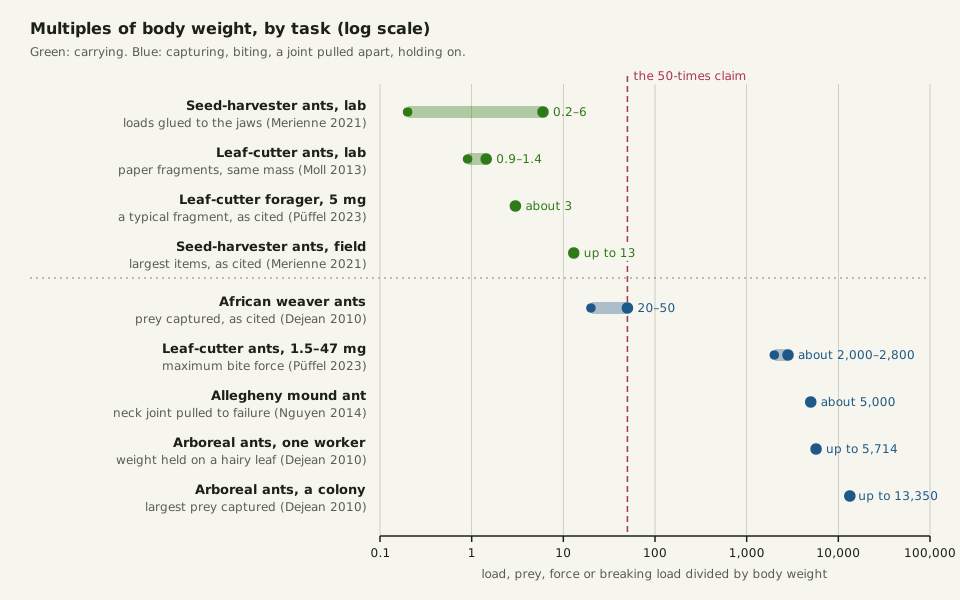
Slide the diagram sideways to read its labels, or open it full size.
Ratios by task for seed-harvester, leaf-cutter, weaver, mound and arboreal ants; the measured carriers were 2–15 mm long [10−3–10−2 m].
Carrying stays below 50; biting, gripping and a neck joint run to thousands. Data: ant-strength-loads.csv (sources, version and license, JSON).
"What ants carry, capture, hold, bite and withstand, as multiples of body weight" by Ants, Cells & Atoms, https://antscellsandatoms.com/insects/ant-strength/ — CC BY 4.0 (https://creativecommons.org/licenses/by/4.0/)
Data sources for this figure
Data: Merienne H, Latil G, Moretto P, Fourcassié V 2021, PeerJ 9:e10664, CC BY 4.0, https://doi.org/10.7717/peerj.10664 (carrying in the lab; field figure as cited from Bernadou et al. 2016), retrieved 2026-10-25; Moll K, Roces F, Federle W 2013, PLoS ONE 8(1):e52816, CC BY 4.0, https://doi.org/10.1371/journal.pone.0052816 (paper fragments; ratio computed from stated masses), retrieved 2026-10-25; Püffel F, Meyer L, Imirzian N, Roces F, Johnston R, Labonte D 2023, Proceedings of the Royal Society B 290:20230355, CC BY 4.0, https://doi.org/10.1098/rspb.2023.0355 (typical forager load as cited), retrieved 2026-10-25; Dejean A, Leroy C, Corbara B, Roux O, Céréghino R, Orivel J, Boulay R 2010, PLoS ONE 5(6):e11331, CC BY 4.0, https://doi.org/10.1371/journal.pone.0011331 (grip and colony prey; weaver-ant prey as cited from Wojtusiak et al. 1995), retrieved 2026-10-25; Püffel F, Roces F, Labonte D 2023, Journal of Experimental Biology 226(13):jeb245140, CC BY 4.0, https://doi.org/10.1242/jeb.245140 (bite ratio computed from the published fit), retrieved 2026-10-25; Nguyen V, Lilly B, Castro C 2014, Journal of Biomechanics 47(2):497-504, https://doi.org/10.1016/j.jbiomech.2013.10.053 (abstract; stated value only), retrieved 2026-10-25; Shi Y, Xu Q, Shi R, Liu H, Zhang M, Hou X, Wang W, Deng Z 2024, Biomimetics 9(9):550, CC BY 4.0, https://doi.org/10.3390/biomimetics9090550 (the 50-times figure for leaf-cutter ants, stated without a source), retrieved 2026-10-25; GBIF Secretariat, GBIF Backbone Taxonomy, CC BY 4.0, https://doi.org/10.15468/39omei (species keys), retrieved 2026-10-25
Data sources for this figure
Data: Merienne H, Latil G, Moretto P, Fourcassié V 2021, PeerJ 9:e10664, CC BY 4.0, https://doi.org/10.7717/peerj.10664, retrieved 2026-10-25; Moll K, Roces F, Federle W 2013, PLoS ONE 8(1):e52816, CC BY 4.0, https://doi.org/10.1371/journal.pone.0052816, retrieved 2026-10-25; Püffel F, Meyer L, Imirzian N, Roces F, Johnston R, Labonte D 2023, Proceedings of the Royal Society B 290:20230355, CC BY 4.0, https://doi.org/10.1098/rspb.2023.0355, retrieved 2026-10-25; Dejean A, Leroy C, Corbara B, Roux O, Céréghino R, Orivel J, Boulay R 2010, PLoS ONE 5(6):e11331, CC BY 4.0, https://doi.org/10.1371/journal.pone.0011331, retrieved 2026-10-25; Püffel F, Roces F, Labonte D 2023, Journal of Experimental Biology 226(13):jeb245140, CC BY 4.0, https://doi.org/10.1242/jeb.245140, retrieved 2026-10-25; Nguyen V, Lilly B, Castro C 2014, Journal of Biomechanics 47(2):497-504, https://doi.org/10.1016/j.jbiomech.2013.10.053 (abstract; stated value only), retrieved 2026-10-25; GBIF Secretariat, GBIF Backbone Taxonomy, CC BY 4.0, https://doi.org/10.15468/39omei (species keys), retrieved 2026-10-25; CODATA 2022 recommended values, NIST SRD 121, standard acceleration of gravity 9.80665 m/s2 (exact), https://physics.nist.gov/cgi-bin/cuu/Value?gn, retrieved 2026-10-25; bite-to-weight and fragment-to-body ratios, computed 2026-10-25
Why does being small make the ratio big?
Force and weight grow at different rates because muscle pull depends on cross-section, an area, while weight depends on volume. Double an animal's length and keep its shape. The cross-section grows 4 times, the weight 8 times, and force divided by weight halves. The rule that strength goes with cross-section dates back to Galileo, Rospars and Meyer-Vernet point out (2016).
The muscle itself barely changes with size. Rospars and Meyer-Vernet compared about 265 biological motors from about 150 species, from single molecules to whole muscles of large animals. The typical force per cross-section was about 200 kPa, with no trend across 19 orders of magnitude of cell or body mass. By their account, arthropod muscles have been put at 300–700 kPa.
So the same shape, made smaller, gets stronger for its weight in direct proportion to how much smaller it is. Take a 170 cm person, the height of the "reference man" in Sender, Fuchs and Milo's 2016 cell count. A body of the same shape 5.0–7.6 mm long, the length of those leaf-cutter foragers, would be 224–340 times as strong for its weight (computed). The water strider page runs the same arithmetic with surface tension in place of muscle.
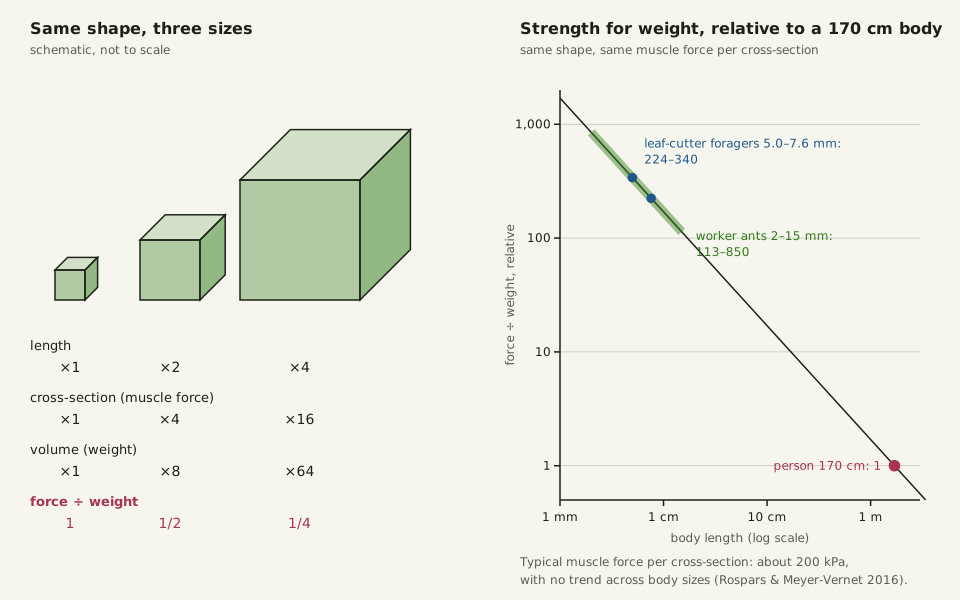
Slide the diagram sideways to read its labels, or open it full size.
The square-cube law: for one shape, strength for weight rises as length falls, so ants 2–15 mm long [10−3–10−2 m] get 113–850 times a 170 cm body's ratio.
Same muscle force per cross-section assumed at every size, as the typical 200 kPa supports; computed for this page. Data: ant-strength-scaling.csv (sources, version and license, JSON).
"The square-cube law: strength for weight against body length" by Ants, Cells & Atoms, https://antscellsandatoms.com/insects/ant-strength/ — CC BY 4.0 (https://creativecommons.org/licenses/by/4.0/)
Data sources for this figure
Data: Rospars JP, Meyer-Vernet N 2016, Royal Society Open Science 3(7):160313, CC BY 4.0, https://doi.org/10.1098/rsos.160313 (principle only), retrieved 2026-10-25; Merienne H, Latil G, Moretto P, Fourcassié V 2021, PeerJ 9:e10664, CC BY 4.0, https://doi.org/10.7717/peerj.10664 (worker lengths), retrieved 2026-10-25; Moll K, Roces F, Federle W 2013, PLoS ONE 8(1):e52816, CC BY 4.0, https://doi.org/10.1371/journal.pone.0052816 (forager lengths), retrieved 2026-10-25; Sender R, Fuchs S, Milo R 2016, PLoS Biology 14(8):e1002533, CC BY 4.0, https://doi.org/10.1371/journal.pbio.1002533 (reference man 70 kg, 170 cm), retrieved 2026-10-25; ratios relative to a 170 cm body, computed 2026-10-25
Data sources for this figure
Data: Merienne H, Latil G, Moretto P, Fourcassié V 2021, PeerJ 9:e10664, CC BY 4.0, https://doi.org/10.7717/peerj.10664, retrieved 2026-10-25; Püffel F, Meyer L, Imirzian N, Roces F, Johnston R, Labonte D 2023, Proceedings of the Royal Society B 290:20230355, CC BY 4.0, https://doi.org/10.1098/rspb.2023.0355, retrieved 2026-10-25; Püffel F, Roces F, Labonte D 2023, Journal of Experimental Biology 226(13):jeb245140, CC BY 4.0, https://doi.org/10.1242/jeb.245140, retrieved 2026-10-25; Moll K, Roces F, Federle W 2013, PLoS ONE 8(1):e52816, CC BY 4.0, https://doi.org/10.1371/journal.pone.0052816, retrieved 2026-10-25; Rospars JP, Meyer-Vernet N 2016, Royal Society Open Science 3(7):160313, CC BY 4.0, https://doi.org/10.1098/rsos.160313, retrieved 2026-10-25; Sender R, Fuchs S, Milo R 2016, PLoS Biology 14(8):e1002533, CC BY 4.0, https://doi.org/10.1371/journal.pbio.1002533 (reference man 70 kg, 170 cm), retrieved 2026-10-25; Shi Y, Xu Q, Shi R, Liu H, Zhang M, Hou X, Wang W, Deng Z 2024, Biomimetics 9(9):550, CC BY 4.0, https://doi.org/10.3390/biomimetics9090550 (the 50-times figure for leaf-cutter ants, stated without a source), retrieved 2026-10-25; CODATA 2022 recommended values, NIST SRD 121, standard acceleration of gravity 9.80665 m/s2 (exact), https://physics.nist.gov/cgi-bin/cuu/Value?gn, retrieved 2026-10-25; every value in the ratio_at_70_kg, shrink factor and gap columns, computed 2026-10-25
How strong would a 70 kg ant be?
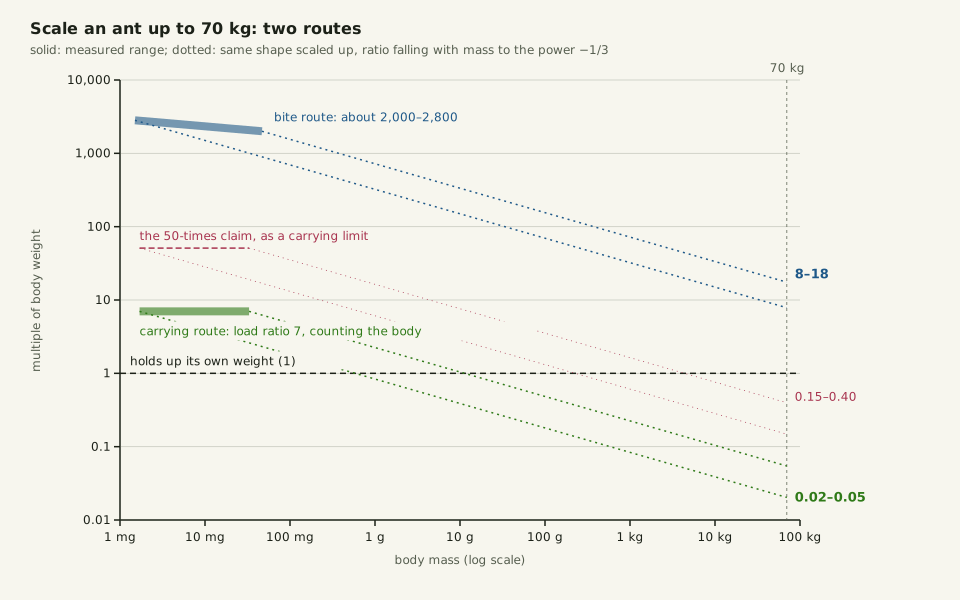
Grow a worker to the reference man's 70 kg without changing its shape. Its forces rise with mass to the power 2/3 and its weight with mass itself. Every ratio therefore shrinks by the cube root of the mass ratio: 114 times for a 46.8 mg worker, 360 times for a 1.5 mg one (computed).
Route one starts from carrying. Seed-harvester workers of 1.7–33.0 mg walked with a load ratio of up to 7, counting their own weight. Scaled to 70 kg, that becomes 0.02–0.05 (computed): the giant could hold up at least 2–5% of its weight. Even the 50-times claim, read as a carrying limit, would fall to 0.15–0.40 (computed).
Route two starts from the jaw: the leaf-cutter's fitted maximum bite, about 2,000–2,800 times body weight, becomes 8–18 times at 70 kg (computed).
| Starting figure | Body mass | At ant size | At 70 kg |
|---|---|---|---|
| Route one: load ratio walked with in the lab | 1.7–33.0 mg | 7 | 0.02–0.05 |
| Field load of up to 13 times body mass, as cited (load ratio 14) | 1.7–40.0 mg | 14 | 0.04–0.12 |
| Typical leaf fragment, as cited (load ratio 4) | 5 mg | 4 | 0.017 |
| Route two: fitted maximum bite force | 1.5–46.8 mg | 2,000–2,800 | 8–18 |
| The 50-times claim as a carrying limit (load ratio 51) | 1.7–33.0 mg | 51 | 0.15–0.40 |
At the same body mass, the two routes differ by a factor of about 300–400 (computed), well past the factor of ten at which this site must trace the cause. Rerun with units at every step, the arithmetic gives the same gap. The cause is the starting point: carried loads were set by experimenters or chosen by the ants, and the carriers ran close to their stability limit or switched to dragging (see above); a bite is the jaw-closing muscle at full activation.
The conclusion is limited to what both routes support. Every ratio shrinks 114–360 times on the way to 70 kg, and none ends near 50: at most about 18 times body weight, from the strongest muscle measured. The carrying figures are floors, so they cannot say whether the giant would stand. An ant's lift is mostly the square-cube law at work, not a superpower.
Slide the diagram sideways to read its labels, or open it full size.
Two routes from worker ants, seed-harvesters 2–15 mm long [10−3–10−2 m] and leaf-cutters of 1.5–47 mg, to the same shapes at 70 kg: carrying falls to 0.02–0.05, biting to 8–18.
Solid: measured ranges; dotted: the same shape scaled up, the ratio falling with mass to the power −1/3; computed for this page. Data: ant-strength-scaling.csv (sources, version and license, JSON).
"Two routes from an ant to a 70 kg ant" by Ants, Cells & Atoms, https://antscellsandatoms.com/insects/ant-strength/ — CC BY 4.0 (https://creativecommons.org/licenses/by/4.0/)
Data sources for this figure
Data: Merienne H, Latil G, Moretto P, Fourcassié V 2021, PeerJ 9:e10664, CC BY 4.0, https://doi.org/10.7717/peerj.10664 (load ratio 7.0 at 1.7-33.0 mg), retrieved 2026-10-25; Püffel F, Roces F, Labonte D 2023, Journal of Experimental Biology 226(13):jeb245140, CC BY 4.0, https://doi.org/10.1242/jeb.245140 (bite force fit at 1.5-46.8 mg), retrieved 2026-10-25; Sender R, Fuchs S, Milo R 2016, PLoS Biology 14(8):e1002533, CC BY 4.0, https://doi.org/10.1371/journal.pbio.1002533 (reference man 70 kg, 170 cm), retrieved 2026-10-25; Shi Y, Xu Q, Shi R, Liu H, Zhang M, Hou X, Wang W, Deng Z 2024, Biomimetics 9(9):550, CC BY 4.0, https://doi.org/10.3390/biomimetics9090550 (the 50-times figure for leaf-cutter ants, stated without a source), retrieved 2026-10-25; CODATA 2022 recommended values, NIST SRD 121, standard acceleration of gravity 9.80665 m/s2 (exact), https://physics.nist.gov/cgi-bin/cuu/Value?gn, retrieved 2026-10-25; isometric scaling to 70 kg, computed 2026-10-25
Data sources for this figure
Data: Merienne H, Latil G, Moretto P, Fourcassié V 2021, PeerJ 9:e10664, CC BY 4.0, https://doi.org/10.7717/peerj.10664, retrieved 2026-10-25; Püffel F, Meyer L, Imirzian N, Roces F, Johnston R, Labonte D 2023, Proceedings of the Royal Society B 290:20230355, CC BY 4.0, https://doi.org/10.1098/rspb.2023.0355, retrieved 2026-10-25; Püffel F, Roces F, Labonte D 2023, Journal of Experimental Biology 226(13):jeb245140, CC BY 4.0, https://doi.org/10.1242/jeb.245140, retrieved 2026-10-25; Moll K, Roces F, Federle W 2013, PLoS ONE 8(1):e52816, CC BY 4.0, https://doi.org/10.1371/journal.pone.0052816, retrieved 2026-10-25; Rospars JP, Meyer-Vernet N 2016, Royal Society Open Science 3(7):160313, CC BY 4.0, https://doi.org/10.1098/rsos.160313, retrieved 2026-10-25; Sender R, Fuchs S, Milo R 2016, PLoS Biology 14(8):e1002533, CC BY 4.0, https://doi.org/10.1371/journal.pbio.1002533 (reference man 70 kg, 170 cm), retrieved 2026-10-25; Shi Y, Xu Q, Shi R, Liu H, Zhang M, Hou X, Wang W, Deng Z 2024, Biomimetics 9(9):550, CC BY 4.0, https://doi.org/10.3390/biomimetics9090550 (the 50-times figure for leaf-cutter ants, stated without a source), retrieved 2026-10-25; CODATA 2022 recommended values, NIST SRD 121, standard acceleration of gravity 9.80665 m/s2 (exact), https://physics.nist.gov/cgi-bin/cuu/Value?gn, retrieved 2026-10-25; every value in the ratio_at_70_kg, shrink factor and gap columns, computed 2026-10-25
Is all of it size?
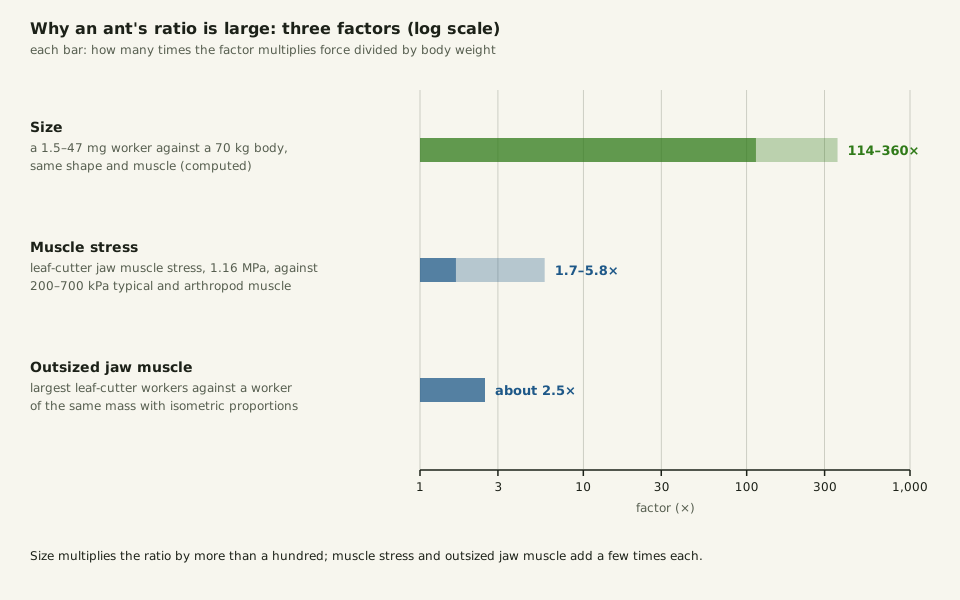
Not all, but most of it. Size multiplies the ratio by more than a hundred; muscle stress and outsized jaw muscle add a few times each (computed). Leaf-cutter jaw muscle is strong for muscle: Püffel and colleagues used a maximum stress of 1.16 MPa, measured, by their account, in the closely related Atta cephalotes. That is 1.7–5.8 times the 200–700 kPa of typical and arthropod muscle (computed).
Big workers also have outsized jaw muscles: across three colonies, maximum bite force grew with body mass to the power 0.90, not the 0.67 that unchanged proportions would give. So the largest workers bite about 2.5 times harder than unchanged proportions predict. The trend runs out of room: a hypothetical leaf-cutter of 3 g would have a jaw muscle larger than its head capsule, Püffel and colleagues calculate.
Without wings, the worker thorax was rebuilt as a rigid box, Peeters and colleagues found in micro-CT scans of queens and workers (2020). Its neck muscles are enlarged, and long muscles outside the legs press them down, lifting the body and any load. How air reaches those muscles is the subject of How Do Insects Breathe?
Slide the diagram sideways to read its labels, or open it full size.
Why leaf-cutter workers, foragers 5.0–7.6 mm long [10−3 m] among them, are strong for their weight: size gives 114–360 times, muscle stress 1.7–5.8, outsized jaw muscle about 2.5.
Computed for this page from the scaling table. Data: ant-strength-scaling.csv (sources, version and license, JSON).
"Where a worker ant's strength for its weight comes from" by Ants, Cells & Atoms, https://antscellsandatoms.com/insects/ant-strength/ — CC BY 4.0 (https://creativecommons.org/licenses/by/4.0/)
Data sources for this figure
Data: Püffel F, Roces F, Labonte D 2023, Journal of Experimental Biology 226(13):jeb245140, CC BY 4.0, https://doi.org/10.1242/jeb.245140 (muscle stress 1.16 MPa as used; allometry factor 2.5, largely from the jaw-closing muscle), retrieved 2026-10-25; Rospars JP, Meyer-Vernet N 2016, Royal Society Open Science 3(7):160313, CC BY 4.0, https://doi.org/10.1098/rsos.160313 (typical 200 kPa; arthropod 300-700 kPa as cited), retrieved 2026-10-25; Sender R, Fuchs S, Milo R 2016, PLoS Biology 14(8):e1002533, CC BY 4.0, https://doi.org/10.1371/journal.pbio.1002533 (reference man 70 kg, 170 cm), retrieved 2026-10-25; size and muscle-stress factors, computed 2026-10-25
Data sources for this figure
Data: Merienne H, Latil G, Moretto P, Fourcassié V 2021, PeerJ 9:e10664, CC BY 4.0, https://doi.org/10.7717/peerj.10664, retrieved 2026-10-25; Püffel F, Meyer L, Imirzian N, Roces F, Johnston R, Labonte D 2023, Proceedings of the Royal Society B 290:20230355, CC BY 4.0, https://doi.org/10.1098/rspb.2023.0355, retrieved 2026-10-25; Püffel F, Roces F, Labonte D 2023, Journal of Experimental Biology 226(13):jeb245140, CC BY 4.0, https://doi.org/10.1242/jeb.245140, retrieved 2026-10-25; Moll K, Roces F, Federle W 2013, PLoS ONE 8(1):e52816, CC BY 4.0, https://doi.org/10.1371/journal.pone.0052816, retrieved 2026-10-25; Rospars JP, Meyer-Vernet N 2016, Royal Society Open Science 3(7):160313, CC BY 4.0, https://doi.org/10.1098/rsos.160313, retrieved 2026-10-25; Sender R, Fuchs S, Milo R 2016, PLoS Biology 14(8):e1002533, CC BY 4.0, https://doi.org/10.1371/journal.pbio.1002533 (reference man 70 kg, 170 cm), retrieved 2026-10-25; Shi Y, Xu Q, Shi R, Liu H, Zhang M, Hou X, Wang W, Deng Z 2024, Biomimetics 9(9):550, CC BY 4.0, https://doi.org/10.3390/biomimetics9090550 (the 50-times figure for leaf-cutter ants, stated without a source), retrieved 2026-10-25; CODATA 2022 recommended values, NIST SRD 121, standard acceleration of gravity 9.80665 m/s2 (exact), https://physics.nist.gov/cgi-bin/cuu/Value?gn, retrieved 2026-10-25; every value in the ratio_at_70_kg, shrink factor and gap columns, computed 2026-10-25
What limits the heaviest load a single worker can walk with is still open. As of 2021, Merienne and colleagues described the mechanics of load carrying in ants as poorly investigated. Every carrying figure on this page is a load ants were given or chose, so each is a lower bound.
Sources
- Merienne H, Latil G, Moretto P, Fourcassié V. "Dynamics of locomotion in the seed harvesting ant Messor barbarus: effect of individual body mass and transported load mass." PeerJ 9:e10664 (2021). https://doi.org/10.7717/peerj.10664 Read: full text. Text license: CC BY 4.0 (https://creativecommons.org/licenses/by/4.0/).
- Collingwood CA. "The Formicidae (Hymenoptera) of Fennoscandia and Denmark." Fauna Entomologica Scandinavica 8:1–174 (1979). Treatment of Formica rufa as digitized by Plazi, GBIF checklist dataset. https://doi.org/10.15468/ppwck3 Read: dataset record. Text license: CC0 1.0 (https://creativecommons.org/publicdomain/zero/1.0/).
- Peeters C, Keller RA, Khalife A, Fischer G, Katzke J, Blanke A, Economo EP. "The loss of flight in ant workers enabled an evolutionary redesign of the thorax for ground labour." Frontiers in Zoology 17:33 (2020). https://doi.org/10.1186/s12983-020-00375-9 Read: full text. Text license: CC BY 4.0 (https://creativecommons.org/licenses/by/4.0/).
- Bernadou A, Felden A, Moreau M, Moretto P, Fourcassié V. "Ergonomics of load transport in the seed harvesting ant Messor barbarus: morphology influences transportation method and efficiency." Journal of Experimental Biology 219:2920–2927 (2016). https://doi.org/10.1242/jeb.141556 Read: abstract.
- Moll K, Roces F, Federle W. "How load-carrying ants avoid falling over: mechanical stability during foraging in Atta vollenweideri grass-cutting ants." PLoS ONE 8(1):e52816 (2013). https://doi.org/10.1371/journal.pone.0052816 Read: full text. Text license: CC BY 4.0 (https://creativecommons.org/licenses/by/4.0/).
- Püffel F, Meyer L, Imirzian N, Roces F, Johnston R, Labonte D. "Developmental biomechanics and age polyethism in leaf-cutter ants." Proceedings of the Royal Society B 290(2000):20230355 (2023). https://doi.org/10.1098/rspb.2023.0355 Read: full text. Text license: CC BY 4.0 (https://creativecommons.org/licenses/by/4.0/).
- Shi Y, Xu Q, Shi R, Liu H, Zhang M, Hou X, Wang W, Deng Z. "Bionic Robot with Multifunctional Leg–Arm Mechanism for In-Orbit Assembly of Space Trusses." Biomimetics 9(9):550 (2024). https://doi.org/10.3390/biomimetics9090550 Read: full text. Text license: CC BY 4.0 (https://creativecommons.org/licenses/by/4.0/).
- Dejean A, Leroy C, Corbara B, Roux O, Céréghino R, Orivel J, Boulay R. "Arboreal ants use the 'Velcro® principle' to capture very large prey." PLoS ONE 5(6):e11331 (2010). https://doi.org/10.1371/journal.pone.0011331 Read: full text. Text license: CC BY 4.0 (https://creativecommons.org/licenses/by/4.0/).
- Püffel F, Roces F, Labonte D. "Strong positive allometry of bite force in leaf-cutter ants increases the range of cuttable plant tissues." Journal of Experimental Biology 226(13):jeb245140 (2023). https://doi.org/10.1242/jeb.245140 Read: full text. Text license: CC BY 4.0 (https://creativecommons.org/licenses/by/4.0/).
- Nguyen V, Lilly B, Castro C. "The exoskeletal structure and tensile loading behavior of an ant neck joint." Journal of Biomechanics 47(2):497–504 (2014). https://doi.org/10.1016/j.jbiomech.2013.10.053 Read: abstract.
- Rospars JP, Meyer-Vernet N. "Force per cross-sectional area from molecules to muscles: a general property of biological motors." Royal Society Open Science 3(7):160313 (2016). https://doi.org/10.1098/rsos.160313 Read: full text. Text license: CC BY 4.0 (https://creativecommons.org/licenses/by/4.0/).
- Sender R, Fuchs S, Milo R. "Revised estimates for the number of human and bacteria cells in the body." PLoS Biology 14(8):e1002533 (2016). https://doi.org/10.1371/journal.pbio.1002533 Read: full text. Text license: CC BY 4.0 (https://creativecommons.org/licenses/by/4.0/).
Cite this page
Ants, Cells & Atoms. “Ants: Strong for Their Weight, Mostly Because They're Small.” Published 2026-10-25. https://antscellsandatoms.com/insects/ant-strength/. Accessed (add the date you read it).
No DOI is issued for entries. Figures made here are CC BY 4.0; see each caption for the license of photographs.
Related entries
Water Strider: The Dimples Under Its Feet Hold Its Weight
Image: “Aquarius remigis 140810489” by Jason Swanson (2021) · CC0 1.0
"Aquarius remigis 140810489" by Jason Swanson — https://commons.wikimedia.org/wiki/File:Aquarius_remigis_140810489.jpg — CC0 1.0 (https://creativecommons.org/publicdomain/zero/1.0/)

How Do Insects Breathe? Through Air Tubes, Not Lungs
Image: “Flickr - ggallice - Spiracles” by Geoff Gallice (2011) · CC BY 2.0
"Flickr - ggallice - Spiracles" by Geoff Gallice — https://commons.wikimedia.org/wiki/File:Flickr_-_ggallice_-_Spiracles.jpg — CC BY 2.0 (https://creativecommons.org/licenses/by/2.0/)

Compound Eye: One as Sharp as Yours Would Span About 7–12 m
Image: “Vespula germanica SEM Eye 01” by SecretDisc (2007) · CC BY 2.5
"Vespula germanica SEM Eye 01" by SecretDisc — https://commons.wikimedia.org/wiki/File:Vespula_germanica_SEM_Eye_01.jpg — CC BY 2.5 (https://creativecommons.org/licenses/by/2.5/)
