Smallest Adult Insect as of 2013: Wingless, Down to 0.13 mm

Slide the ladder sideways to read its labels, or open it full size.
Dicopomorpha echmepterygis males, the smallest adult insects on record by a 2013 count, 126–240 µm long [10−4 m], beside Paramecium caudatum cells (140–311 µm long) and a human hair (50–100 µm across).
Log scale from 10 cm to 0.1 nm, each rung ten times smaller; dashed lines: naked eye about 0.1 mm, light microscope about 0.2 µm (How to read the Zoom ladder). Data: smallest-insect-records.csv (sources, version and license, JSON).
"Zoom ladder: the smallest insect" by Ants, Cells & Atoms, https://antscellsandatoms.com/insects/smallest-insect/ — CC BY 4.0 (https://creativecommons.org/licenses/by/4.0/)
Data sources for this figure
Data: Male lengths: Mockford EL 1997, Annals of the Entomological Society of America 90(2):115-120 (abstract), https://doi.org/10.1093/aesa/90.2.115, and Huber JT, Noyes JS 2013, Journal of Hymenoptera Research 32:17-44, CC BY 3.0, https://doi.org/10.3897/jhr.32.4663, retrieved 2026-10-25; Paramecium caudatum length: Velho Rodrigues MF, Lisicki M, Lauga E 2021, PLOS ONE 16(6):e0252291, CC BY 4.0, https://doi.org/10.1371/journal.pone.0252291, as listed in this site's cell-sizes.csv, retrieved 2026-10-25; Human hair width: Li C et al. 2023, Journal of Biomedical Optics 28(11):116501, CC BY 4.0, https://doi.org/10.1117/1.JBO.28.11.116501, as listed in this site's reference-objects.csv, retrieved 2026-10-25
Data sources for this figure
Data: Mockford EL 1997, Annals of the Entomological Society of America 90(2):115-120 (abstract), https://doi.org/10.1093/aesa/90.2.115, retrieved 2026-10-25; Huber JT, Noyes JS 2013, Journal of Hymenoptera Research 32:17-44, CC BY 3.0, https://doi.org/10.3897/jhr.32.4663, retrieved 2026-10-25; Polilov AA 2015, ZooKeys 526:61-64, CC BY 4.0, https://doi.org/10.3897/zookeys.526.6531, retrieved 2026-10-25; Polilov AA 2017, PLOS ONE 12(5):e0175566, CC BY 4.0, https://doi.org/10.1371/journal.pone.0175566, retrieved 2026-10-25; Farisenkov SE et al. 2022, Nature 602:96-100, CC BY 4.0, https://doi.org/10.1038/s41586-021-04303-7, retrieved 2026-10-25; GBIF Secretariat 2023, GBIF Backbone Taxonomy, checklist dataset https://doi.org/10.15468/39omei, CC BY 4.0, retrieved 2026-10-25
Bench card
- Actual size
- males 126–240 µm long [10−4 m]: 139–240 µm for eight slide-mounted males, 126–130 µm for two dried ones; females about 340–550 µmSource: Huber & Noyes 2013, citing Mockford 1997 for the slide-mounted range, https://doi.org/10.3897/jhr.32.4663
- Size in this image
- male photo below: about 126–128 µm against its printed 50 µm bar; opening photo, a Tinkerbella nana female: about 213–222 µm against its 100 µm bar (both computed for this page)Source: computed for this page from the scale bars given in the figure legends of Huber & Noyes 2013
- Lives in
- inside eggs of Echmepteryx hageni, an insect of the order Psocoptera (Psocodea in GBIF); male movement outside the host egg appears limitedSource: Mockford 1997 (abstract), https://doi.org/10.1093/aesa/90.2.115
- Seen with
- light microscope; the photos here are electron micrographs and light photographsSource: Huber & Noyes 2013, https://doi.org/10.3897/jhr.32.4663
- Color in images
- native: electron micrographs without color in the opening and male photos; light photographs in the two later fairyfly photos, which the paper notes were retouched as needed except for primary typesSource: figure captions on this page
smallest-insect-bench.csv (CSV) · where each value comes from, and its license (JSON)
Data credits for this card
Data: GBIF Secretariat 2023, GBIF Backbone Taxonomy, Dicopomorpha echmepterygis (taxon key 1367990), checklist dataset https://doi.org/10.15468/39omei, CC BY 4.0, retrieved 2026-10-25; Huber JT, Noyes JS 2013, Journal of Hymenoptera Research 32:17-44, CC BY 3.0, https://doi.org/10.3897/jhr.32.4663, retrieved 2026-10-25; Mockford EL 1997, Annals of the Entomological Society of America 90(2):115-120 (abstract), https://doi.org/10.1093/aesa/90.2.115, retrieved 2026-10-25; Photo lengths computed 2026-10-25 from the scale bars of photos by John T. Huber, John S. Noyes and J. Read, CC BY 3.0
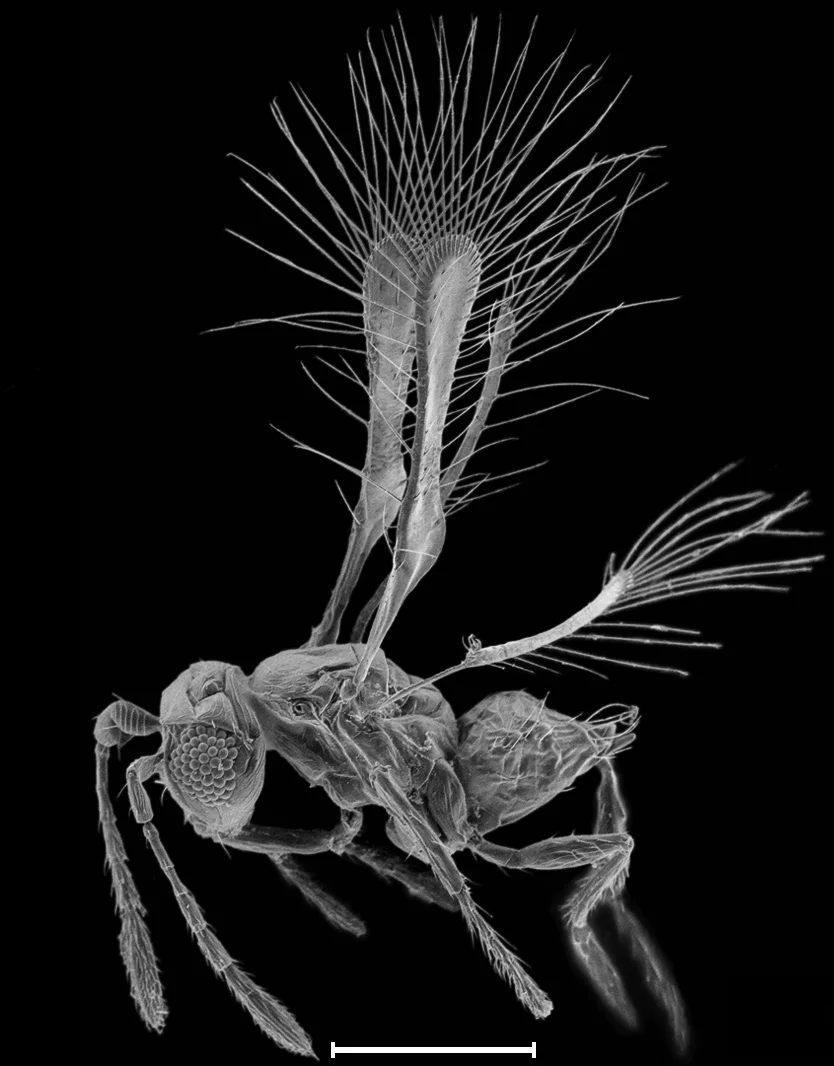
A female Tinkerbella nana, a fairyfly whose females measure 225–250 µm long, in a scanning electron micrograph [10−4 m].
Color: native (electron micrograph, no color)
"Tinkerbella nana female Fig8" by John T. Huber, John S. Noyes, J. Read — https://commons.wikimedia.org/wiki/File:Tinkerbella_nana_female_Fig8.jpg — CC BY 3.0 (https://creativecommons.org/licenses/by/3.0/)

That fairyfly is Tinkerbella nana, described from Costa Rica in 2013 by Huber and Noyes. They measured six females at 225–250 µm. Against the 100 µm bar printed on the photo, this one spans about 213–222 µm from head to abdomen tip, computed for this page (smallest-insect-photo-sizes.csv (sources, version and license, JSON) Data: Photos: John T. Huber, John S. Noyes, J. Read, Tinkerbella nana female Fig8 and Dicopomorpha echmepterygis, CC BY 3.0, Wikimedia Commons; figure legends in Huber JT, Noyes JS 2013, https://doi.org/10.3897/jhr.32.4663; lengths computed 2026-10-25). Its wings are narrow blades edged with bristles longer than the blades are wide.
How small is the smallest insect?
The record belongs to a wasp whose males cannot fly. Edward Mockford described Dicopomorpha echmepterygis in 1997 from adults reared from the eggs of Echmepteryx hageni, an insect of the order Psocoptera (Psocodea in GBIF). By his account (abstract), the males are completely wingless and lack eyes. They are 0.4 times the length of the females and measure 139–240 µm.
That 139 µm comes from slide-mounted specimens. In 2013 John Huber and John Noyes measured two dried males with an electron microscope: 126.17 and 130 µm, which round to 0.13 mm, the figure behind this page's title. The male below spans about 126–128 µm against its printed 50 µm bar, computed for this page.
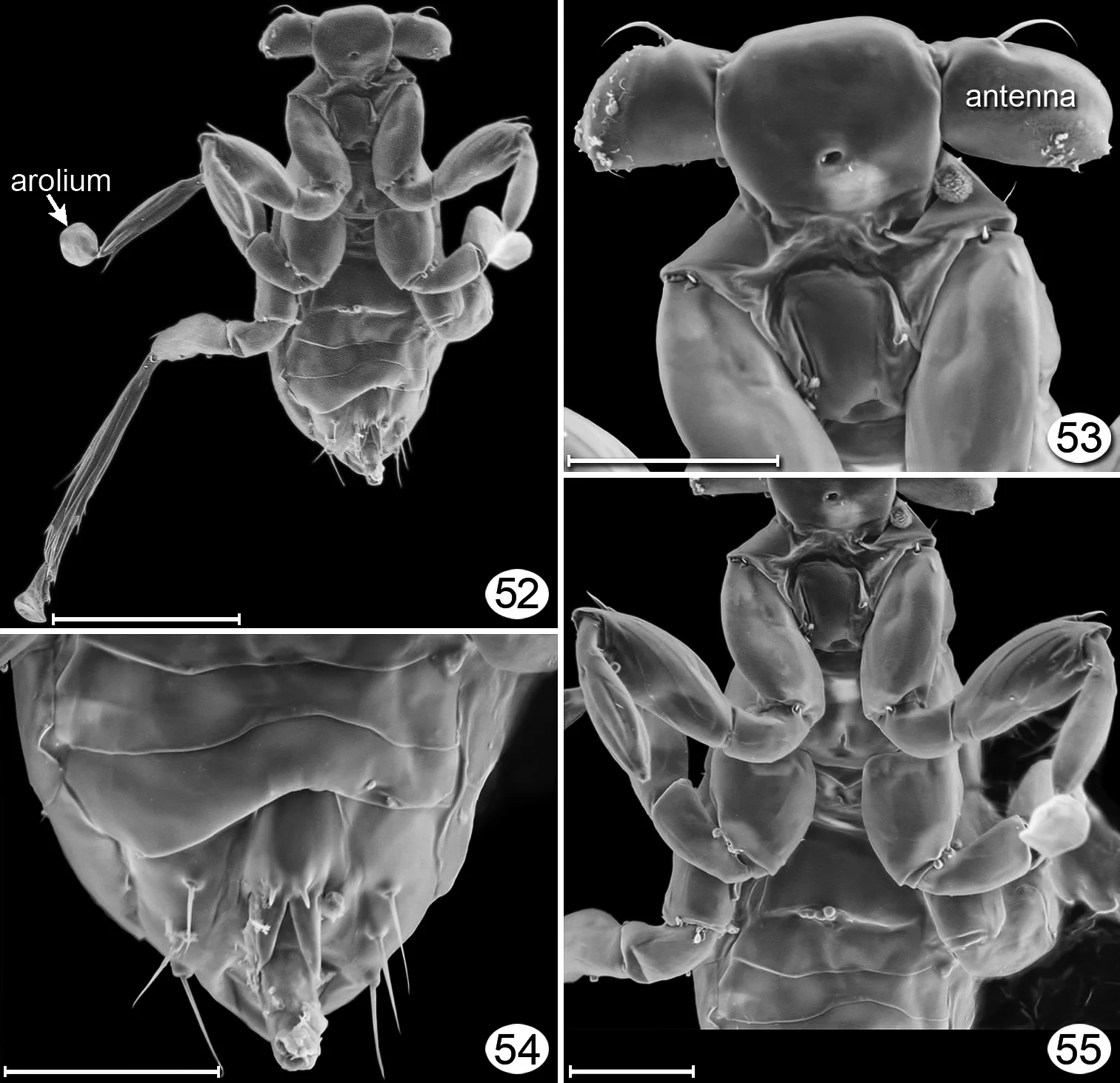
A Dicopomorpha echmepterygis male from below, about 126–128 µm long against the printed 50 µm bar [10−4 m], with close-ups of its head, abdomen tip and legs.
Color: native (electron micrograph, no color)
"Dicopomorpha echmepterygis" by John T. Huber, John S. Noyes, J. Read — https://commons.wikimedia.org/wiki/File:Dicopomorpha_echmepterygis.jpg — CC BY 3.0 (https://creativecommons.org/licenses/by/3.0/)

The males lack wings, eyes, ocelli and mouthparts, and they cannot feed, Huber and Noyes write. One to three of them may share a host egg with a female, Mockford reported (abstract). In Huber and Noyes's view, they almost certainly mate before she leaves the egg.
Other records depend on what counts. Ranked by the shortest length measured:
| Insect | Group | Length | Record |
|---|---|---|---|
| Dicopomorpha echmepterygis males | fairyfly (Mymaridae) | 126–240 µm | smallest adult insect on record (2013); wingless |
| Kikiki huna females | fairyfly (Mymaridae) | 158–190 µm (ten dried specimens) | smallest winged insect, by the 2013 count |
| Megaphragma caribea | Trichogrammatidae | 170 µm | earlier winged record (Delvare 1993, as cited in 2013) |
| Megaphragma mymaripenne | Trichogrammatidae | 221–255 µm | anatomy described in detail in 2017 |
| Tinkerbella nana females | fairyfly (Mymaridae) | 225–250 µm | the species in the opening photo |
| Scydosella musawasensis | featherwing beetle (Ptiliidae) | 325–352 µm | smallest free-living insect and smallest beetle, as of 2015 |
| Paratuposa placentis | featherwing beetle (Ptiliidae) | about 395 µm | flight filmed in 3D in 2022 |
A figure of 0.25 mm for the smallest beetles appears in a great number of scientific and popular publications, Alexey Polilov wrote in 2015. It is wrong, he added: it traces back to 19th-century measurements that a later re-examination found to be in error. He measured ten Scydosella musawasensis from Colombia with a scanning electron microscope at 325–352 µm.
Free-living insects, whose larvae must move and feed, may need eggs big enough to set a floor near 400 µm. That is Grebennikov's 2008 estimate, as Huber and Noyes cite it. Scydosella, measured in 2015, comes in under it.
Is the smallest insect shorter than a single cell?
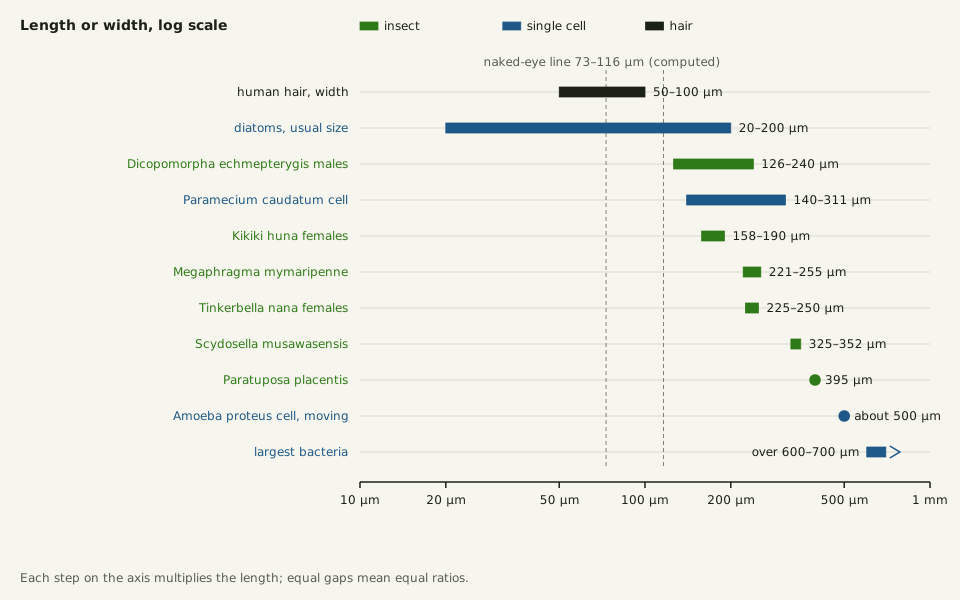
For the shortest males, yes. Paramecium caudatum cells measure 140–311 µm long across the studies in the BOSO-Micro database (Velho Rodrigues and colleagues, 2021). The 126–139 µm males are shorter than any of those cells, while the longest male, at 240 µm, falls inside that range (Paramecium). The smallest insects are comparable in size to unicellular organisms, Polilov wrote in 2012 (abstract).
Other single cells are longer still. A moving Amoeba proteus is roughly 500 µm, and some Thiomargarita and Epulopiscium bacteria exceed 600–700 µm, by two essays in a 2012 forum on cell size. Diatoms are usually 20–200 µm (Piegari and colleagues, 2019), so a large diatom can outmeasure a small wasp. Farisenkov and colleagues pictured a 395 µm featherwing beetle beside an Amoeba proteus of similar size in 2022.
Slide the diagram sideways to read its labels, or open it full size.
The smallest insects, 126–395 µm long, beside single cells and a human hair on a log scale [10−4 m]: Dicopomorpha males overlap Paramecium caudatum cells in length.
Bars are ranges, dots single values; the naked-eye line is computed for this site. Data: smallest-insect-comparison.csv (sources, version and license, JSON).
"The smallest insects beside single cells and a hair" by Ants, Cells & Atoms, https://antscellsandatoms.com/insects/smallest-insect/ — CC BY 4.0 (https://creativecommons.org/licenses/by/4.0/)
Data sources for this figure
Data: Insect lengths: Mockford EL 1997 (abstract), https://doi.org/10.1093/aesa/90.2.115; Huber JT, Noyes JS 2013, CC BY 3.0, https://doi.org/10.3897/jhr.32.4663; Polilov AA 2015, CC BY 4.0, https://doi.org/10.3897/zookeys.526.6531; Polilov AA 2017, CC BY 4.0, https://doi.org/10.1371/journal.pone.0175566; Farisenkov SE et al. 2022, CC BY 4.0, https://doi.org/10.1038/s41586-021-04303-7 (retrieved 2026-10-25); Single cells: Velho Rodrigues MF, Lisicki M, Lauga E 2021, CC BY 4.0, https://doi.org/10.1371/journal.pone.0252291; Piegari G et al. 2019, CC BY 4.0, https://doi.org/10.3389/fvets.2019.00404; Marshall WF et al. 2012, What determines cell size?, CC BY 2.0, https://doi.org/10.1186/1741-7007-10-101 (as listed in this site's cell-sizes.csv; retrieved 2026-10-25); Hair and naked-eye line: Li C et al. 2023, CC BY 4.0, https://doi.org/10.1117/1.JBO.28.11.116501; de Jong PTVM 2024, CC BY 4.0, https://doi.org/10.1038/s41433-022-02180-6 (as listed in this site's reference-objects.csv, where the naked-eye sizes are computed; retrieved 2026-10-25); Chart computed 2026-10-25
Data sources for this figure
Data: Insect lengths: Mockford EL 1997 (abstract), https://doi.org/10.1093/aesa/90.2.115; Huber JT, Noyes JS 2013, CC BY 3.0, https://doi.org/10.3897/jhr.32.4663; Polilov AA 2015, CC BY 4.0, https://doi.org/10.3897/zookeys.526.6531; Polilov AA 2017, CC BY 4.0, https://doi.org/10.1371/journal.pone.0175566; Farisenkov SE et al. 2022, CC BY 4.0, https://doi.org/10.1038/s41586-021-04303-7 (retrieved 2026-10-25); Single cells: Velho Rodrigues MF, Lisicki M, Lauga E 2021, CC BY 4.0, https://doi.org/10.1371/journal.pone.0252291; Piegari G et al. 2019, CC BY 4.0, https://doi.org/10.3389/fvets.2019.00404; Marshall WF et al. 2012, CC BY 2.0, https://doi.org/10.1186/1741-7007-10-101 (as listed in this site's cell-sizes.csv; retrieved 2026-10-25); Hair and naked-eye line: Li C et al. 2023, CC BY 4.0, https://doi.org/10.1117/1.JBO.28.11.116501; de Jong PTVM 2024, CC BY 4.0, https://doi.org/10.1038/s41433-022-02180-6 (as listed in this site's reference-objects.csv, where the naked-eye sizes are computed; retrieved 2026-10-25)
Can you see one with the naked eye?
Only at the edge. This site's naked-eye line is one minute of arc, the finest separation Hooke reckoned the eye could resolve, as quoted in de Jong's 2024 history of eye testing. At viewing distances of 25–40 cm that is 73–116 µm, computed for this site.
A 139 µm male spans 1.2–1.9 times that line, computed for this page, too little to show its shape. Whether it shows up as a dot depends on contrast and eyesight. A human hair, typically 50–100 µm wide (Li and colleagues, 2023), sits near the same line.
What still fits inside a body this small?
Much of the usual insect anatomy, though several organ systems are cut down. Polilov's 2017 study looked at two Megaphragma species, 221–286 µm long and reared from thrips eggs. It found no heart or blood vessels, and a tracheal system of only a few air tubes with few branches. The wasps' compound eyes have 28–30 facets each; a Tinkerbella nana eye has about 50 (Huber and Noyes, 2013).
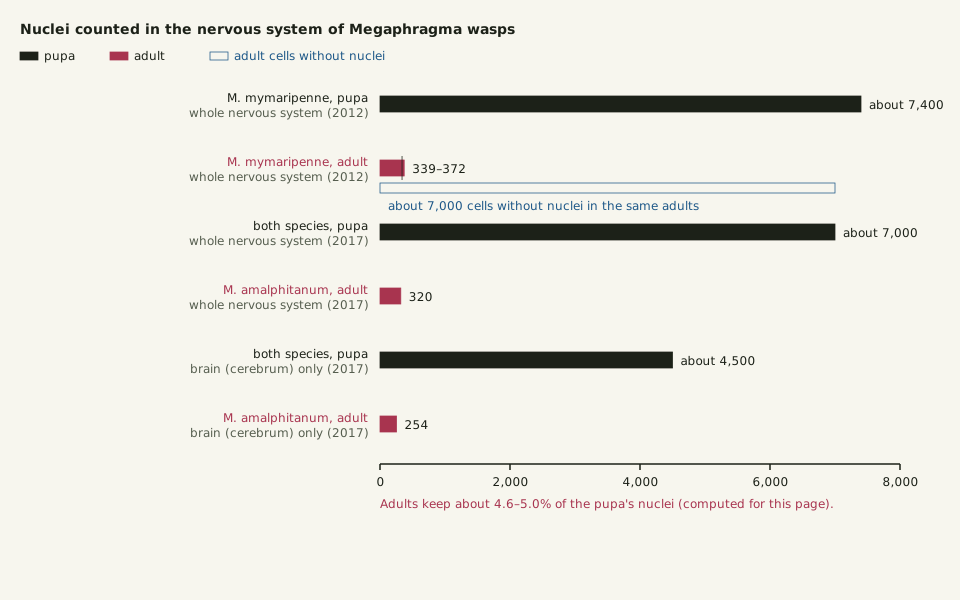
The nervous system is unlike that of any other insect, the 2017 study found. Megaphragma mymaripenne pupae have about 7,400 nuclei in the central nervous system, but adults keep only 339–372, Polilov reported in 2012 (abstract). Most neuron cell bodies break down late in pupal development, leaving about 7,000 cells without nuclei, yet the adults still fly and search for hosts. In M. amalphitanum, the 2017 study counted 320 nuclei in the adult's nervous system, 254 of them in the brain, against about 7,000 in the pupa.
Slide the diagram sideways to read its labels, or open it full size.
Megaphragma wasps, 221–286 µm long [10−4 m]: about 7,000–7,400 nuclei in the pupa's nervous system and 320–372 in the adult's, about 4.6–5.0% kept, computed for this page.
Data: smallest-insect-neurons.csv (sources, version and license, JSON).
"Megaphragma: nuclei in the nervous system, pupa and adult" by Ants, Cells & Atoms, https://antscellsandatoms.com/insects/smallest-insect/ — CC BY 4.0 (https://creativecommons.org/licenses/by/4.0/)
Data: Polilov AA 2012, Arthropod Structure & Development 41(1):29-34 (abstract), https://doi.org/10.1016/j.asd.2011.09.001, retrieved 2026-10-25; Polilov AA 2017, PLOS ONE 12(5):e0175566, CC BY 4.0, https://doi.org/10.1371/journal.pone.0175566, retrieved 2026-10-25; Shares kept by the adult computed 2026-10-25
Data: Polilov AA 2012, Arthropod Structure & Development 41(1):29-34 (abstract), https://doi.org/10.1016/j.asd.2011.09.001, retrieved 2026-10-25; Polilov AA 2017, PLOS ONE 12(5):e0175566, CC BY 4.0, https://doi.org/10.1371/journal.pone.0175566, retrieved 2026-10-25; Shares computed 2026-10-25
Huber and Noyes suggest a floor. Once cells reach their minimum size, an organ can only lose cells, perhaps down to one, such as a single muscle fiber or eye facet. Being small makes an animal relatively stronger, the scaling behind ant strength. Yet a point still comes, they argue, where muscles are too small to move a jointed leg.
Why are the smallest insects' wings made of bristles?
A Tinkerbella nana fore wing is 195–240 µm long but only 30–50 µm wide, with marginal bristles up to 100–155 µm long. Its hind wing is just 5–10 µm wide (Huber and Noyes, 2013). In Kikiki huna the fringe is about five times the fore wing's 20–25 µm width, against about 0.2 times in broader-winged Trichogramma wasps.
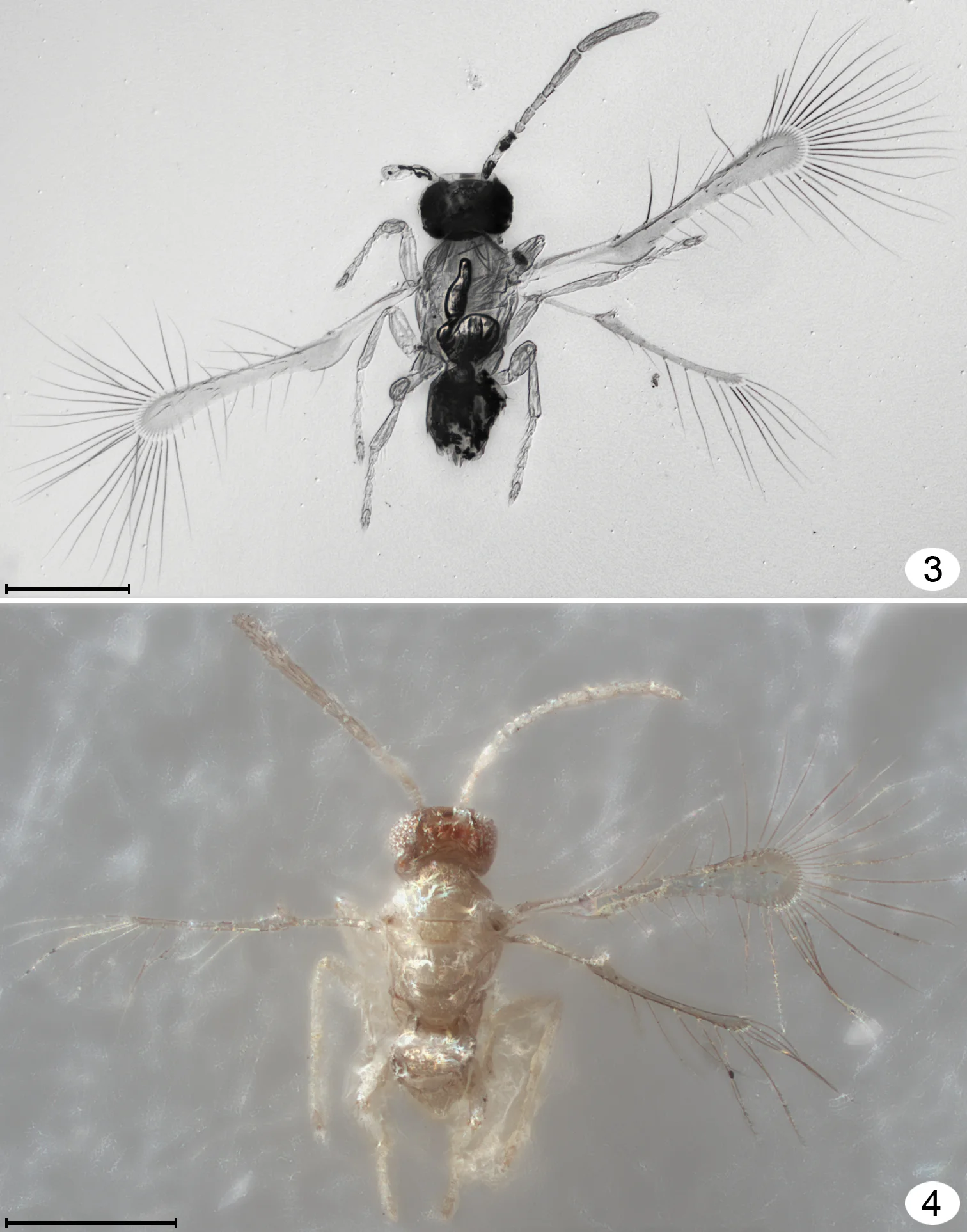
Two Tinkerbella nana females, a species whose females measure 225–250 µm long [10−4 m]: one on a microscope slide (top), one dried on a card (bottom), each with paddle-shaped wings fringed with long bristles.
Color: native (light photographs; the paper notes that photos other than of primary types were retouched as needed)
"Tinkerbella nana female1" by John T. Huber, John S. Noyes, J. Read — https://commons.wikimedia.org/wiki/File:Tinkerbella_nana_female1.jpg — CC BY 3.0 (https://creativecommons.org/licenses/by/3.0/)

Bristled wings, a condition called ptiloptery, turn up in the smallest members of several insect orders: thrips, small moths, parasitic wasps and featherwing beetles among them (Huber and Noyes, 2013; Farisenkov and colleagues, 2022). In 2013 Huber and Noyes suggested the long bristles might cut turbulence and drag. A 2022 study of the featherwing beetle Paratuposa placentis, collected in Vietnam, pointed to weight instead.
The beetle's bristled wing is estimated at about 0.024 µg, near 1% of body mass, against 0.13–0.19 µg for a solid wing of the same outline. In simulations it still gave 68% of the solid wing's mean upward force. The gaps barely leak because, at this size, viscosity blocks the air flowing between neighbouring bristles.
Across featherwing beetles, Kolomenskiy and colleagues (2025) found gaps of 7–14 µm and a gap Reynolds number near 0.5 during power strokes, low enough for that blocking to hold.
How do the smallest insects fly?
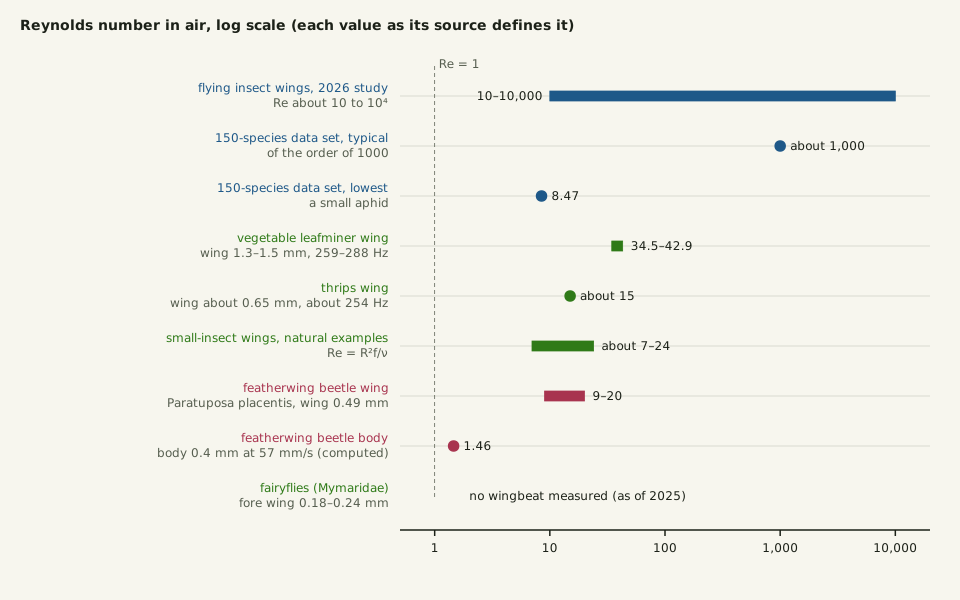
Farisenkov and colleagues filmed Paratuposa placentis with two synchronized high-speed cameras (2022). Its bristled wings, each 493 µm long, trace a figure-of-eight and clap together above and below the body. Meanwhile the wing cases open and close to damp the body's rocking. The wing's Reynolds number — a ratio of inertia to the air's stickiness — averages 9 over a wingbeat and reaches 20 in power strokes, in air at 25 °C.
The whole beetle, 395 µm long at 57 mm/s in air at 25 °C, flies at a Reynolds number of about 1.5, computed for this site's swimmers table. That is close to the syrup line, where Re = 1 and inertia and viscosity are of the same order. A vegetable leafminer, a fly with 1.3–1.5 mm wings, works at a wing Reynolds number of 34.5–42.9 (Cheng and Sun, 2016).
For average and large insects the value is above 100, Cheng and Sun note. A 2026 study of flies gives about 10 to 104 for flying insect wings (Le Roy and colleagues). In a data set of over 150 insect species, a ratio Deakin calls essentially a Reynolds number was mostly above 100, typically of the order of 1,000; the lowest, 8.47, belonged to a small aphid (Deakin, 2010).
Slide the diagram sideways to read its labels, or open it full size.
Wing Reynolds numbers in air, as each source states them: small insects with wings about 0.2–1.5 mm long [10−4–10−3 m] beside values for flying insects in general (about 10 to 104 in a 2026 study).
Definitions differ by source. Data: smallest-insect-reynolds.csv (sources, version and license, JSON); wingbeat rates: wingbeat-frequencies.csv (sources, version and license, JSON).
"Wing Reynolds numbers of small insects, as their sources state them" by Ants, Cells & Atoms, https://antscellsandatoms.com/insects/smallest-insect/ — CC BY 4.0 (https://creativecommons.org/licenses/by/4.0/)
Data sources for this figure
Data: Farisenkov SE et al. 2022, Nature 602:96-100, CC BY 4.0, https://doi.org/10.1038/s41586-021-04303-7, retrieved 2026-10-25; Engels T, Kolomenskiy D, Lehmann FO 2021, Journal of the Royal Society Interface 18(183):20210518, CC BY 4.0, https://doi.org/10.1098/rsif.2021.0518, retrieved 2026-10-25; Cheng X, Sun M 2016, Scientific Reports 6:25706, CC BY 4.0, https://doi.org/10.1038/srep25706, retrieved 2026-10-25; Deakin MAB 2010, Journal of Insect Science 10:96, CC BY 2.5, https://doi.org/10.1673/031.010.9601, retrieved 2026-10-25; Le Roy C, Bharathi I, Engels T, Muijres FT 2026, PLOS Biology 24(7):e3003473, CC BY 4.0, https://doi.org/10.1371/journal.pbio.3003473, retrieved 2026-10-25; Fairyfly wing lengths: Huber JT, Noyes JS 2013, CC BY 3.0, https://doi.org/10.3897/jhr.32.4663; no fairyfly kinematics: Kolomenskiy D et al. 2025, PNAS 122(34):e2506403122, CC BY 4.0, https://doi.org/10.1073/pnas.2506403122 (retrieved 2026-10-25); Body Reynolds number of Paratuposa placentis as computed in this site's swimmers-reynolds.csv, retrieved 2026-10-25
Data sources for this figure
Data: Farisenkov SE et al. 2022, Nature 602:96-100, CC BY 4.0, https://doi.org/10.1038/s41586-021-04303-7, retrieved 2026-10-25; Engels T, Kolomenskiy D, Lehmann FO 2021, Journal of the Royal Society Interface 18(183):20210518, CC BY 4.0, https://doi.org/10.1098/rsif.2021.0518, retrieved 2026-10-25; Cheng X, Sun M 2016, Scientific Reports 6:25706, CC BY 4.0, https://doi.org/10.1038/srep25706, retrieved 2026-10-25; Deakin MAB 2010, Journal of Insect Science 10:96, CC BY 2.5, https://doi.org/10.1673/031.010.9601, retrieved 2026-10-25; Le Roy C, Bharathi I, Engels T, Muijres FT 2026, PLOS Biology 24(7):e3003473, CC BY 4.0, https://doi.org/10.1371/journal.pbio.3003473, retrieved 2026-10-25; Huber JT, Noyes JS 2013, CC BY 3.0, https://doi.org/10.3897/jhr.32.4663; Kolomenskiy D et al. 2025, PNAS 122(34):e2506403122, CC BY 4.0, https://doi.org/10.1073/pnas.2506403122 (retrieved 2026-10-25)
Data sources for this figure
Data: Kolomenskiy D, Farisenkov SE, Petrov PN, Polilov AA 2025, PNAS 122(34):e2506403122, CC BY 4.0, https://doi.org/10.1073/pnas.2506403122, retrieved 2026-10-25; Cheng X, Sun M 2016, Scientific Reports 6:25706, CC BY 4.0, https://doi.org/10.1038/srep25706, retrieved 2026-10-25; Huber JT, Noyes JS 2013, Journal of Hymenoptera Research 32:17-44, CC BY 3.0, https://doi.org/10.3897/jhr.32.4663, retrieved 2026-10-25; Altshuler DL et al. 2005, PNAS 102(50):18213-18218 (abstract), https://doi.org/10.1073/pnas.0506590102, retrieved 2026-10-25; GBIF Secretariat 2023, GBIF Backbone Taxonomy, checklist dataset https://doi.org/10.15468/39omei, CC BY 4.0, retrieved 2026-10-25; Yasuda H, Inglis MR, Yamamoto Y, Henningsson P, Nakata T, Bomphrey RJ 2026, Integrative and Comparative Biology 66:icag077, CC BY 4.0, https://doi.org/10.1093/icb/icag077, retrieved 2026-10-25; Tahmasian S, Kotulak-Smith BC 2024, Scientific Reports 14:2814, CC BY 4.0, https://doi.org/10.1038/s41598-024-53139-4, retrieved 2026-10-25; Combes SA, Gravish N, Gagliardi SF 2023, Journal of Experimental Biology 226(Suppl 1):jeb245374, CC BY 4.0, https://doi.org/10.1242/jeb.245374, retrieved 2026-10-25; Casey C, Heveran C, Jankauski M 2023, Journal of the Royal Society Interface 20(201):20230029, CC BY 4.0, https://doi.org/10.1098/rsif.2023.0029, retrieved 2026-10-25; Miller-Struttmann NE et al. 2017, PLOS ONE 12(6):e0179273, CC BY 4.0, https://doi.org/10.1371/journal.pone.0179273, retrieved 2026-10-25
Has anyone timed a fairyfly's wingbeat?
Not as of 2025. Kolomenskiy and colleagues note that no kinematic data exist for fairyflies, so the wingbeat of a 158 µm Kikiki huna, the smallest winged insect on record in 2013, is unmeasured. Other insects have been timed: featherwing beetles beat their wings 140–210 times a second (Kolomenskiy and colleagues, 2025), the leafminer 259–288 and a honeybee about 230 (Altshuler and colleagues, 2005; abstract); bumblebee flight has its own page.
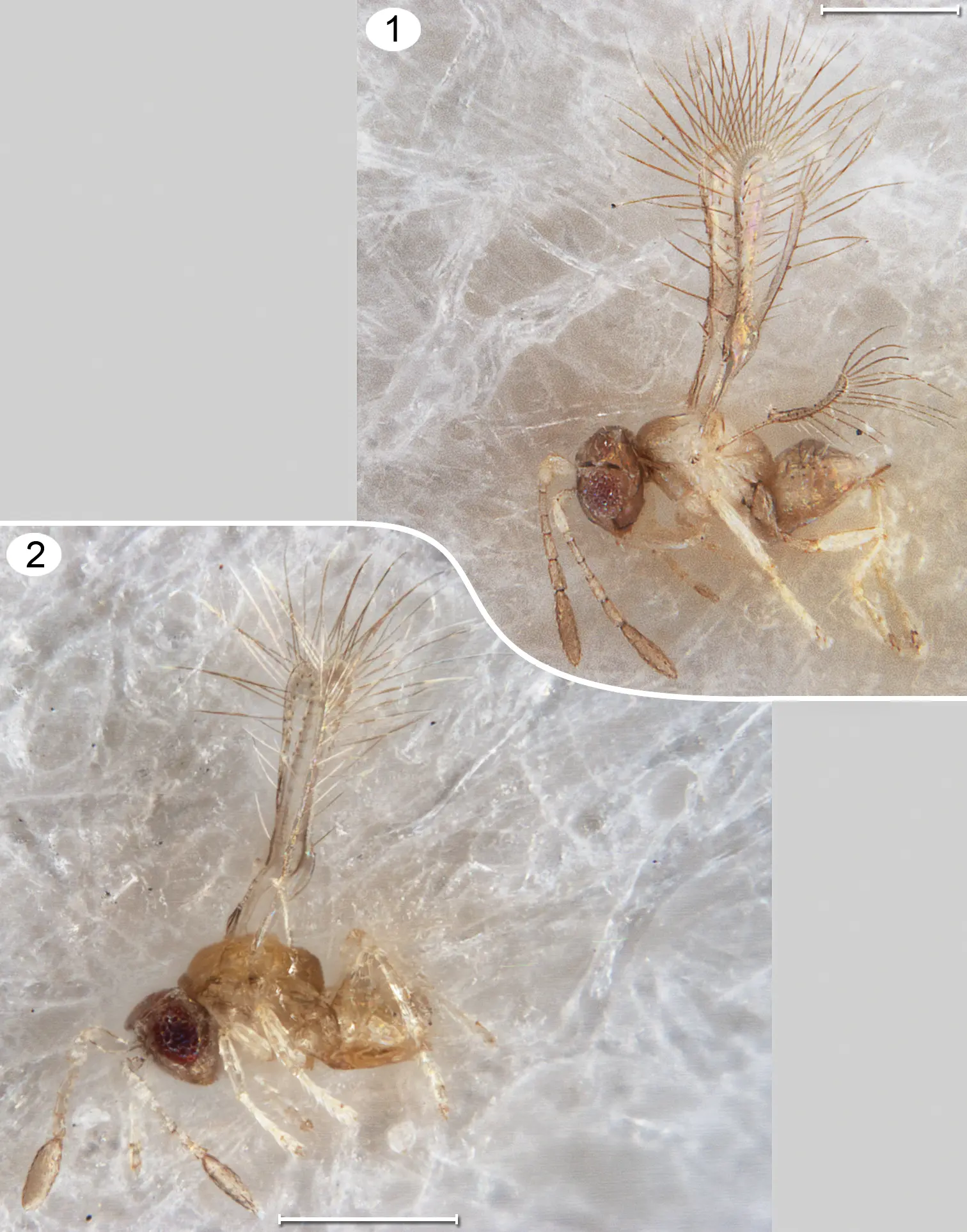
Two fairyflies in side view: Tinkerbella nana (top) and Kikiki huna (bottom), the smallest winged insect on record in 2013, with ten dried females measured at 158–190 µm [10−4 m].
Color: native (light photographs; the paper notes that photos other than of primary types were retouched as needed)
"Tinkerbella nana & Kikiki huna" by John T. Huber, John S. Noyes, J. Read — https://commons.wikimedia.org/wiki/File:Tinkerbella_nana_%26_Kikiki_huna.jpg — CC BY 3.0 (https://creativecommons.org/licenses/by/3.0/)

The sources differ on what limits the smallest fliers. Farisenkov and colleagues describe flight at this size as dominated by viscous air friction. Huber and Noyes argued in 2013 that air viscosity was likely not yet a constraint; the problem was the insect's own inertia.
Huber and Noyes put the floor for flapping flight near 150 µm and for normal walking near 125 µm. The two dried Dicopomorpha males they measured, at 126 and 130 µm, sit within 5 µm of that second line.
Sources
- Huber JT, Noyes JS. "A new genus and species of fairyfly, Tinkerbella nana (Hymenoptera, Mymaridae), with comments on its sister genus Kikiki, and discussion on small size limits in arthropods." Journal of Hymenoptera Research 32:17–44 (2013). https://doi.org/10.3897/jhr.32.4663 Read: full text. Text license: CC BY 3.0 (https://creativecommons.org/licenses/by/3.0/).
- Velho Rodrigues MF, Lisicki M, Lauga E. "The bank of swimming organisms at the micron scale (BOSO-Micro)." PLOS ONE 16(6):e0252291 (2021). https://doi.org/10.1371/journal.pone.0252291 Read: full text. Text license: CC BY 4.0 (https://creativecommons.org/licenses/by/4.0/).
- Mockford EL. "A New Species of Dicopomorpha (Hymenoptera: Mymaridae) with Diminutive, Apterous Males." Annals of the Entomological Society of America 90(2):115–120 (1997). https://doi.org/10.1093/aesa/90.2.115 Read: abstract.
- GBIF Secretariat. GBIF Backbone Taxonomy. Checklist dataset https://doi.org/10.15468/39omei, accessed 2026-10-25; Dicopomorpha echmepterygis Mockford, 1997, usage key 1367990; Echmepteryx hageni (Packard, 1870), usage key 1031792; Kikiki huna Huber, 2000, usage key 1368626; Tinkerbella nana Huber & Noyes, 2013, usage key 8936074; Megaphragma mymaripenne Timberlake, 1924, usage key 1399586; Megaphragma amalphitanum Viggiani, 1997, usage key 1399578; Scydosella musawasensis Hall, 1999, usage key 8736602; Paratuposa placentis Deane, 1931, usage key 4760663. Read: dataset record (species match). Text license: CC BY 4.0 (https://creativecommons.org/licenses/by/4.0/).
- Polilov AA. "Anatomy of adult Megaphragma (Hymenoptera: Trichogrammatidae), one of the smallest insects, and new insight into insect miniaturization." PLOS ONE 12(5):e0175566 (2017). https://doi.org/10.1371/journal.pone.0175566 Read: full text. Text license: CC BY 4.0 (https://creativecommons.org/licenses/by/4.0/).
- Polilov AA. "How small is the smallest? New record and remeasuring of Scydosella musawasensis Hall, 1999 (Coleoptera, Ptiliidae), the smallest known free-living insect." ZooKeys 526:61–64 (2015). https://doi.org/10.3897/zookeys.526.6531 Read: full text. Text license: CC BY 4.0 (https://creativecommons.org/licenses/by/4.0/).
- Polilov AA. "The smallest insects evolve anucleate neurons." Arthropod Structure & Development 41(1):29–34 (2012). https://doi.org/10.1016/j.asd.2011.09.001 Read: abstract.
- Marshall WF, Young KD, Swaffer M, Wood E, Nurse P, Kimura A, Frankel J, Wallingford J, Walbot V, Qu X, Roeder AHK. "What determines cell size?" BMC Biology 10:101 (2012). https://doi.org/10.1186/1741-7007-10-101 Read: full text. Text license: CC BY 2.0 (https://creativecommons.org/licenses/by/2.0/).
- Piegari G, De Biase D, d'Aquino I, Prisco F, Fico R, Ilsami R, Pozzato N, Genovese A, Paciello O. "Diagnosis of Drowning and the Value of the Diatom Test in Veterinary Forensic Pathology." Frontiers in Veterinary Science 6:404 (2019). https://doi.org/10.3389/fvets.2019.00404 Read: full text. Text license: CC BY 4.0 (https://creativecommons.org/licenses/by/4.0/).
- Farisenkov SE, Kolomenskiy D, Petrov PN, Engels T, Lapina NA, Lehmann F-O, Onishi R, Liu H, Polilov AA. "Novel flight style and light wings boost flight performance of tiny beetles." Nature 602:96–100 (2022). https://doi.org/10.1038/s41586-021-04303-7 Read: full text. Text license: CC BY 4.0 (https://creativecommons.org/licenses/by/4.0/).
- de Jong PTVM. "A history of visual acuity testing and optotypes." Eye 38(1):13–24 (2024). https://doi.org/10.1038/s41433-022-02180-6 Read: full text. Text license: CC BY 4.0 (https://creativecommons.org/licenses/by/4.0/).
- Li C, Du Y, Chen H, Han X, Wu W, Kong X, Zhang C, Yuan X. "Transmission infrared micro-spectroscopic study of individual human hair." Journal of Biomedical Optics 28(11):116501 (2023). https://doi.org/10.1117/1.JBO.28.11.116501 Read: full text. Text license: CC BY 4.0 (https://creativecommons.org/licenses/by/4.0/).
- Kolomenskiy D, Farisenkov SE, Petrov PN, Polilov AA. "Scaling and mechanical optimality of bristled wings in microinsects." Proceedings of the National Academy of Sciences 122(34):e2506403122 (2025). https://doi.org/10.1073/pnas.2506403122 Read: full text. Text license: CC BY 4.0 (https://creativecommons.org/licenses/by/4.0/).
- Le Roy C, Bharathi I, Engels T, Muijres FT. "Dipteran flight diversity is shaped by aerodynamic constraints, scaling, and evolutionary trade-offs." PLOS Biology 24(7):e3003473 (2026). https://doi.org/10.1371/journal.pbio.3003473 Read: full text. Text license: CC BY 4.0 (https://creativecommons.org/licenses/by/4.0/).
- Deakin MAB. "Formulae for Insect Wingbeat Frequency." Journal of Insect Science 10:96 (2010). https://doi.org/10.1673/031.010.9601 Read: full text. Text license: CC BY 2.5 (https://creativecommons.org/licenses/by/2.5/).
- Cheng X, Sun M. "Wing-kinematics measurement and aerodynamics in a small insect in hovering flight." Scientific Reports 6:25706 (2016). https://doi.org/10.1038/srep25706 Read: full text. Text license: CC BY 4.0 (https://creativecommons.org/licenses/by/4.0/).
- Engels T, Kolomenskiy D, Lehmann F-O. "Flight efficiency is a key to diverse wing morphologies in small insects." Journal of the Royal Society Interface 18(183):20210518 (2021). https://doi.org/10.1098/rsif.2021.0518 Read: full text. Text license: CC BY 4.0 (https://creativecommons.org/licenses/by/4.0/).
- Altshuler DL, Dickson WB, Vance JT, Roberts SP, Dickinson MH. "Short-amplitude high-frequency wing strokes determine the aerodynamics of honeybee flight." Proceedings of the National Academy of Sciences 102(50):18213–18218 (2005). https://doi.org/10.1073/pnas.0506590102 Read: abstract.
Cite this page
Ants, Cells & Atoms. “Smallest Adult Insect as of 2013: Wingless, Down to 0.13 mm.” Published 2026-10-25. https://antscellsandatoms.com/insects/smallest-insect/. Accessed (add the date you read it).
No DOI is issued for entries. Figures made here are CC BY 4.0; see each caption for the license of photographs.
Related entries
Water Strider: The Dimples Under Its Feet Hold Its Weight
Image: “Aquarius remigis 140810489” by Jason Swanson (2021) · CC0 1.0
"Aquarius remigis 140810489" by Jason Swanson — https://commons.wikimedia.org/wiki/File:Aquarius_remigis_140810489.jpg — CC0 1.0 (https://creativecommons.org/publicdomain/zero/1.0/)

How Do Insects Breathe? Through Air Tubes, Not Lungs
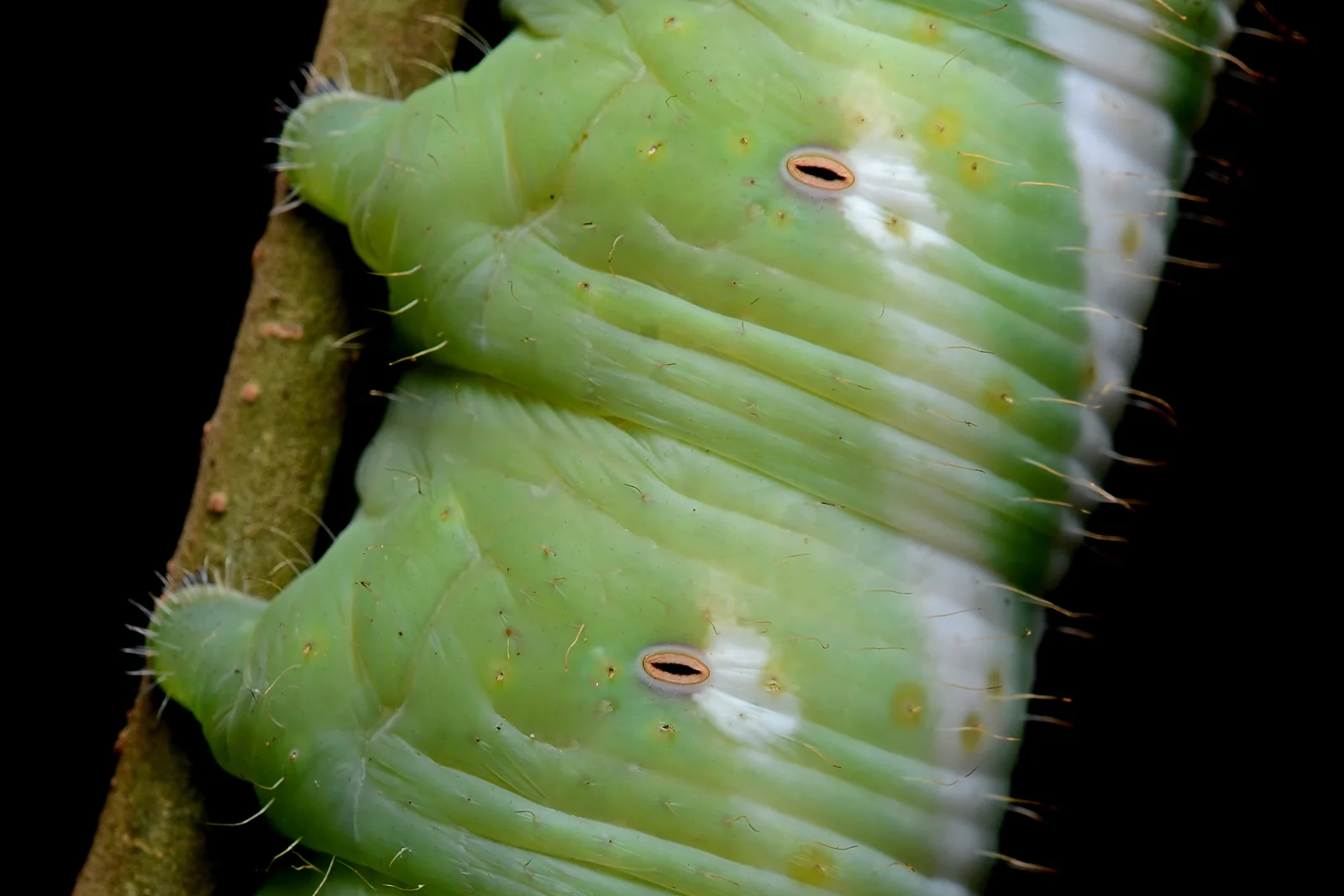
Image: “Flickr - ggallice - Spiracles” by Geoff Gallice (2011) · CC BY 2.0
"Flickr - ggallice - Spiracles" by Geoff Gallice — https://commons.wikimedia.org/wiki/File:Flickr_-_ggallice_-_Spiracles.jpg — CC BY 2.0 (https://creativecommons.org/licenses/by/2.0/)

Ants: Strong for Their Weight, Mostly Because They're Small
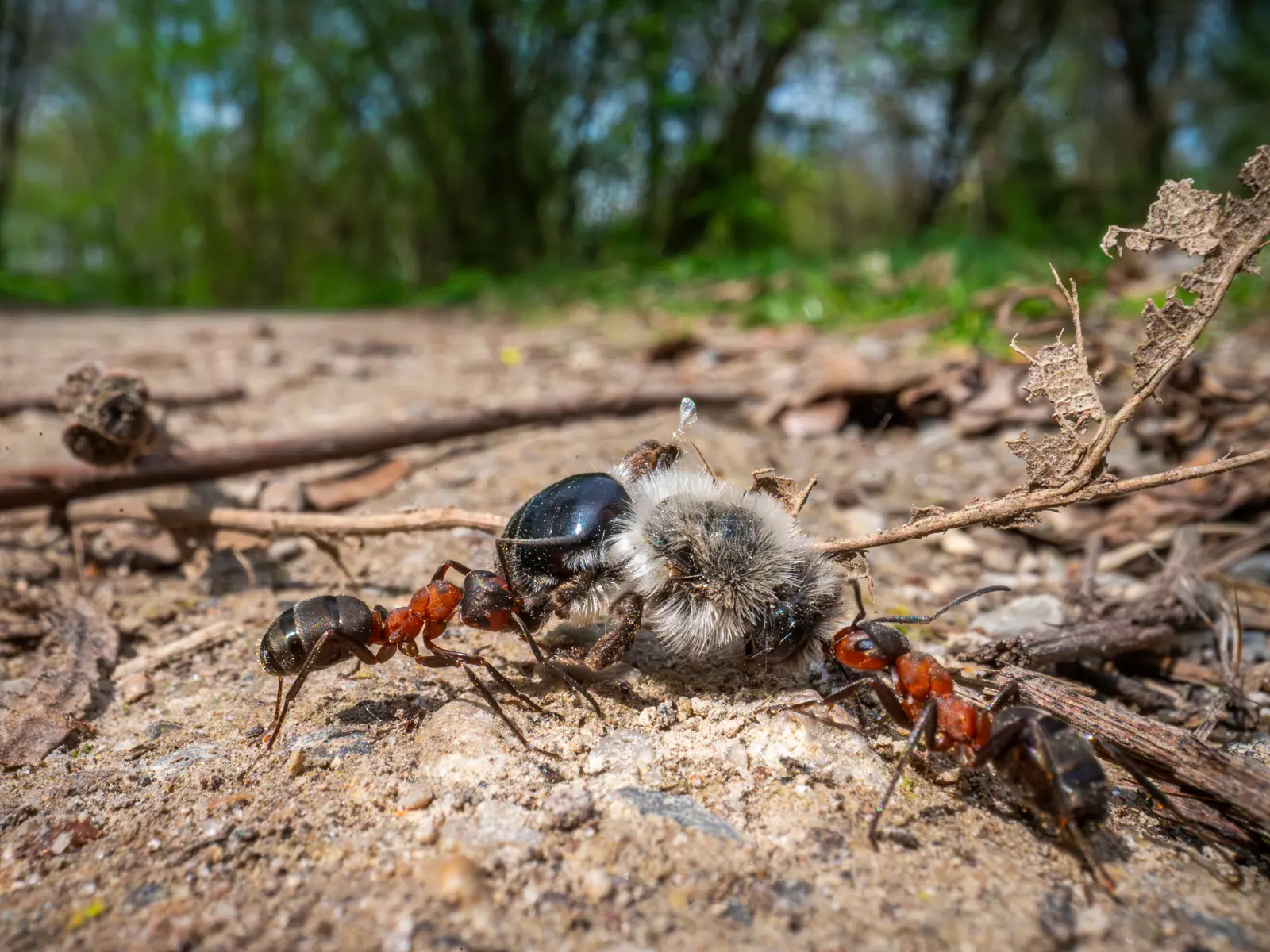
Image: “Rote Waldameisen mit Beute 01” by Stephan Sprinz (2026) · CC BY 4.0
"Rote Waldameisen mit Beute 01" by Stephan Sprinz — https://commons.wikimedia.org/wiki/File:Rote_Waldameisen_mit_Beute_01.jpg — CC BY 4.0 (https://creativecommons.org/licenses/by/4.0/)
