Bumblebee Flight: Why the 'Can't Fly' Sum Fell Short

Slide the ladder sideways to read its labels, or open it full size.
Bumblebee wingspan, wingtip to wingtip: about 22–32 mm [10−2 m]; mean wing chord 3–4 mm.
Log scale from 10 cm to 0.1 nm, each rung ten times smaller; dashed lines: naked eye about 0.1 mm, light microscope about 0.2 µm (How to read the Zoom ladder). Data: bumblebee-flight-fixed-wing.csv (sources, version and license, JSON).
"Zoom ladder: bumblebee flight" by Ants, Cells & Atoms, https://antscellsandatoms.com/insects/bumblebee-flight/ — CC BY 4.0 (https://creativecommons.org/licenses/by/4.0/)
Data: Wingspans and chords: Yasuda H et al. 2026, Integrative and Comparative Biology 66:icag077, CC BY 4.0, https://doi.org/10.1093/icb/icag077, and Tahmasian S, Kotulak-Smith BC 2024, Scientific Reports 14:2814, CC BY 4.0, https://doi.org/10.1038/s41598-024-53139-4, both tabulating Dudley and Ellington 1990, retrieved 2026-10-25
Data sources for this figure
Data: Yasuda H, Inglis MR, Yamamoto Y, Henningsson P, Nakata T, Bomphrey RJ 2026, Integrative and Comparative Biology 66:icag077, CC BY 4.0, https://doi.org/10.1093/icb/icag077, retrieved 2026-10-25; Tahmasian S, Kotulak-Smith BC 2024, Scientific Reports 14:2814, CC BY 4.0, https://doi.org/10.1038/s41598-024-53139-4, retrieved 2026-10-25; Farisenkov SE et al. 2022, Nature 602:96-100, CC BY 4.0, https://doi.org/10.1038/s41586-021-04303-7, retrieved 2026-10-25; Prisacariu EG, Dumitrescu O 2026, Biomimetics 11(4):250, CC BY 4.0, https://doi.org/10.3390/biomimetics11040250, retrieved 2026-10-25; Speeds, Reynolds numbers, ratios and syrup line computed 2026-10-25
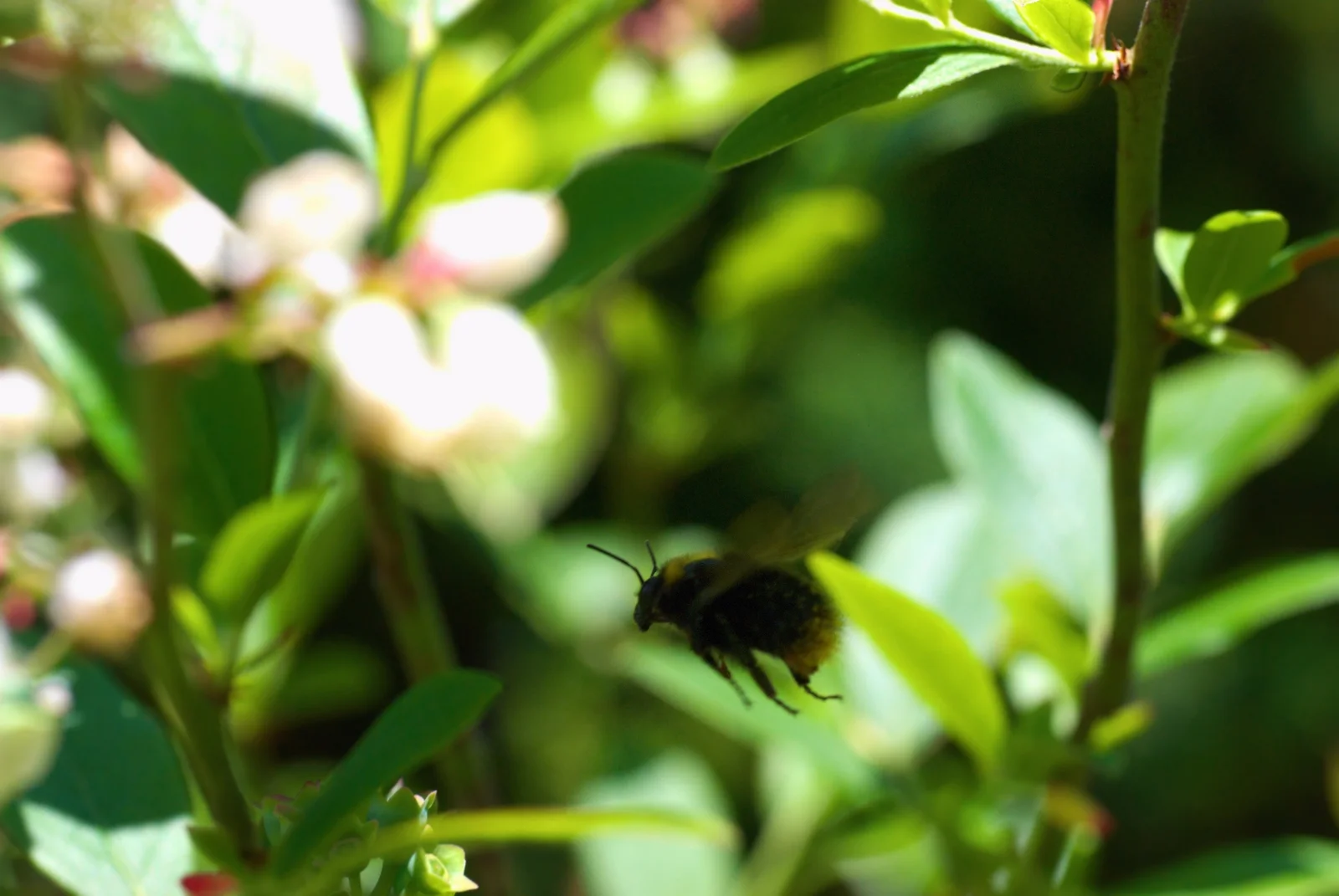
A bumblebee in flight, species not identified; wingspans in two measured species run 22–32 mm [10−2 m].
Color: native
"Flying Bumblebee" by Devcore — https://commons.wikimedia.org/wiki/File:Flying_Bumblebee.jpg — CC0 1.0 (https://creativecommons.org/publicdomain/zero/1.0/)

Who said bumblebees can't fly?
Take the claim that bumblebees cannot fly. Gehrke and Mulleners, writing in 2025, attribute it to a 1934 book on insect flight by the French entomologist Antoine Magnan, who wrote that bumblebees should not be able to fly. In their account, conventional fixed-wing aerodynamic theory said the bee's small wings could not make enough lift for sustained flight. Only the bibliographic record of Magnan's Le vol des insectes is cited here.
Wikipedia's article on bumblebees (read 2026-10-25) gives a translation of the book's introduction. As translated there, Magnan writes that, spurred by aviation, he applied the laws of air resistance to insects and reached, with André Sainte-Laguë, the conclusion that their flight was impossible. The same passage adds that the mismatch should surprise no one, because the aerodynamics of an insect wing were not yet known.
The article also quotes Michael Dickinson, writing in Scientific American in 2001, on what the sum probably rested on. By his account, as Wikipedia quotes it, the most lift that aircraft wings as small as a bee's could make, moving as slowly as a bee flies, would be much less than the bee's weight. The same article calls the claim's origin hard to pin down, and elsewhere describes the sum differently: a simplified, linear treatment of wings oscillating through small strokes, with the air never separating from them.
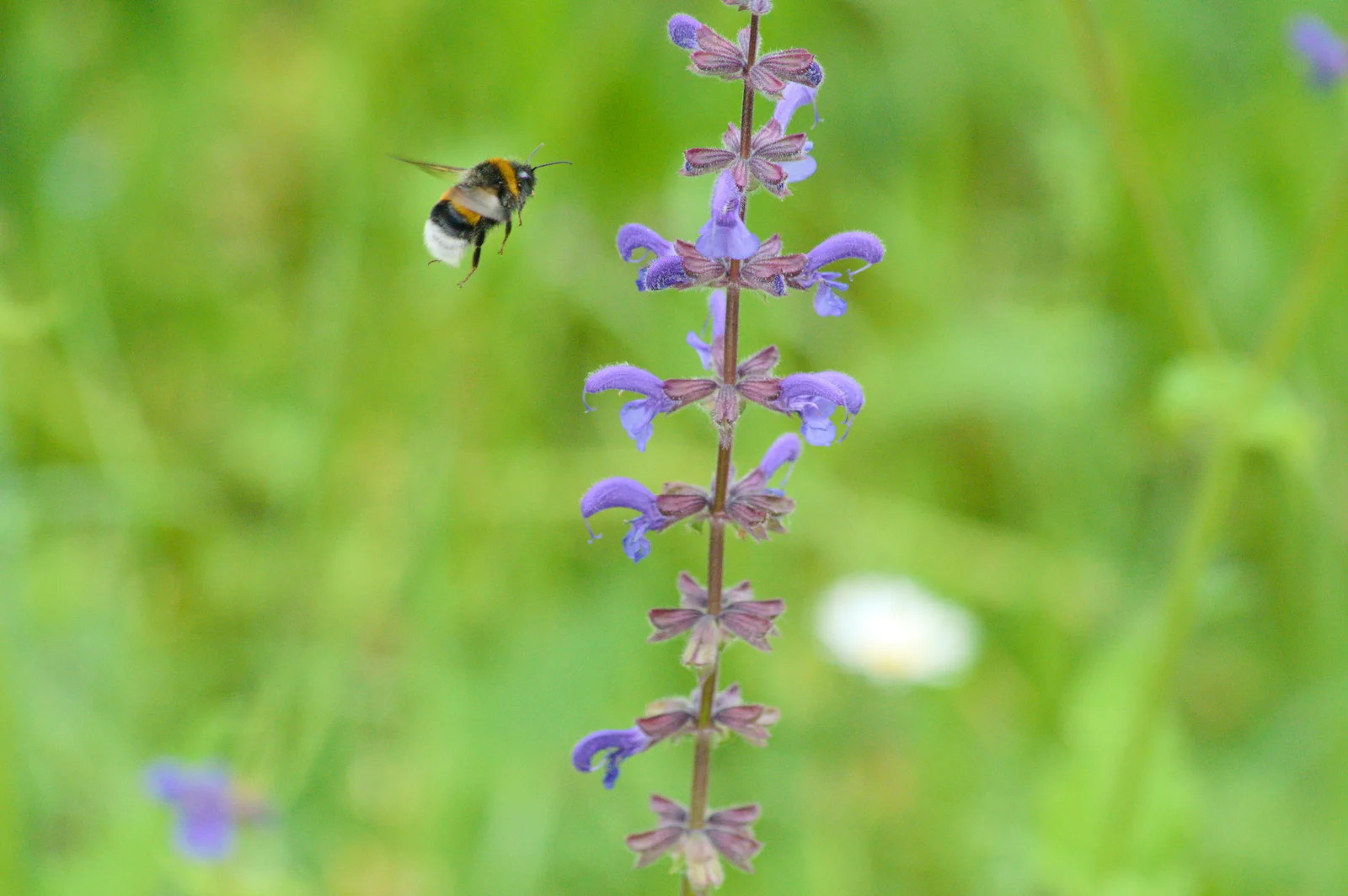
A bumblebee of the Bombus terrestris group flying toward meadow sage; workers of the buff-tailed bumblebee are 11–17 mm long [10−2 m].
Color: native
"A bumblebee (Bombus gr. terrestris) in flight, visiting a flowering sage (Salvia pratensis)" by Samulus.i.n — https://commons.wikimedia.org/wiki/File:A_bumblebee_(Bombus_gr._terrestris)_in_flight,_visiting_a_flowering_sage_(Salvia_pratensis).jpg — CC BY-SA 4.0 (https://creativecommons.org/licenses/by-sa/4.0/)

The bees in question are not big. Wikipedia's article on the buff-tailed bumblebee, Bombus terrestris, gives workers as 11–17 mm long and queens as 20–22 mm (read 2026-10-25). The compound eye page covers how the eyes of Bombus terrestris workers change with body size.
What did the fixed-wing sum leave out?
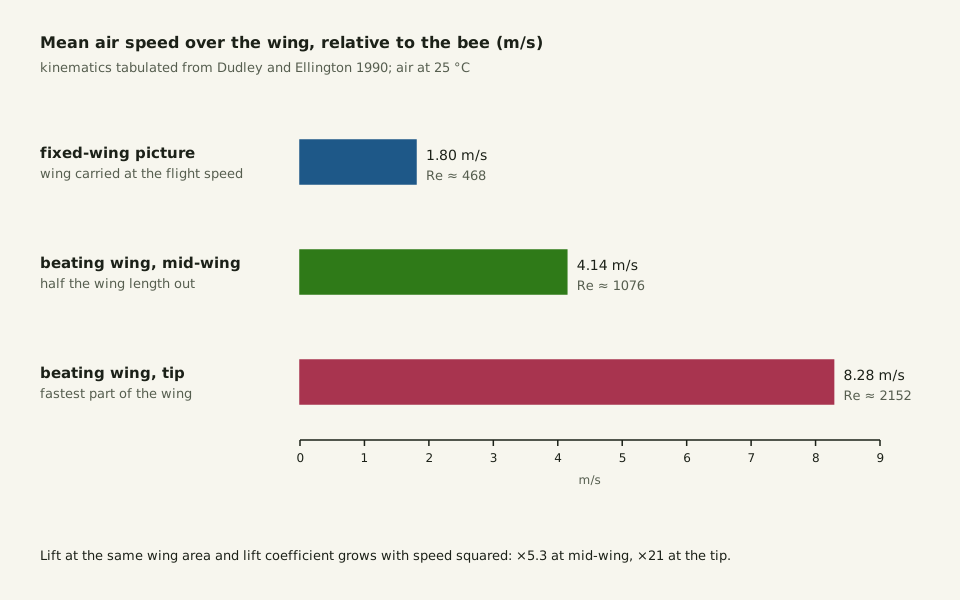
Speed, first. A fixed wing meets the air only as fast as the aircraft flies. Yasuda and colleagues (2026) tabulate a buff-tailed bumblebee from Dudley and Ellington's 1990 free-flight films at a representative 1.8 m/s, with a mean wing chord of 4 mm, the wing's average front-to-back width.
A beating wing moves much faster than the body. Tahmasian and Kotulak-Smith (2024) list bumblebee kinematics from Dudley and Ellington's 1990 work: 155 beats a second, a wing 13.2 mm long and a stroke that swings 58° either side of its middle, a sweep of 116° each half-stroke. From those numbers the wingtip averages about 8.3 m/s relative to the body and the middle of the wing about 4.1 m/s, computed for this page. Both papers take their numbers from the 1990 study, but their rows differ: Yasuda and colleagues list 126.7 beats a second, so the two need not describe the same bee.
For a given wing area and lift coefficient, lift grows with the square of the air speed over the wing, the scaling Prisăcariu and Dumitrescu set out in a 2026 review. At the same coefficient, air at 4.1 m/s gives about 5 times the lift of air at 1.8 m/s, and air at 8.3 m/s about 21 times, computed for this page. A fixed-wing sum at flight speed starts far behind.
Slide the diagram sideways to read its labels, or open it full size.
Bumblebee wing 13.2 mm long [10−2 m]: air meets it at 1.8 m/s if held still at flight speed; beating, it moves about 4.1 m/s at mid-wing and 8.3 m/s at the tip, relative to the body.
Computed for this page from a flight speed and kinematics that two papers tabulate from the 1990 study, not necessarily for the same bee; Reynolds numbers for air at 25 °C. Data: bumblebee-flight-fixed-wing.csv (sources, version and license, JSON).
"Fixed wing against beating wing: air speed and Reynolds number" by Ants, Cells & Atoms, https://antscellsandatoms.com/insects/bumblebee-flight/ — CC BY 4.0 (https://creativecommons.org/licenses/by/4.0/)
Data sources for this figure
Data: Flight speed and chord: Yasuda H et al. 2026, Integrative and Comparative Biology 66:icag077, CC BY 4.0, https://doi.org/10.1093/icb/icag077, retrieved 2026-10-25; Wingbeat frequency, wing length, chord and stroke amplitude: Tahmasian S, Kotulak-Smith BC 2024, Scientific Reports 14:2814, CC BY 4.0, https://doi.org/10.1038/s41598-024-53139-4, retrieved 2026-10-25; Kinematic viscosity of air at 25 °C: Farisenkov SE et al. 2022, Nature 602:96-100, CC BY 4.0, https://doi.org/10.1038/s41586-021-04303-7, retrieved 2026-10-25; Speeds, Reynolds numbers and lift factors computed 2026-10-25
Data sources for this figure
Data: Yasuda H, Inglis MR, Yamamoto Y, Henningsson P, Nakata T, Bomphrey RJ 2026, Integrative and Comparative Biology 66:icag077, CC BY 4.0, https://doi.org/10.1093/icb/icag077, retrieved 2026-10-25; Tahmasian S, Kotulak-Smith BC 2024, Scientific Reports 14:2814, CC BY 4.0, https://doi.org/10.1038/s41598-024-53139-4, retrieved 2026-10-25; Farisenkov SE et al. 2022, Nature 602:96-100, CC BY 4.0, https://doi.org/10.1038/s41586-021-04303-7, retrieved 2026-10-25; Prisacariu EG, Dumitrescu O 2026, Biomimetics 11(4):250, CC BY 4.0, https://doi.org/10.3390/biomimetics11040250, retrieved 2026-10-25; Speeds, Reynolds numbers, ratios and syrup line computed 2026-10-25
Speed alone does not close the gap. Dudley and Ellington measured steady lift and drag on bumblebee wings and bodies and concluded, by their 1990 abstract, that quasi-steady mechanisms — steady-flow rules applied moment by moment through the stroke — cannot explain even fast forward flight. Ellington's 1999 abstract puts the shortfall for insect wings at typically 2–3 times: that much more lift than conventional aerodynamics accounts for. Senior and colleagues note (2025) that the 1990 analysis came before the leading-edge vortex was known, citing a 1996 paper by Ellington and colleagues.
At what Reynolds number does a bumblebee wing work?
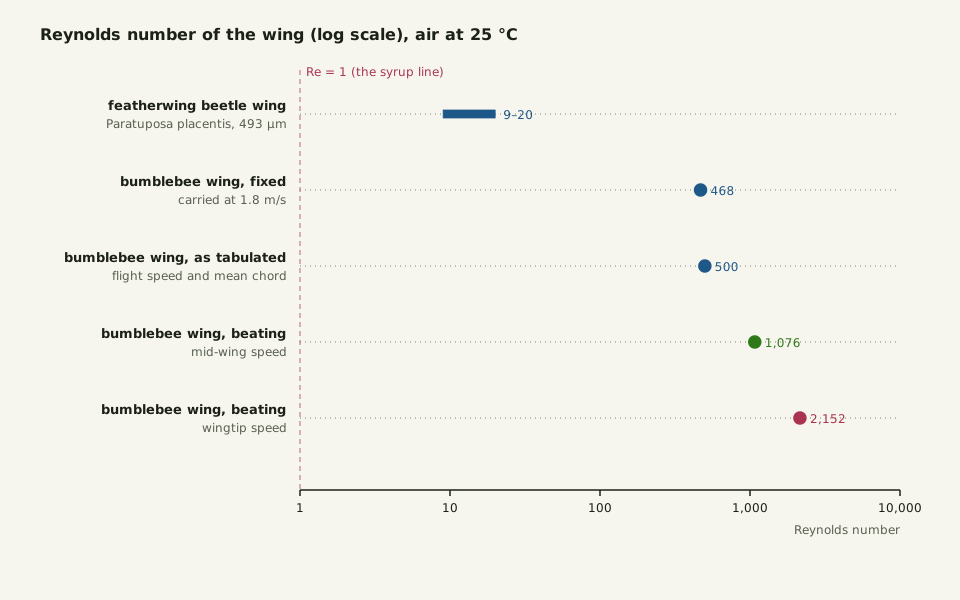
The same speeds give the wing its Reynolds number, a ratio of inertia to the air's stickiness. Farisenkov and colleagues (2022) give air at 25 °C a kinematic viscosity of 1.54×10⁻⁵ m2/s. With that value, a 4 mm chord at 1.8 m/s scores about 470, close to the 500 that Yasuda and colleagues list; beating, the wing scores about 1,100 at mid-wing and 2,200 at the tip, computed for this page.
All of these sit far above the syrup line, where the Reynolds number falls to 1. In air at 25 °C, for a body moving 1–10 body lengths a second, that line falls at about 1.2–3.9 mm, computed for this page. At a few hundred to a few thousand, inertia outweighs the air's stickiness. The water strider page runs the same sum for a rowing leg in water.
Slide the diagram sideways to read its labels, or open it full size.
Bumblebee wing 13.2 mm long [10−2 m]: Reynolds numbers of about 470 held at flight speed and 1,100–2,200 beating, in air at 25 °C, against about 9–20 for a 493 µm featherwing beetle wing.
Log scale; the dashed line is Re = 1. Computed for this page except the tabulated 500 and the beetle's values, which use the wing's speed at its radius of gyration. Data: bumblebee-flight-fixed-wing.csv (sources, version and license, JSON).
"Reynolds numbers of beating wings, on a log scale" by Ants, Cells & Atoms, https://antscellsandatoms.com/insects/bumblebee-flight/ — CC BY 4.0 (https://creativecommons.org/licenses/by/4.0/)
Data: Bumblebee wing: Yasuda H et al. 2026, CC BY 4.0, https://doi.org/10.1093/icb/icag077; Tahmasian S, Kotulak-Smith BC 2024, CC BY 4.0, https://doi.org/10.1038/s41598-024-53139-4 (retrieved 2026-10-25); Air viscosity and the featherwing beetle wing: Farisenkov SE et al. 2022, Nature 602:96-100, CC BY 4.0, https://doi.org/10.1038/s41586-021-04303-7, as listed in this site's swimmers-reynolds.csv, retrieved 2026-10-25; Reynolds numbers computed 2026-10-25
Data sources for this figure
Data: Yasuda H, Inglis MR, Yamamoto Y, Henningsson P, Nakata T, Bomphrey RJ 2026, Integrative and Comparative Biology 66:icag077, CC BY 4.0, https://doi.org/10.1093/icb/icag077, retrieved 2026-10-25; Tahmasian S, Kotulak-Smith BC 2024, Scientific Reports 14:2814, CC BY 4.0, https://doi.org/10.1038/s41598-024-53139-4, retrieved 2026-10-25; Farisenkov SE et al. 2022, Nature 602:96-100, CC BY 4.0, https://doi.org/10.1038/s41586-021-04303-7, retrieved 2026-10-25; Prisacariu EG, Dumitrescu O 2026, Biomimetics 11(4):250, CC BY 4.0, https://doi.org/10.3390/biomimetics11040250, retrieved 2026-10-25; Speeds, Reynolds numbers, ratios and syrup line computed 2026-10-25
Smaller wings sit much closer to the line. Farisenkov and colleagues put the bristled wing of the featherwing beetle Paratuposa placentis, 493 µm long, at a Reynolds number of 9 averaged over a wingbeat and 20 in power strokes, in the same air at 25 °C.
How does a beating wing make the extra lift?
The missing lift comes from what the air does at the wing's front edge. Gehrke and Mulleners describe it for a thin wing tilted steeply to the flow: air separating at the sharp leading edge rolls up into a vortex on top of the wing. Pressure in the vortex core is lower than around it. As long as the vortex stays on the wing, the wing makes more lift than one held fixed at the same angle, which in their words resolves Magnan's conundrum.
The vortex does not last. It eventually leaves the wing and breaks down in the wake, and by their account flapping fliers reverse the stroke about then and build a new vortex on the other side of the wing. Ellington's 1999 abstract adds that pressure differences along a flapping wing drive a strong flow toward the tip, which spirals the vortex outward.
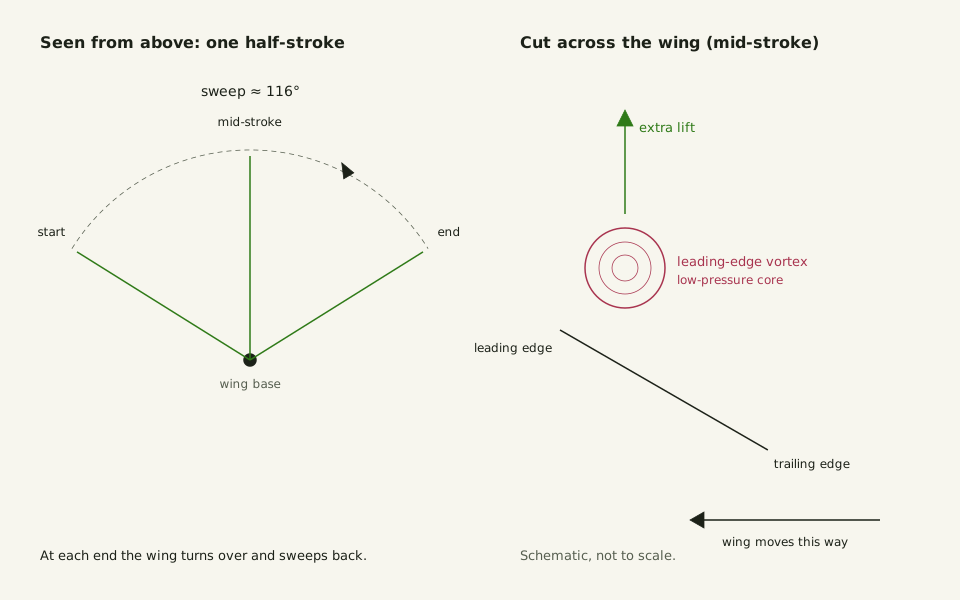
Slide the diagram sideways to read its labels, or open it full size.
Bumblebee wing 13.2 mm long [10−2 m]: a sweep of about 116° each half-stroke, and a leading-edge vortex on top of the wing in cross-section.
Schematic, not to scale, drawn from the descriptions by Gehrke and Mulleners (2025) and Ellington (1999, abstract).
"One half-stroke and the leading-edge vortex (schematic)" by Ants, Cells & Atoms, https://antscellsandatoms.com/insects/bumblebee-flight/ — CC BY 4.0 (https://creativecommons.org/licenses/by/4.0/)
Data: Stroke amplitude: Tahmasian S, Kotulak-Smith BC 2024, Scientific Reports 14:2814, CC BY 4.0, https://doi.org/10.1038/s41598-024-53139-4, retrieved 2026-10-25; Leading-edge vortex as described by Gehrke A, Mulleners K 2025, PNAS 122(6):e2410833121, https://doi.org/10.1073/pnas.2410833121, and Ellington CP 1999, Journal of Experimental Biology 202(23):3439-3448 (abstract), https://doi.org/10.1242/jeb.202.23.3439, retrieved 2026-10-25
Two more act at the ends of the stroke. Dickinson, Lehmann and Sane name all three in their 1999 abstract: delayed stall while the wing sweeps at a steep angle, rotational circulation as it turns over at stroke reversal, and wake capture. In wake capture, as the 2026 review by Prisăcariu and Dumitrescu describes it, vortices shed in one half-stroke meet the wing as it turns. For bumblebees specifically, the same review describes lift from leading-edge vortices, with the vortices at the wingtip and the wing root shed separately.
One nerve signal, many wingbeats
Wings that beat about 130–200 times a second need muscles that keep pace. In bees the flight muscles do not pull on the wings directly, Vallejo-Marín explains in a 2022 review. Two sets of indirect flight muscles, the dorso-ventral and the dorsal-longitudinal, deform the thorax in turn, and a hinge where each wing meets the thorax turns that flexing into upstrokes and downstrokes.
These are asynchronous muscles. When one set contracts, it stretches the other, and the stretch sets off the next contraction; nerve impulses only keep the cycle going. In flight, Vallejo-Marín writes, citing Heinrich (1993), an impulse arrives about once every 10 contractions. Casey, Heveran and Jankauski state the contrast in 2023: in asynchronous muscle one nerve signal generates several wingbeats, where synchronous muscle runs one to one.
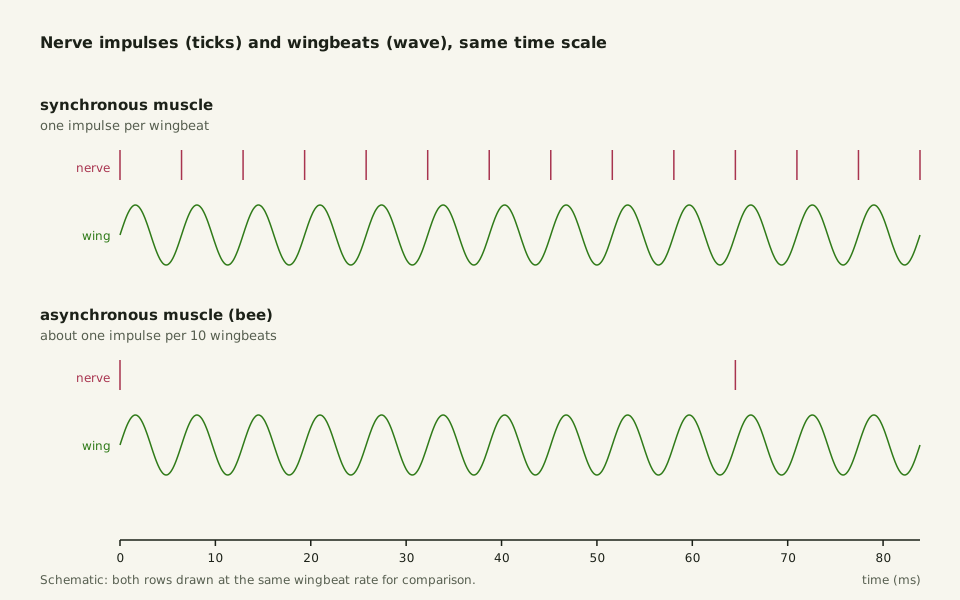
Slide the diagram sideways to read its labels, or open it full size.
Flight muscle of a bumblebee, wingspan 22–32 mm in two measured species [10−2 m]: about one nerve impulse per 10 wingbeats, drawn at 155 beats a second.
Schematic; the top row shows synchronous muscle, one impulse per beat, for comparison. Impulse spacing after Heinrich (1993) as summarized by Vallejo-Marín (2022).
"One nerve impulse, many wingbeats (schematic)" by Ants, Cells & Atoms, https://antscellsandatoms.com/insects/bumblebee-flight/ — CC BY 4.0 (https://creativecommons.org/licenses/by/4.0/)
Data: Wingbeat frequency: Tahmasian S, Kotulak-Smith BC 2024, Scientific Reports 14:2814, CC BY 4.0, https://doi.org/10.1038/s41598-024-53139-4, retrieved 2026-10-25; Impulse spacing: Vallejo-Marín M 2022, Journal of Experimental Botany 73(4):1080-1092, CC BY 4.0, https://doi.org/10.1093/jxb/erab428, citing Heinrich 1993, retrieved 2026-10-25
Josephson, Malamud and Stokes list the traits of such muscle in their 2000 primer (abstract): electrical and mechanical activity out of step, a delayed response to stretch and a switch-off on shortening. For the buff-tailed bumblebee, Josephson (1997, abstract) drove a dorso-ventral flight muscle preparation at 141–173 cycles a second, depending on the bee's size, and at 40 °C. He gives those frequencies and that muscle temperature as typical of free flight (bumblebee-flight-muscle.csv (sources, version and license, JSON) Data: Josephson RK 1997, Journal of Experimental Biology 200(8):1241-1246 (abstract), https://doi.org/10.1242/jeb.200.8.1241, retrieved 2026-10-25; Vallejo-Marín M 2022, Journal of Experimental Botany 73(4):1080-1092, CC BY 4.0, https://doi.org/10.1093/jxb/erab428, retrieved 2026-10-25). The best preparations put out slightly more than 100 W per kilogram of muscle.
Flying insects have some of the highest rates of aerobic metabolism among animals, the 2022 review notes. The insect breathing page follows how oxygen reaches flight muscle through air tubes.
How fast do bumblebee wings beat?
In the studies read here, bumblebees in free flight beat their wings about 127–196 times a second. The table lists every bumblebee value in the site's shared wingbeat file. It mixes species, sizes and methods, so each row stands on its own.
| Bumblebee | Condition | Beats per second | Source |
|---|---|---|---|
| Bombus terrestris | free flight, tabulated from 1990 films | 126.7 | Yasuda et al. 2026 |
| Bombus, species not named | hovering-model input from the 1990 study | 155 | Tahmasian and Kotulak-Smith 2024 |
| Bombus pascuorum | free flight, tabulated from 1990 films | 158.2 | Yasuda et al. 2026 |
| Bombus centralis | tethered, species average | 160 | Casey et al. 2023 |
| Bombus terrestris | free flight, as cited | 160–180 | Casey et al. 2023 |
| Bombus balteatus queen | flight buzz, one recording | about 175 | Miller-Struttmann et al. 2017 |
| Bombus impatiens | free flight into a 0.75 m/s headwind, 61 flights | 186.9 (mean) | Combes et al. 2023 |
| Bombus impatiens | free flight in still air, 98 flights | 196.2 (mean) | Combes et al. 2023 |
Size accounts for much of the spread. Within the common eastern bumblebee, Bombus impatiens, wingbeat frequency falls as body mass rises, roughly as mass to the power −0.16, Darveau reports in a 2024 review. The cause he gives is that wing area keeps the body's proportions, growing as mass to about the 2/3 power, the same square-cube arithmetic behind the lifting power of ants. Miller-Struttmann and colleagues found the same direction in two alpine species in 2017: bees with longer wings buzzed lower.
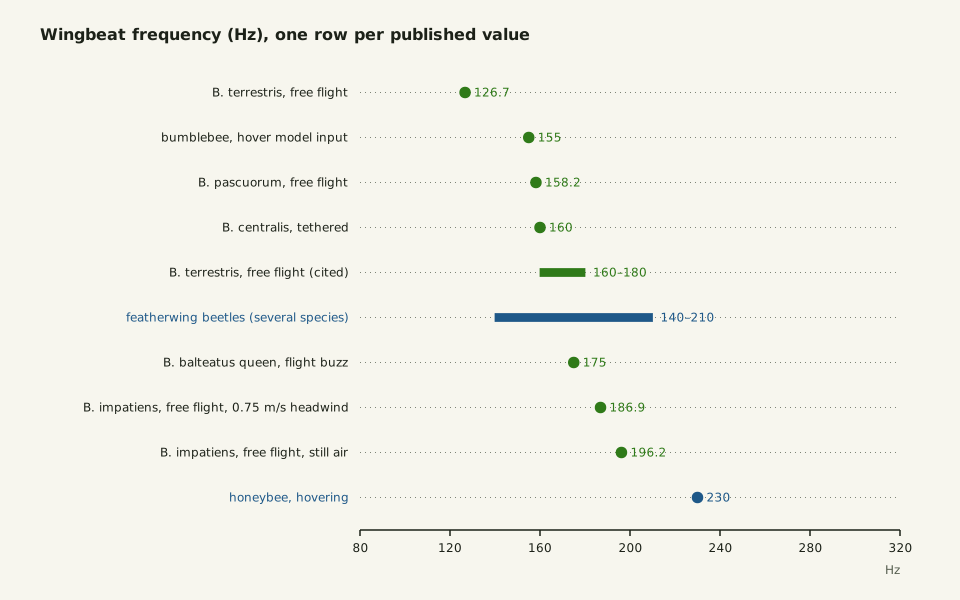
Slide the diagram sideways to read its labels, or open it full size.
Bumblebees, wingspans 22–32 mm in two measured species [10−2 m]: wingbeat frequencies in the studies read here, about 127–196 Hz in free flight.
Dots are single values, bars ranges; a honeybee and featherwing beetles for comparison. Data: wingbeat-frequencies.csv (sources, version and license, JSON).
"Bumblebee wingbeat frequencies in the studies read for this page" by Ants, Cells & Atoms, https://antscellsandatoms.com/insects/bumblebee-flight/ — CC BY 4.0 (https://creativecommons.org/licenses/by/4.0/)
Data sources for this figure
Data: Yasuda H et al. 2026, CC BY 4.0, https://doi.org/10.1093/icb/icag077; Tahmasian S, Kotulak-Smith BC 2024, CC BY 4.0, https://doi.org/10.1038/s41598-024-53139-4; Combes SA, Gravish N, Gagliardi SF 2023, CC BY 4.0, https://doi.org/10.1242/jeb.245374; Casey C, Heveran C, Jankauski M 2023, CC BY 4.0, https://doi.org/10.1098/rsif.2023.0029 (retrieved 2026-10-25); Miller-Struttmann NE et al. 2017, CC BY 4.0, https://doi.org/10.1371/journal.pone.0179273 (retrieved 2026-10-25); Altshuler DL et al. 2005 (abstract), https://doi.org/10.1073/pnas.0506590102; Kolomenskiy D et al. 2025, CC BY 4.0, https://doi.org/10.1073/pnas.2506403122 (retrieved 2026-10-25)
Data sources for this figure
Data: Kolomenskiy D, Farisenkov SE, Petrov PN, Polilov AA 2025, PNAS 122(34):e2506403122, CC BY 4.0, https://doi.org/10.1073/pnas.2506403122, retrieved 2026-10-25; Cheng X, Sun M 2016, Scientific Reports 6:25706, CC BY 4.0, https://doi.org/10.1038/srep25706, retrieved 2026-10-25; Huber JT, Noyes JS 2013, Journal of Hymenoptera Research 32:17-44, CC BY 3.0, https://doi.org/10.3897/jhr.32.4663, retrieved 2026-10-25; Altshuler DL et al. 2005, PNAS 102(50):18213-18218 (abstract), https://doi.org/10.1073/pnas.0506590102, retrieved 2026-10-25; GBIF Secretariat 2023, GBIF Backbone Taxonomy, checklist dataset https://doi.org/10.15468/39omei, CC BY 4.0, retrieved 2026-10-25; Yasuda H, Inglis MR, Yamamoto Y, Henningsson P, Nakata T, Bomphrey RJ 2026, Integrative and Comparative Biology 66:icag077, CC BY 4.0, https://doi.org/10.1093/icb/icag077, retrieved 2026-10-25; Tahmasian S, Kotulak-Smith BC 2024, Scientific Reports 14:2814, CC BY 4.0, https://doi.org/10.1038/s41598-024-53139-4, retrieved 2026-10-25; Combes SA, Gravish N, Gagliardi SF 2023, Journal of Experimental Biology 226(Suppl 1):jeb245374, CC BY 4.0, https://doi.org/10.1242/jeb.245374, retrieved 2026-10-25; Casey C, Heveran C, Jankauski M 2023, Journal of the Royal Society Interface 20(201):20230029, CC BY 4.0, https://doi.org/10.1098/rsif.2023.0029, retrieved 2026-10-25; Miller-Struttmann NE et al. 2017, PLOS ONE 12(6):e0179273, CC BY 4.0, https://doi.org/10.1371/journal.pone.0179273, retrieved 2026-10-25
Method matters as well. Casey and colleagues suggest that tethering may have lowered the wingbeat frequencies they measured. For comparison, a hovering honeybee beats about 230 times a second (Altshuler and colleagues, 2005; abstract), and featherwing beetles, with wings 0.43–1.41 mm long, beat 140–210 (Kolomenskiy and colleagues, 2025).
Why do bumblebees buzz?
The flight buzz is the wingbeat, heard. In a spectrogram of a Bombus balteatus queen's flight buzz, Miller-Struttmann and colleagues (2017) read the lowest band, about 175 Hz, as the wingbeat frequency. The sound also carries energy at whole-number multiples of it, the harmonics.
On a piano tuned to A = 440 Hz, the 126.7 Hz tabulated for a buff-tailed bumblebee sits near B2, and the 196.2 Hz of common eastern bumblebees in still air lands almost exactly on G3, the G below middle C, computed for this page. A cent in the table is a hundredth of a semitone.
| Wingbeats per second | One wingbeat lasts | Nearest note | Bee |
|---|---|---|---|
| 126.7 | 7.89 ms | B2, 45 cents sharp | Bombus terrestris, free flight |
| 155 | 6.45 ms | D♯3, 6 cents flat | Bombus, hovering-model input |
| 175 | 5.71 ms | F3, 4 cents sharp | Bombus balteatus queen |
| 196.2 | 5.10 ms | G3, 2 cents sharp | Bombus impatiens, still air |
| 230 | 4.35 ms | A♯3, 23 cents flat | honeybee, hovering |
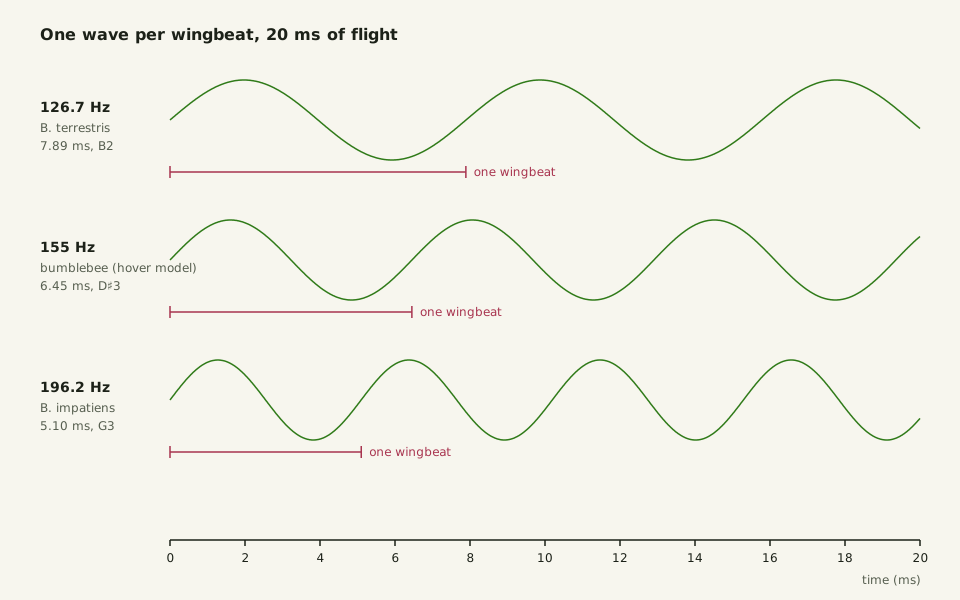
Slide the diagram sideways to read its labels, or open it full size.
Bumblebees, wingspans 22–32 mm in two measured species [10−2 m]: one wave per wingbeat, 5.10–7.89 ms each at 196.2–126.7 Hz.
Pure waves for clarity; a real flight buzz adds harmonics. Computed for this page. Data: bumblebee-flight-pitch.csv (sources, version and license, JSON).
"Idealized wingbeat waveforms over 20 ms" by Ants, Cells & Atoms, https://antscellsandatoms.com/insects/bumblebee-flight/ — CC BY 4.0 (https://creativecommons.org/licenses/by/4.0/)
Data: Frequencies: Yasuda H et al. 2026, CC BY 4.0, https://doi.org/10.1093/icb/icag077; Tahmasian S, Kotulak-Smith BC 2024, CC BY 4.0, https://doi.org/10.1038/s41598-024-53139-4; Combes SA, Gravish N, Gagliardi SF 2023, CC BY 4.0, https://doi.org/10.1242/jeb.245374 (retrieved 2026-10-25); Periods and notes computed 2026-10-25
Data sources for this figure
Data: Frequencies: Yasuda H et al. 2026, CC BY 4.0, https://doi.org/10.1093/icb/icag077; Tahmasian S, Kotulak-Smith BC 2024, CC BY 4.0, https://doi.org/10.1038/s41598-024-53139-4; Casey C et al. 2023, CC BY 4.0, https://doi.org/10.1098/rsif.2023.0029 (retrieved 2026-10-25); Frequencies: Miller-Struttmann NE et al. 2017, CC BY 4.0, https://doi.org/10.1371/journal.pone.0179273; Combes SA, Gravish N, Gagliardi SF 2023, CC BY 4.0, https://doi.org/10.1242/jeb.245374; Altshuler DL et al. 2005 (abstract), https://doi.org/10.1073/pnas.0506590102 (retrieved 2026-10-25); Periods and notes computed 2026-10-25
Not every buzz is flight. Bees also run the same muscles without flying, Vallejo-Marín's review explains: to make heat with little vibration, and, with the wings mostly folded, to buzz in defence or to shake pollen from flowers. In the buff-tailed bumblebee, work from 1997 that the review summarizes suggests that the thorax contracts about twice as fast in defence buzzes as in tethered flight, 200–300 against 100–150 times a second. In large bees, Bombus among them, floral buzzes run 1.3 to 2.5 times the flight frequency.
On temperature, the studies disagree. Saha and colleagues, comparing earlier work in a 2024 paper, note that Sotavalta in 1963 found the wingbeat of Bombus pascuorum independent of temperature, while Unwin and colleagues saw it fall with temperature in several bees and bumblebees. None of the bumblebee free-flight rows in the shared file gives an air temperature at all.
Sources
- Gehrke A, Mulleners K. "Highly deformable flapping membrane wings suppress the leading edge vortex in hover to perform better." Proceedings of the National Academy of Sciences 122(6):e2410833121 (2025). https://doi.org/10.1073/pnas.2410833121 Read: full text. Text license: CC BY-NC-ND 4.0 (https://creativecommons.org/licenses/by-nc-nd/4.0/).
- Magnan A. La locomotion chez les animaux. I. Le vol des insectes. Paris: Hermann et Cie (1934). https://catalogue.bnf.fr/ark:/12148/cb32407303w Read: bibliographic record only.
- Wikipedia contributors. "Bumblebee." Wikipedia (read 2026-10-25). https://en.wikipedia.org/wiki/Bumblebee Read: full text. Text license: CC BY-SA 4.0 (https://creativecommons.org/licenses/by-sa/4.0/).
- Dickinson M. "Solving the mystery of insect flight." Scientific American 284(6):48–57 (2001). https://doi.org/10.1038/scientificamerican0601-48 Read: bibliographic record only.
- Wikipedia contributors. "Bombus terrestris." Wikipedia (read 2026-10-25). https://en.wikipedia.org/wiki/Bombus_terrestris Read: full text. Text license: CC BY-SA 4.0 (https://creativecommons.org/licenses/by-sa/4.0/).
- GBIF Secretariat. GBIF Backbone Taxonomy. Checklist dataset https://doi.org/10.15468/39omei, accessed 2026-10-25; Bombus Latreille, 1802, usage key 1340278; Bombus terrestris (Linnaeus, 1758), 1340503; Bombus impatiens Cresson, 1863, 1340350; Bombus pascuorum (Scopoli, 1763), 1340405; Bombus balteatus Dahlbom, 1832, 1340403; Bombus centralis Cresson, 1864, 1340324. Read: dataset record (species match). Text license: CC BY 4.0 (https://creativecommons.org/licenses/by/4.0/).
- Yasuda H, Inglis MR, Yamamoto Y, Henningsson P, Nakata T, Bomphrey RJ. "Span efficiency of flying animals." Integrative and Comparative Biology 66:icag077 (2026). https://doi.org/10.1093/icb/icag077 Read: full text. Text license: CC BY 4.0 (https://creativecommons.org/licenses/by/4.0/).
- Dudley R, Ellington CP. "Mechanics of forward flight in bumblebees: I. Kinematics and morphology." Journal of Experimental Biology 148(1):19–52 (1990). https://doi.org/10.1242/jeb.148.1.19 Read: abstract.
- Tahmasian S, Kotulak-Smith BC. "The effects of wing inertial forces and mean stroke angle on the pitch dynamics of hovering insects." Scientific Reports 14:2814 (2024). https://doi.org/10.1038/s41598-024-53139-4 Read: full text. Text license: CC BY 4.0 (https://creativecommons.org/licenses/by/4.0/).
- Prisăcariu EG, Dumitrescu O. "Bridging biology and engineering: unsteady aerodynamics and biomimetic design of micro air vehicles." Biomimetics 11(4):250 (2026). https://doi.org/10.3390/biomimetics11040250 Read: full text. Text license: CC BY 4.0 (https://creativecommons.org/licenses/by/4.0/).
- Farisenkov SE, Kolomenskiy D, Petrov PN, Engels T, Lapina NA, Lehmann F-O, Onishi R, Liu H, Polilov AA. "Novel flight style and light wings boost flight performance of tiny beetles." Nature 602(7895):96–100 (2022). https://doi.org/10.1038/s41586-021-04303-7 Read: full text. Text license: CC BY 4.0 (https://creativecommons.org/licenses/by/4.0/).
- Dudley R, Ellington CP. "Mechanics of forward flight in bumblebees: II. Quasi-steady lift and power requirements." Journal of Experimental Biology 148(1):53–88 (1990). https://doi.org/10.1242/jeb.148.1.53 Read: abstract.
- Ellington CP. "The novel aerodynamics of insect flight: applications to micro-air vehicles." Journal of Experimental Biology 202(23):3439–3448 (1999). https://doi.org/10.1242/jeb.202.23.3439 Read: abstract.
- Senior EJ, Tickle P, Walker SM, Askew GN. "Energetics of free and tethered flight in bumblebees (Bombus terrestris, Linnaeus 1758)." Biology Letters 21(11):20250325 (2025). https://doi.org/10.1098/rsbl.2025.0325 Read: full text. Text license: CC BY 4.0 (https://creativecommons.org/licenses/by/4.0/).
- Ellington CP, van den Berg C, Willmott AP, Thomas ALR. "Leading-edge vortices in insect flight." Nature 384(6610):626–630 (1996). https://doi.org/10.1038/384626a0 Read: bibliographic record only.
- Dickinson MH, Lehmann FO, Sane SP. "Wing rotation and the aerodynamic basis of insect flight." Science 284(5422):1954–1960 (1999). https://doi.org/10.1126/science.284.5422.1954 Read: abstract.
- Vallejo-Marín M. "How and why do bees buzz? Implications for buzz pollination." Journal of Experimental Botany 73(4):1080–1092 (2022). https://doi.org/10.1093/jxb/erab428 Read: full text. Text license: CC BY 4.0 (https://creativecommons.org/licenses/by/4.0/).
- Josephson RK, Malamud JG, Stokes DR. "Asynchronous muscle: a primer." Journal of Experimental Biology 203(18):2713–2722 (2000). https://doi.org/10.1242/jeb.203.18.2713 Read: abstract.
- Casey C, Heveran C, Jankauski M. "Experimental studies suggest differences in the distribution of thorax elasticity between insects with synchronous and asynchronous musculature." Journal of the Royal Society Interface 20(201):20230029 (2023). https://doi.org/10.1098/rsif.2023.0029 Read: full text. Text license: CC BY 4.0 (https://creativecommons.org/licenses/by/4.0/).
- Josephson RK. "Power output from a flight muscle of the bumblebee Bombus terrestris. III. Power during simulated flight." Journal of Experimental Biology 200(8):1241–1246 (1997). https://doi.org/10.1242/jeb.200.8.1241 Read: abstract.
- Combes SA, Gravish N, Gagliardi SF. "Going against the flow: bumblebees prefer to fly upwind and display more variable kinematics when flying downwind." Journal of Experimental Biology 226(Suppl 1):jeb245374 (2023). https://doi.org/10.1242/jeb.245374 Read: full text. Text license: CC BY 4.0 (https://creativecommons.org/licenses/by/4.0/).
- Miller-Struttmann NE, Heise D, Schul J, Geib JC, Galen C. "Flight of the bumble bee: buzzes predict pollination services." PLOS ONE 12(6):e0179273 (2017). https://doi.org/10.1371/journal.pone.0179273 Read: full text. Text license: CC BY 4.0 (https://creativecommons.org/licenses/by/4.0/).
- Darveau CA. "Insect flight energetics and the evolution of size, form, and function." Integrative and Comparative Biology 64(2):586–597 (2024). https://doi.org/10.1093/icb/icae028 Read: full text. Text license: CC BY 4.0 (https://creativecommons.org/licenses/by/4.0/).
- Altshuler DL, Dickson WB, Vance JT, Roberts SP, Dickinson MH. "Short-amplitude high-frequency wing strokes determine the aerodynamics of honeybee flight." Proceedings of the National Academy of Sciences 102(50):18213–18218 (2005). https://doi.org/10.1073/pnas.0506590102 Read: abstract.
- Kolomenskiy D, Farisenkov SE, Petrov PN, Polilov AA. "Scaling and mechanical optimality of bristled wings in microinsects." Proceedings of the National Academy of Sciences 122(34):e2506403122 (2025). https://doi.org/10.1073/pnas.2506403122 Read: full text. Text license: CC BY 4.0 (https://creativecommons.org/licenses/by/4.0/).
- Saha T, Genoud AP, Park JH, Thomas BP. "Temperature dependency of insect's wingbeat frequencies: an empirical approach to temperature correction." Insects 15(5):342 (2024). https://doi.org/10.3390/insects15050342 Read: full text. Text license: CC BY 4.0 (https://creativecommons.org/licenses/by/4.0/).
Cite this page
Ants, Cells & Atoms. “Bumblebee Flight: Why the 'Can't Fly' Sum Fell Short.” Published 2026-10-25. https://antscellsandatoms.com/insects/bumblebee-flight/. Accessed (add the date you read it).
No DOI is issued for entries. Figures made here are CC BY 4.0; see each caption for the license of photographs.
Related entries
Water Strider: The Dimples Under Its Feet Hold Its Weight
Image: “Aquarius remigis 140810489” by Jason Swanson (2021) · CC0 1.0
"Aquarius remigis 140810489" by Jason Swanson — https://commons.wikimedia.org/wiki/File:Aquarius_remigis_140810489.jpg — CC0 1.0 (https://creativecommons.org/publicdomain/zero/1.0/)

How Do Insects Breathe? Through Air Tubes, Not Lungs
Image: “Flickr - ggallice - Spiracles” by Geoff Gallice (2011) · CC BY 2.0
"Flickr - ggallice - Spiracles" by Geoff Gallice — https://commons.wikimedia.org/wiki/File:Flickr_-_ggallice_-_Spiracles.jpg — CC BY 2.0 (https://creativecommons.org/licenses/by/2.0/)

Ants: Strong for Their Weight, Mostly Because They're Small
Image: “Rote Waldameisen mit Beute 01” by Stephan Sprinz (2026) · CC BY 4.0
"Rote Waldameisen mit Beute 01" by Stephan Sprinz — https://commons.wikimedia.org/wiki/File:Rote_Waldameisen_mit_Beute_01.jpg — CC BY 4.0 (https://creativecommons.org/licenses/by/4.0/)
